
The idea sounds simple and incredibly appealing.
You invest in a business, systems handle the work, and your store runs in the background. Sales come in, orders get fulfilled, and you focus on growth instead of daily tasks. This is the promise behind a fully automated amazon store.
But here’s the truth most articles don’t explain clearly:
Automation can help you scale but it’s not magic.
To build something sustainable, you need the right expectations, the right systems, and most importantly, the right amazon automation agency—if you choose to work with one.
This guide gives you a realistic, experience-driven breakdown of how automation actually works, what to expect, and how to make smart decisions that support long-term success.
What Is a Fully Automated Amazon Store?
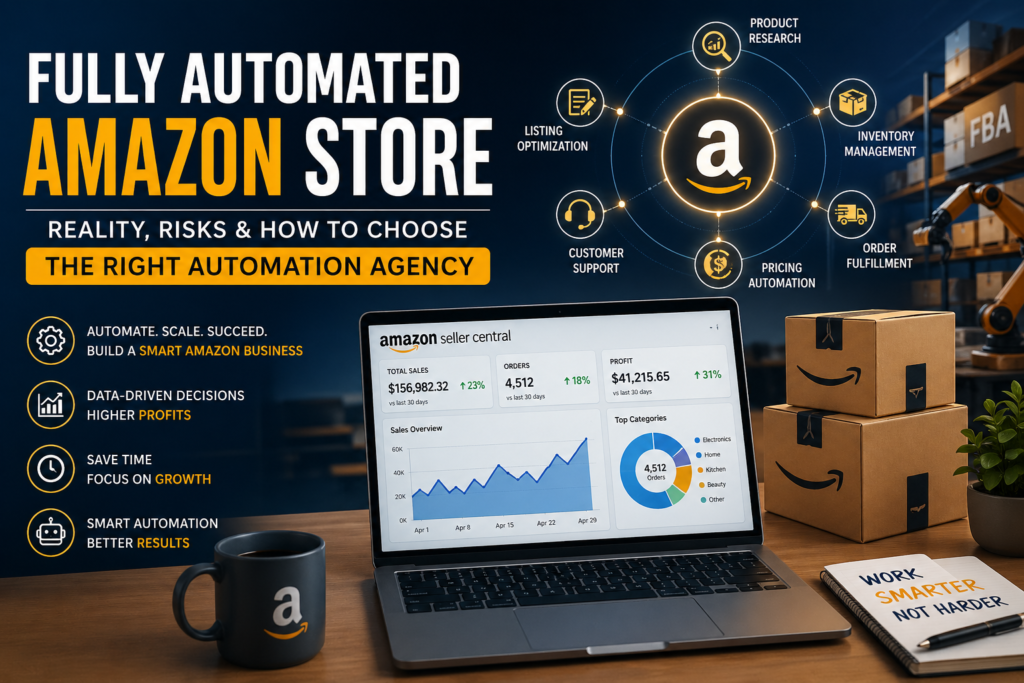
A fully automated amazon store is a business model where most operational tasks are handled through systems, tools, and structured workflows.
Instead of doing everything manually, automation supports:
- Product research
- Inventory management
- Order fulfillment
- Pricing updates
- Customer communication
The goal is not to eliminate your role it’s to reduce repetitive work.
The Big Misconception
Many people believe automation means:
👉 “Set it and forget it”
That’s not accurate.
Even the most advanced systems require:
- Monitoring
- Decision-making
- Strategy
Automation removes manual effort but not responsibility.
How Amazon Automation Actually Works
To understand the model, you need to see how different parts connect.
1. Product Research Systems
Everything starts with product selection.
Automation tools analyze:
- Market demand
- Competition
- Price trends
But tools don’t make decisions—you do.
2. Supplier and Inventory Systems
Once products are selected:
- Inventory is sourced
- Stock levels are tracked
- Restocking is planned
Automation helps prevent stockouts and overselling.
3. Listing Optimization
Listings are created using structured frameworks.
Automation ensures:
- Consistent formatting
- Keyword placement
- Regular updates
4. Order Fulfillment (FBA)
With Fulfillment by Amazon (FBA):
- Amazon stores your products
- Ships orders
- Handles returns
This is a major part of automation.
5. Pricing Automation
Pricing tools adjust product prices based on:
- Competition
- Market demand
- Cost changes
This keeps your store competitive.
6. Customer Communication
Automation helps manage:
- Order updates
- Common questions
- Basic support
But complex issues still require human input.
The Real Benefits of a Fully Automated Amazon Store
Let’s separate hype from reality.
1. Time Efficiency
Automation reduces daily workload.
Instead of spending hours on operations, you focus on:
- Growth strategy
- Product expansion
- Performance analysis
2. Scalability
Manual systems break under pressure.
Automation allows you to:
- Add more products
- Handle higher order volume
- Expand without increasing workload
3. Reduced Errors
Automation minimizes:
- Inventory mistakes
- Pricing errors
- Order delays
4. Consistency
Systems follow rules.
This ensures:
- Standardized workflows
- Reliable operations
- Better customer experience
5. Data-Driven Decisions
Automation tools provide insights.
You can track:
- Sales performance
- Profit margins
- Product trends
The Reality: What Automation Cannot Do
This is where most competitors fall short.
Let’s be honest.
It Does Not Guarantee Profit
No system can guarantee success.
Your results depend on:
- Product selection
- Market demand
- Execution
It Does Not Eliminate Risk
Every business has risk.
Automation reduces operational risk—but not market risk.
It Does Not Replace Strategy
You still need to:
- Make decisions
- Adjust pricing
- Choose products
It Is Not Instant
Building a successful store takes time.
What Is an Amazon Automation Agency?
An amazon automation agency provides systems, tools, and sometimes management support to help run your store.
They focus on building processes that improve efficiency.
What They Typically Handle
Depending on the setup, they may assist with:
- Store setup
- Product research
- Supplier coordination
- Listing management
- Inventory tracking
- Performance monitoring
What They Do NOT Do
A realistic agency will not:
- Guarantee profits
- Eliminate your involvement
- Control market conditions
Types of Amazon Automation Agencies
Not all agencies operate the same way.
1. Software-Focused Agencies
Provide tools and dashboards.
You manage the store.
2. Managed Service Agencies
Handle most operations for you.
You oversee performance.
3. Hybrid Models
A mix of tools and partial management.
How to Choose the Right Amazon Automation Agency
This is the most important part.
Step 1: Understand Your Goals
Before choosing any service, ask:
- Do I want passive income or active growth?
- How involved do I want to be?
- What is my budget?
Step 2: Evaluate Transparency
A good amazon automation agency should clearly explain:
- How their system works
- What they handle
- What you are responsible for
Avoid vague answers.
Step 3: Look at Process, Not Promises
Focus on:
- Systems
- Workflows
- Execution
Not marketing claims.
Step 4: Ask About Risk
A trustworthy agency will discuss:
- Challenges
- Limitations
- Realistic timelines
Step 5: Understand Costs
Know what you’re paying for:
- Setup
- Tools
- Ongoing management
Step 6: Check Communication
Strong communication is essential.
You should always know:
- What’s happening
- What’s improving
- What needs attention
Red Flags to Avoid
Many sellers make mistakes here.
Unrealistic Income Claims
If someone promises guaranteed returns—be cautious.
Lack of Process Clarity
If they can’t explain how things work, that’s a problem.
Over-Automation Claims
No system runs 100% independently.
No Data or Reporting
You should always have access to performance data.
Poor Communication
If communication is weak early, it won’t improve later.
Cost Breakdown: What to Expect
Costs vary depending on the model.
Common Cost Areas
- Setup fees
- Software tools
- Management services
- Inventory investment
Key Insight
Don’t focus only on cost.
Focus on:
- Efficiency
- Scalability
- Long-term value
Realistic Timeline to Profitability
Let’s set clear expectations.
Month 1–2: Setup Phase
- Store setup
- Product research
- Supplier sourcing
Month 3–6: Testing Phase
- Product performance
- Adjustments
- Optimization
Month 6+: Scaling Phase
- Expanding product range
- Increasing volume
- Improving margins
Strategy: The Missing Piece in Most Articles
Automation without strategy doesn’t work.
Focus on Product Selection
Winning products drive success.
Build Supplier Relationships
Reliable suppliers reduce risk.
Optimize Listings
Better listings improve conversions.
Monitor Performance
Track data regularly.
Fully Automated Amazon Store vs Reality
Let’s summarize the truth.
Myth vs Reality
| Myth | Reality |
|---|---|
| Fully passive income | Requires oversight |
| Guaranteed profits | Depends on strategy |
| No work needed | Less work, not zero |
| Instant results | Takes time |
How to Build a Sustainable System
If your goal is long-term success:
Start Simple
Don’t overcomplicate early.
Add Automation Gradually
Build step by step.
Focus on Data
Use insights to improve.
Stay Consistent
Growth comes from consistency.
The Future of Amazon Automation
Automation is evolving quickly.
Future trends include:
- AI-driven insights
- Smarter pricing systems
- Better integrations
The role of the amazon automation agency will shift toward strategy and optimization.
FAQs: Fully Automated Amazon Store & Amazon Automation Agency
1. What is a fully automated Amazon store?
A fully automated Amazon store is a business model where systems and tools handle tasks like product research, inventory, order processing, and pricing. It reduces manual work but still requires monitoring and strategic decisions.
2. Is a fully automated Amazon store truly passive income?
No, it’s not completely passive. While automation reduces daily workload, you still need to oversee performance, make decisions, and adjust strategies to keep the store profitable.
3. What does an Amazon automation agency do?
An Amazon automation agency helps build and manage systems that streamline store operations. This may include product research, listing management, inventory tracking, and performance monitoring.
4. How much does it cost to start a fully automated Amazon store?
Costs vary depending on tools, services, and inventory. You may need to budget for setup, software, and initial product investment. Focus on value rather than just cost.
5. How long does it take to see results?
Most sellers begin seeing progress within 3–6 months. Scaling and consistent profits usually take longer, depending on product selection and market conditions.
6. Can beginners use Amazon automation services?
Yes, beginners can use automation services. However, it’s important to understand the basics of Amazon selling so you can make informed decisions and monitor performance effectively.
7. Are Amazon automation agencies worth it?
They can be valuable if they provide clear systems, transparency, and realistic expectations. The key is choosing the right agency and staying involved in your business.
8. What are the risks of a fully automated Amazon store?
Risks include poor product selection, unreliable suppliers, market competition, and unrealistic expectations. Automation reduces operational risk but doesn’t eliminate business risk.
9. Do I lose control of my store with automation?
No, you remain in control. Automation handles repetitive tasks, but you still make key decisions about products, pricing, and strategy.
10. What should I look for in an Amazon automation agency?
Look for transparency, clear processes, realistic expectations, strong communication, and data-driven strategies. Avoid agencies that promise guaranteed profits.
Final Thoughts
A fully automated amazon store is not about removing effort—it’s about removing inefficiency.
Automation allows you to:
- Save time
- Reduce errors
- Scale faster
But success still depends on:
- Your decisions
- Your strategy
- Your consistency
The right amazon automation agency can support your journey—but it cannot replace it.
If you approach this model with realistic expectations and a structured plan, you can build a business that grows with confidence.