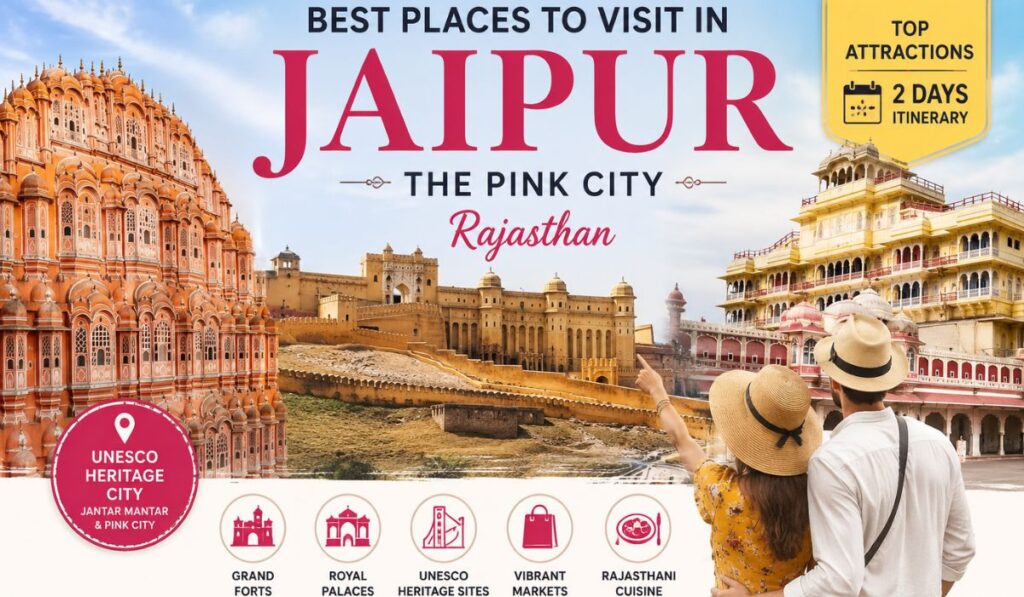

Jaipur, India’s famous Pink City, is where royal history meets everyday life in the most colorful way possible. Grand forts sit on hilltops overlooking the city, palaces glow amber at sunset, and bazaars hum with the sound of bargaining and bangles. This Jaipur travel guide is built to help first-time visitors make sense of it all.
For most international travelers, Jaipur is the final stop on a classic North India journey, following Delhi and Agra. It’s also, for many, the most memorable one — the city where Rajasthan’s royal past feels closest to the surface.
This guide walks through the best places to visit in Jaipur, along with practical tips drawn from firsthand travel experience, so you can plan a trip that goes beyond the usual checklist of photos.
Why Visit Jaipur?
Jaipur earns its place on nearly every India itinerary for good reason.
Royal history. Founded in 1727 by Maharaja Sawai Jai Singh II, Jaipur was one of India’s first planned cities, built around principles of Vedic architecture.
UNESCO recognition. Jaipur’s old city was inscribed as a UNESCO World Heritage Site, a status you can read more about on the UNESCO World Heritage Centre website.
Distinct architecture. Pink sandstone facades, intricate jharokhas (overhanging windows), and geometric city planning give Jaipur a visual identity unlike anywhere else in India.
Living culture. Traditional crafts like block printing, gemstone cutting, and blue pottery are still practiced in the old city today.
Markets and food. From spice-laden bazaars to Rajasthani thalis, Jaipur rewards travelers who wander beyond the monuments.
Festivals. Events like Teej and the Jaipur Literature Festival bring the city’s culture to life in ways that go far beyond sightseeing.
For a broader look at the region, Rajasthan Tourism offers detailed, official information on the state’s heritage sites.
Top Places to Visit in Jaipur
Amber Fort
Perched on a hilltop just outside the city, Amber Fort is Jaipur’s most photographed monument, known for its mirrored Sheesh Mahal and sweeping views over Maota Lake.
Best time: Early morning, before tour buses arrive. Photo tip: Shoot from the Kesar Kyari Bagh across the lake for the classic fort reflection shot. Nearby: Panna Meena Ka Kund and Jaigarh Fort are both a short drive away.
Hawa Mahal
The “Palace of Winds” is a five-story sandstone facade with 953 small windows, originally built so royal women could observe street life unseen.
Best time: Early morning light hits the pink facade beautifully. Photo tip: The best exterior shots come from the rooftop café directly across the street. Nearby: City Palace and Jantar Mantar are both walking distance away.
City Palace
Still partly home to Jaipur’s former royal family, City Palace is a working blend of Rajasthani and Mughal architecture, with courtyards, museums, and an impressive weapons collection.
Best time: Mid-morning, when the courtyards are well-lit for photos. Photo tip: The Peacock Gate in Pritam Niwas Chowk is one of the most detailed spots in the complex. Nearby: Jantar Mantar sits just next door.
Jantar Mantar
This UNESCO-listed astronomical observatory houses 19 architectural instruments, including the world’s largest stone sundial, built by Sawai Jai Singh II himself.
Best time: Late morning, so the sun casts clear shadows on the instruments. Photo tip: Wide-angle shots capture the scale of the giant sundial best. Nearby: City Palace and Hawa Mahal.
Jal Mahal
This “Water Palace” appears to float in the middle of Man Sagar Lake, especially striking at sunset when the surrounding hills glow orange.
Best time: Sunset. Photo tip: Shoot from the lakeside promenade rather than trying to access the palace itself, as it’s closed to the public. Nearby: A scenic stop en route to Amber Fort or Nahargarh Fort.
Nahargarh Fort
Built as a defensive extension of Amber Fort, Nahargarh sits on the Aravalli hills and offers one of the best panoramic views of Jaipur.
Best time: Sunset, for golden-hour views over the city. Photo tip: The fort’s café terrace offers an unobstructed skyline view. Nearby: Jaigarh Fort is connected by a walkable ridge road.
Jaigarh Fort
Known for housing Jaivana, one of the world’s largest cannons on wheels, Jaigarh Fort also offers insight into Rajput military architecture and underground water storage systems.
Best time: Morning, when it’s cooler for the uphill walk. Photo tip: The fort walls at sunrise offer dramatic light against the stone. Nearby: Directly connected to Amber Fort by an underground passage.
Albert Hall Museum
Housed in an Indo-Saracenic building inside Ram Niwas Garden, this is Rajasthan’s oldest museum, showcasing artifacts, textiles, and an Egyptian mummy.
Best time: Late afternoon, when the building is beautifully lit at dusk. Photo tip: The museum’s exterior is most striking after sunset when illuminated. Nearby: A short drive from the old city.
Birla Temple
A striking white marble temple dedicated to Lord Vishnu and Goddess Lakshmi, blending traditional and modern architectural elements.
Best time: Evening, when the temple is lit up. Photo tip: Capture the marble facade against the evening sky from the temple garden. Nearby: Close to Moti Doongri Fort.
Patrika Gate
One of Jaipur’s newer landmarks, this vividly painted gateway is dedicated to the nine districts of Rajasthan, each represented through detailed artwork.
Best time: Golden hour, when the colors pop against soft light. Photo tip: A wide shot from the center of the gate captures its full symmetry. Nearby: Inside Jawahar Circle Garden.
Panna Meena Ka Kund
A striking stepwell with symmetrical staircases descending on all sides, often overlooked despite being just minutes from Amber Fort.
Best time: Morning, for soft light on the stone steps. Photo tip: Shoot from the top corners to capture the full geometric pattern. Nearby: Amber Fort and Panna Meena village.
Johari Bazaar
Jaipur’s famous jewelry market, known for gemstones, traditional Rajasthani jewelry, and vibrant textiles.
Best time: Late afternoon, when shops are fully open and less crowded than evening. Nearby: Bapu Bazaar and Hawa Mahal.
Bapu Bazaar
A bustling market for textiles, juttis (traditional footwear), and handicrafts, popular among both locals and travelers.
Best time: Early evening for the liveliest atmosphere. Nearby: Johari Bazaar and Sanganeri Gate.
Galtaji Temple
Also known as the “Monkey Temple,” this temple complex is built around natural springs and sacred water tanks in a valley outside the city.
Best time: Morning, before it gets too warm for the walk. Photo tip: The temple’s tiered water tanks make for striking reflection shots. Nearby: Sisodia Rani Garden.
Sisodia Rani Garden
A multi-level Mughal-style garden built for a Jaipur queen, featuring fountains, murals, and quiet pavilions.
Best time: Morning or late afternoon, when it’s peaceful and cool. Nearby: Galtaji Temple.
Hidden Gems in Jaipur
Beyond the well-known landmarks, a few lesser-visited spots offer a quieter side of Jaipur.
Anokhi Museum of Hand Printing showcases traditional block-printing techniques in a beautifully restored haveli.
Amrapali Museum displays traditional Indian jewelry design, ideal for travelers interested in craftsmanship over crowds.
Chokhi Dhani, on the city’s outskirts, recreates a traditional Rajasthani village experience with folk performances and regional food.
Elefantastic, an ethical elephant sanctuary near Amber Fort, offers a responsible alternative to elephant riding, focusing on care and interaction instead.
Best Time to Visit Jaipur
October to March is the ideal window, with cool mornings and pleasant days suited for walking through forts and markets.
- October–February: Comfortable weather, peak tourist season
- March: Warming up but still manageable
- April–June: Very hot, often exceeding 40°C — best avoided for extensive sightseeing
- July–September: Monsoon season, humid with intermittent rain, but the city’s gardens and lakes look their greenest
If your trip aligns with Teej (July/August) or the Jaipur Literature Festival (January), you’ll also catch Jaipur at its most culturally vibrant.
Travel Tips for Visiting Jaipur
- Start sightseeing early to beat both the heat and the crowds.
- Wear comfortable shoes — forts involve significant walking and uneven steps.
- Carry sunscreen and water, especially between March and June.
- Dress modestly when visiting temples, covering shoulders and knees.
- Keep some cash for local markets, as many small vendors don’t accept cards.
- Book monument tickets online where possible to avoid queues.
- Respect local customs, including asking permission before photographing people.
- Bargain politely in traditional markets — it’s expected, but courtesy goes a long way.
- Hire a knowledgeable local guide to get accurate historical context at major sites.
- Carry a power bank and valid ID, as some monuments require identification for entry.
Local Food You Must Try
Jaipur’s food scene is as rich as its architecture.
Dal Baati Churma — baked wheat rolls served with lentils and a sweet, crumbled wheat-jaggery mix, Rajasthan’s signature dish.
Laal Maas — a fiery red mutton curry made with Mathania chilies, traditionally a royal Rajput dish.
Ghewar — a disc-shaped sweet made from flour and soaked in sugar syrup, especially popular during Teej.
Kachori — a deep-fried, spiced pastry snack, best enjoyed hot from a local stall.
Lassi — a thick, chilled yogurt drink, perfect for cooling down after a day of sightseeing.
Shopping in Jaipur
Johari Bazaar is the go-to for gemstones and traditional jewelry, with generations of jewelers working from the same shopfronts.
Bapu Bazaar is ideal for textiles, mojaris (traditional shoes), and Rajasthani handicrafts.
Tripolia Bazaar specializes in lac bangles, brassware, and traditional Rajasthani ironware.
Shopping tip: Compare prices across a couple of shops before buying, and don’t hesitate to negotiate — it’s part of the experience, not a sign of disrespect.
How Jaipur Completes the Golden Triangle Tour
Jaipur is the final stop on India’s classic Delhi-Agra-Jaipur circuit, and it plays a distinct role in that journey.
Where Delhi offers a mix of Mughal and colonial history, and Agra is centered almost entirely around the Taj Mahal, Jaipur brings Rajasthan’s royal architecture, living traditions, and marketplace energy into the mix.
This is why most well-structured Golden Triangle Tour Packages place Jaipur last — it rounds out the trip with a completely different visual and cultural texture, from pink sandstone forts to bustling bazaars.
If you’re also researching the earlier legs of this route, guides covering the best places to visit in Delhi and top spots in Agra can help you plan a more complete itinerary before arriving in Jaipur.
Why Choose India Travel Bear Tour Operator?
Planning a trip across Delhi, Agra, and Jaipur involves a lot of moving pieces — transportation, guides, timing, and logistics that can be hard to coordinate independently, especially on a first visit to India.
India Travel Bear approaches this as a private tour operator, building itineraries around what travelers actually want to see rather than fitting them into a fixed group schedule.
Their approach typically includes:
- Private tours with dedicated vehicles and drivers
- Customized itineraries based on trip length and interests
- Experienced local guides familiar with each city’s history and etiquette
- Comfortable transportation for longer drives between cities
- Flexible travel plans that can adjust to weather, energy levels, or personal interests along the way
For travelers exploring Rajasthan and North India for the first time, working with an operator like India Travel Bear can simplify the logistics considerably, leaving more energy for actually enjoying Jaipur’s forts, markets, and food.
Frequently Asked Questions
1. How many days do I need to see Jaipur properly? Two full days is generally enough to cover the major forts, palaces, and markets, though a third day allows time for hidden gems and a more relaxed pace.
2. What is the best time of day to visit Amber Fort? Early morning is ideal, both for cooler temperatures and to avoid the tour groups that arrive by mid-morning.
3. Is Jaipur safe for solo travelers? Yes, Jaipur is generally considered safe for solo travelers, though standard precautions apply, especially at night in less touristy areas.
4. Can I visit Jaipur as a day trip from Delhi? It’s possible but not ideal — Jaipur is roughly 4-5 hours from Delhi by road, and a single day leaves little time to properly explore its forts and markets.
5. What should I wear when visiting temples in Jaipur? Modest clothing covering shoulders and knees is recommended, and some temples may require you to remove shoes before entering.
6. Is Jaipur part of every Golden Triangle Tour? Yes, Jaipur is one of the three core cities in the classic Golden Triangle route, alongside Delhi and Agra.
7. What is Jaipur famous for? Jaipur is known as the Pink City, famous for its forts, palaces, gemstone markets, and distinctive pink-sandstone architecture.
8. Do I need a guide to visit Jaipur’s forts? A guide isn’t mandatory, but it adds meaningful historical context, especially at complex sites like Amber Fort and City Palace.
9. What is the best way to travel between Jaipur’s attractions? Most attractions are spread across the city, so a private vehicle or hired car is more practical than walking or relying on public transport.
10. Is Jaipur worth visiting outside the Golden Triangle route? Absolutely — Jaipur works well as a standalone Rajasthan destination too, particularly for travelers interested in architecture, crafts, and food.
Conclusion
Jaipur is more than a stop on the way between Delhi and Agra — it’s a city that rewards travelers who take the time to look closely, from the geometry of Jantar Mantar to the quiet symmetry of Panna Meena Ka Kund.
Whether you’re drawn by the forts, the food, or the markets, Jaipur offers enough depth to fill several days, let alone the one or two most itineraries allow.
If you’re mapping out a wider trip through North India, exploring how Jaipur fits alongside Delhi and Agra — and working with an experienced operator to handle the logistics — can turn a good trip into a genuinely memorable one.