
Waterfront property in St. Augustine is a trade-off, and most owners figure that out within the first hurricane season. You get the view, the dock, the direct water access – and in exchange, the water spends every single day trying to take a little more of your land than it did the day before. Tides pull at it. Waves chew at it. A hard rain does more damage in an afternoon than most people notice happening. Left alone, that shoreline doesn’t erode dramatically – it just quietly shrinks, until one year you look up and the yard’s noticeably smaller than it used to be. A well-built bulkhead is what stops that slow bleed. If you’re weighing bulkhead construction in St. Augustine, Florida, it helps to actually understand what the wall is doing down there, not just that it works.
What is a Bulkhead?
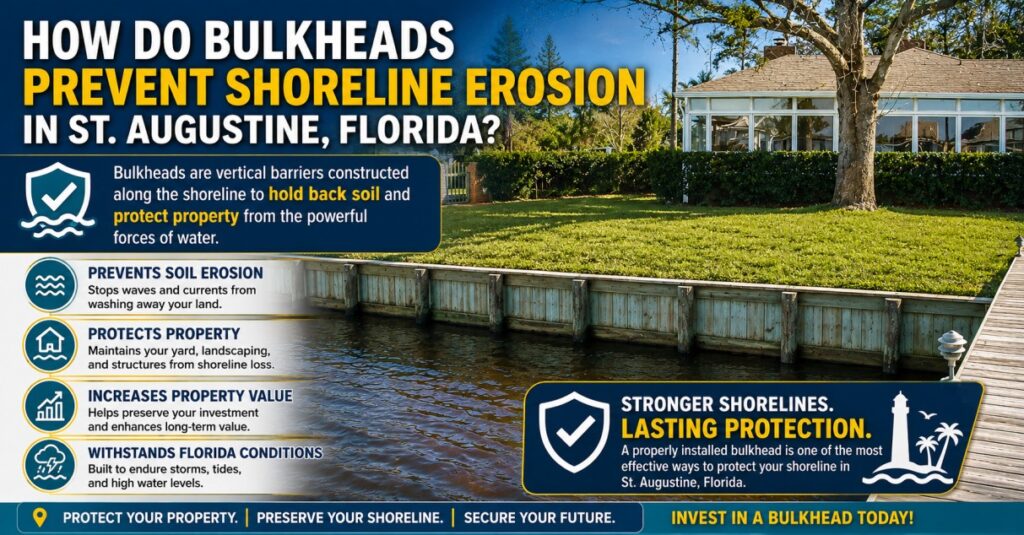
Strip away the marketing language and a bulkhead is a retaining wall, built where land meets water, with one job: keep the soil on your side of the line. A natural shoreline has no such backup – it’s just dirt and roots holding on against wave action, which is a losing fight over time. A bulkhead gives that soil something rigid to lean against.
At Docks, Decks and More, we don’t build the same wall twice. Every stretch of shoreline behaves differently – soil composition, wave exposure, boat traffic nearby – and the design has to account for all of it, or it’s just an expensive wall that fails early.
Where the Erosion Protection Actually Comes From?
Erosion isn’t one event. It’s thousands of small ones – every wave, every tidal swing, every wake from a passing boat pulling a little more soil out with the retreating water. Over enough seasons, that adds up to real land loss.
Solid bulkhead construction in St. Augustine, Florida interrupts that cycle in a few specific ways:
- It holds soil in place behind a reinforced wall instead of letting it slowly wash out
- It absorbs and redirects wave energy before it reaches the exposed shoreline
- It keeps sediment from clouding into the water, which matters for both aesthetics and the surrounding ecosystem
- It supports higher, more stable ground elevation right at the waterline
- It gives docks and other marine structures something solid to anchor into, rather than shifting ground
None of that happens by accident. It’s the difference between a wall that’s in the right place and one that’s engineered for the specific conditions it’s fighting.
When Storms Show Up
Anyone who’s lived through a Florida coastal season knows the weather doesn’t ease in – it swings. Calm water one week, a tropical system dumping surge and wind the next. That kind of pressure finds every weak point in a shoreline fast.
A properly installed bulkhead won’t make your property storm-proof – nothing does, and anyone who tells you otherwise is selling something. What it does is take a lot of the abuse that would otherwise go straight into your yard. Good bulkhead construction in St. Augustine, Florida is one of the more effective things you can do to keep a bad storm from becoming a rebuilding project.
Why This Is Really a Value Conversation?
Erosion isn’t just a landscaping annoyance – it’s a slow drain on what your property is worth. Buyers notice a shrinking shoreline. Insurance underwriters notice it too. And every foot of soil you lose is a foot you eventually pay to replace, one way or another.
A durable bulkhead pays that back over time through:
- A shoreline that actually holds its shape year over year
- Property value that doesn’t quietly erode along with the land
- Docks and marine structures with a stable base to sit on
- Fewer surprise repair bills after routine tidal wear
- One less thing to worry about heading into hurricane season
Our team at Docks, Decks and More builds toward that long game – not just a wall that looks finished on installation day, but one that’s still doing its job a decade later, and permitted properly from the start.
Material Choice Isn’t One-Size-Fits-All
The right bulkhead material depends on what’s actually happening at your specific site – soil type, water depth, how much wave and boat-wake activity you’re dealing with, and how long you need the structure to last.
Options we work with regularly include:
- Vinyl sheet piling
- Pressure-treated timber
- Reinforced concrete
- Composite marine materials
- Steel, for sites that need something heavier-duty
We walk the site before recommending anything. A material that performs great in a calm, shallow inlet can fail fast in a spot with heavier current or boat traffic, and getting that match right is most of what separates good bulkhead construction in St. Augustine, Florida from a wall that needs replacing in five years.
Why the Installation Crew Matters as Much as the Wall?
Building a bulkhead is not just setting panels along a shoreline and calling it done. There’s site evaluation first, then engineering, permitting, excavation, drainage planning – and only after all that, the actual construction. Skip or rush any one of those steps and the wall’s lifespan drops fast, no matter how good the materials are.
Working with a contractor who’s done this before, repeatedly, in this exact environment, is what keeps a bulkhead performing years down the line. At Docks, Decks and More, we handle the whole sequence ourselves – planning, permitting, construction – so homeowners aren’t stitching together separate contractors and hoping it all lines up.
Don’t Wait on This One
Shoreline erosion doesn’t correct itself. It just keeps going, quietly, until the damage is expensive to reverse. Whether you’re putting in a new bulkhead or replacing one that’s clearly past its prime, Docks, Decks and More brings the marine construction experience to get it right the first time. Reach out, and we’ll walk your property with you. And if you’re also considering boathouse construction in Orange Park, Florida, we handle that too – full marine construction, built around how you actually use your waterfront.
Frequently Asked Questions
1. How does a bulkhead stop shoreline erosion?
It gives your soil a rigid barrier to rest against, so waves, tides, and everyday water movement can’t keep pulling it out from under you.
2. How long does a bulkhead typically last?
That depends heavily on material, installation quality, and how rough the local conditions are. Done right, a bulkhead can hold up for decades with reasonable upkeep.
3. Do I need permits for bulkhead construction in St. Augustine?
Yes, almost always. Waterfront construction here goes through regulatory approval, and a contractor who’s navigated that process before can save you a lot of back-and-forth.
4. What materials are commonly used for bulkheads?
Vinyl, treated timber, reinforced concrete, composite materials, and steel each show up depending on the site – there’s no single default answer.
5. Why should I hire a professional marine contractor?
Because shoreline engineering, drainage, permitting, and construction technique all have to work together, and getting one piece wrong usually shortens the life of the whole structure.