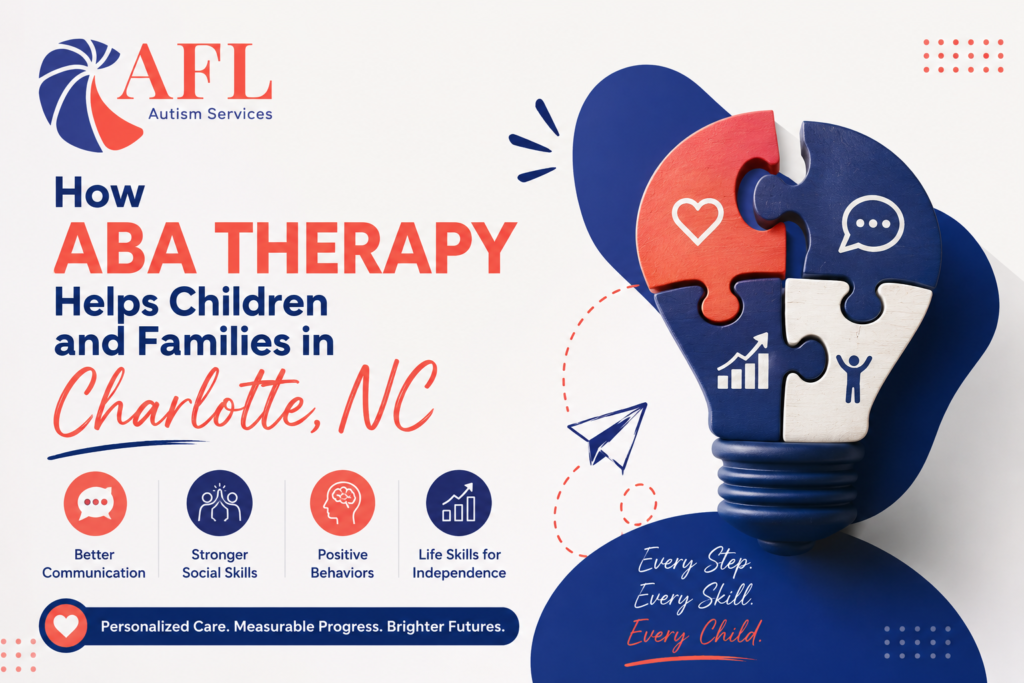

More families in Charlotte are searching for autism support than ever before. As awareness grows and diagnosis rates rise across North Carolina, parents want clear answers about what actually helps their child grow, communicate, and thrive.
Applied Behavior Analysis, better known as ABA therapy, is one of the most researched and widely recommended approaches for children with autism. It’s not a one-size-fits-all program. Good ABA therapy is built around the individual child, shaped by real data, and carried out with families as active partners, not bystanders.
This article walks through what ABA therapy actually does, how it supports development at every stage, and what Charlotte families should look for when choosing autism services for their child.
Understanding ABA Therapy
Applied Behavior Analysis is a therapeutic approach that studies how behavior works and uses that understanding to teach new skills and reduce behaviors that get in the way of learning. At its core, ABA breaks down complex skills like speaking, sharing, or getting dressed into smaller, teachable steps.
It’s considered evidence-based because decades of peer-reviewed research support its effectiveness for children with autism spectrum disorder. Organizations like the American Academy of Pediatrics and the US Surgeon General have recognized ABA as an effective treatment for autism, particularly when started early.
What makes ABA different from a generic learning program is how personal it is. A Board Certified Behavior Analyst (BCBA) starts by observing the child, talking with parents, and identifying specific goals. From there, a treatment plan is built around that child’s strengths, challenges, and family priorities. No two plans look exactly alike, because no two children are exactly alike.
This individualized planning is reviewed and adjusted regularly. As a child grows and meets goals, the plan evolves with them.
How ABA Therapy Supports Child Development
ABA therapy touches nearly every area of a child’s growth. Here’s how it plays out in four key areas.
Communication Skills
Many children with autism struggle to express what they want or need, which can lead to frustration for both the child and the family. ABA therapy works on functional communication, whether that’s spoken language, sign language, or picture-based systems like PECS. In many cases, speech therapy runs alongside ABA to strengthen these gains even further.
For example, a therapist might work with a nonverbal child to request a snack using a picture card, then gradually build toward simple phrases. Over time, that same child might progress to asking full questions or holding a short conversation.
Social Skills
Social interaction often doesn’t come naturally for children on the spectrum. ABA therapy breaks social skills into concrete, practiced steps like making eye contact, taking turns, or reading a peer’s facial expression.
A practical example: a therapist might use role-play to teach a child how to join a group game at recess, then practice that same skill during a supervised playdate to help it generalize beyond the therapy room.
Behavioral Regulation
Meltdowns, aggression, or repetitive behaviors are often a child’s way of communicating distress or overwhelm. ABA therapy looks at what’s driving a behavior and teaches the child a more effective way to cope or communicate instead.
For instance, if a child becomes overwhelmed by loud noises in a classroom, a therapist might teach them to request a break using a simple gesture or card, rather than escalating into a meltdown.
Daily Living Skills
Independence in everyday tasks, brushing teeth, getting dressed, following a morning routine, is a major focus of ABA therapy. These skills matter because they build confidence and reduce the daily stress families carry.
A therapist might break “getting dressed” into five or six small steps, teaching and reinforcing each one until the child can complete the whole routine independently.
Why Families in Charlotte Choose ABA Therapy
Charlotte parents choosing ABA therapy for their child often point to a few consistent reasons.
Personalized treatment programs. No child is handed a generic worksheet. Every goal, from first words to classroom readiness, is tailored to that child’s needs and pace.
Measurable progress tracking. ABA relies on data. Therapists track behaviors and skills session by session, so families can actually see progress instead of guessing whether therapy is working.
Family-centered care. The best programs treat parents as partners, not observers. Families are trained on strategies they can use at home, which makes progress stick. Our guide on how parents can support ABA therapy at home covers this in more depth.
Long-term developmental support. ABA isn’t just about today’s challenges. It’s designed to build a foundation that supports the child through school, friendships, and eventually greater independence.
The Benefits of Early Intervention
Research consistently shows that starting ABA therapy early, ideally before age 5, leads to stronger outcomes. The early years are when the brain is most adaptable, which makes this window especially valuable for building foundational skills.
Early intervention helps in several ways:
Building foundational skills. Communication, attention, and basic social skills learned early become the base for everything that follows.
Supporting school readiness. Children who receive early ABA therapy often enter kindergarten better equipped to follow instructions, sit through structured activities, and interact with classmates.
Encouraging independence. Skills like using the bathroom, eating with utensils, or following a simple routine reduce daily caregiving demands and build a child’s confidence.
Improving long-term outcomes. Multiple studies link early, intensive ABA therapy to better language development, cognitive skills, and adaptive behavior later in life. Before starting therapy, many families begin with our autism diagnostic services to get a clear picture of their child’s needs.
That said, older children and even teens can still benefit significantly from ABA therapy. It’s never “too late” to start, though earlier is generally better.
Home, Clinic, and Community-Based Learning
Skills taught in one setting don’t always transfer automatically to another. That’s why comprehensive ABA programs use multiple environments to help children practice and generalize what they learn.
Home-Based ABA Therapy
Therapy in the home lets the therapist work within the child’s natural routines, mealtimes, bedtime, playtime, and teach skills in the exact context where they’ll be used. It also makes it easier for parents to observe and practice strategies alongside the therapist. Learn more about our home and community-based ABA therapy programs.
Clinic-Based ABA Therapy
A clinic setting offers a structured, distraction-controlled environment that’s ideal for building new skills from the ground up. Clinics often have specialized equipment, sensory tools, and trained staff on hand, which can accelerate early skill acquisition. Our clinic-based autism therapy program is built around exactly this kind of structured learning.
Community-Based Learning Opportunities
Skills eventually need to work outside the home or clinic too. Community-based sessions might involve practicing at a grocery store, playground, or restaurant, helping a child apply what they’ve learned in real-world Charlotte settings.
Using a mix of these environments helps ensure that progress isn’t limited to one room. A child who can request a snack at the clinic should be able to do the same thing at grandma’s house or the local park.
The Role of Parents and Caregivers
Parents aren’t just supporting ABA therapy from the sidelines. They’re one of the most important parts of it.
Parent training. BCBAs teach parents the same strategies used in sessions, so families can reinforce skills throughout the day, not just during scheduled therapy hours.
Reinforcement strategies. Learning how to reward and encourage desired behaviors consistently makes a real difference in how quickly a child progresses.
Consistency across settings. When parents, teachers, and therapists all use similar approaches, children learn faster and feel more secure.
Working with BCBAs. Regular check-ins with the Board Certified Behavior Analyst give parents a chance to ask questions, share observations, and stay involved in adjusting the treatment plan. You can find more guidance in our parent resources hub.
Families who stay engaged in this process tend to see more consistent and lasting progress in their child.
What Progress Can Families Expect?
Every child’s timeline looks different, but families who commit to ABA therapy often see meaningful changes over time.
Improved communication. Children may move from limited communication to using words, phrases, or full sentences to express their needs.
Increased independence. Everyday tasks that once required constant support, dressing, eating, following routines, become things a child can do on their own.
Better social participation. Many children begin engaging more comfortably with siblings, classmates, and other kids at the park or in group settings.
Greater confidence. As children master new skills, families often notice reduced frustration and a more confident, engaged child overall.
Progress isn’t always a straight line, and that’s normal. What matters is the overall trend over months and years of consistent therapy.
Choosing Autism Services in Charlotte, NC
With more providers entering the Charlotte area, it’s worth knowing what actually separates a strong ABA program from a mediocre one.
Qualified BCBAs. Look for a provider with Board Certified Behavior Analysts overseeing every treatment plan, not just registered behavior technicians working without close supervision.
Individualized treatment plans. Be cautious of any provider using a generic curriculum for every child. Plans should be built around your child’s specific goals and updated regularly.
Family involvement. A good provider will train and involve you directly, not just hand you a monthly report.
Progress monitoring. Ask how data is collected and how often you’ll review it. Real ABA therapy is measurable.
Comprehensive autism support. Some children benefit from a combination of services, ABA therapy alongside speech therapy or autism testing. Providers who offer a fuller range of support can coordinate care more effectively. Our Charlotte–Matthews location offers this kind of coordinated, comprehensive care.
Taking time to ask these questions upfront can save families a lot of frustration down the road.
Frequently Asked Questions
- What is ABA therapy?
ABA therapy, or Applied Behavior Analysis, is an evidence-based approach that teaches skills and reduces challenging behaviors by breaking them into small, manageable steps and reinforcing progress along the way. - How does ABA therapy help children with autism?
It supports communication, social skills, behavioral regulation, and daily living skills through individualized, data-driven treatment plans built around each child’s needs. - When should a child start ABA therapy?
Most experts recommend starting as early as possible, ideally before age 5, though children of any age can benefit from ABA therapy. - Can parents participate in ABA therapy?
Yes, and they should. Parent training is a core part of effective ABA programs, helping families reinforce skills consistently at home and in the community. - How is progress measured in ABA therapy?
Progress is tracked through ongoing data collection during sessions, with regular reviews between families and the BCBA to adjust goals as the child grows.
Conclusion
ABA therapy gives children with autism the tools to communicate more clearly, build social connections, manage big emotions, and gain independence in daily life. With individualized planning, consistent data tracking, and real family involvement, it offers a path forward that’s grounded in both compassion and evidence.
For Charlotte families navigating an autism diagnosis, choosing the right support can make all the difference in how a child grows and thrives.
If you’re looking for trusted autism services in Charlotte, NC, Adapt For Life – AFL Autism Services provides individualized ABA therapy, autism testing, speech therapy, and family support designed to help children thrive. Visit aflaba.com or call +1 502-965-1116 to learn more.