
There’s a phase in every business where things feel… stretched.
Not broken. Not failing. Just harder than they used to be.
Orders take longer to process. Teams double-check numbers more often. Reports don’t match unless someone manually fixes them. You start hearing things like, “Let me confirm that,” a little too frequently.
That’s usually the point where an ERP Software Solution enters the conversation.
Not as a big strategic initiative. More like a necessary correction.
I’ve seen this pattern repeat across industries retail, manufacturing, services. Different businesses, same signals. And the companies that recognize it early tend to move faster and waste less time fixing avoidable problems later.
Let’s walk through this in a way that reflects how it actually plays out in real businesses.
The Real Reason ERP Becomes Necessary
Most companies don’t wake up one day and decide, We need ERP.
What actually happens is this:
They build systems over time.
- A tool for accounting
- Another for sales
- Something else for inventory
- Spreadsheets connecting everything
At first, it worked. Then it works with effort. Then it barely works.
The issue isn’t the tools themselves, it’s the lack of connection between them.
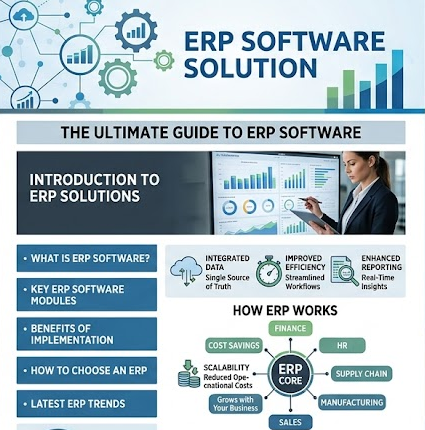
An ERP Software Solution replaces that patchwork with a unified system. But more importantly, it removes the dependency on manual coordination.
What Changes After ERP (That People Don’t Talk About)
A lot of content focuses on features. But the real impact shows up in daily operations.
Decisions Become Faster and Less Debated
When data is scattered, every decision turns into a discussion about which numbers are correct.
With ERP, the conversation shifts from:
“Is this data right?”
to
“What should we do next?”
That’s a big shift.
Fewer Follow-Ups Across Teams
In many companies, work depends on reminders.
- “Did finance approve this?
- “Has inventory updated the stock?
- “Did we send that invoice?
ERP reduces these dependencies by connecting workflows.
Problems Surface Earlier
This might sound like a downside, but it’s not.
ERP makes gaps visible:
- Delays
- Inefficiencies
- Process issues
And once visible, they can actually be fixed.
Where ERP Delivers the Most Value
Not every department benefits equally at first. These are the areas where impact is usually immediate:
Finance
Instead of waiting for the month-end, you get real-time visibility into cash flow, expenses, and revenue.
Operations
Processes become structured. Less guesswork, fewer delays.
Inventory Management
Stock levels, movement, and demand patterns become especially important for product-based businesses.
Customer Management
Sales and support teams work with the same customer data, reducing miscommunication.
The Hidden Cost of Not Using ERP
Many businesses hesitate because ERP feels like a big investment.
But the cost of not implementing it often goes unnoticed.
Think about:
- Time spent reconciling data
- Errors in reporting
- Delayed decisions
- Missed opportunities
These don’t show up as a line item but they affect growth.
Over time, the cost of inefficiency becomes higher than the cost of the system itself.
Choosing an ERP Software Solution: A Ground-Level Approach
This is where most businesses either get it right or make things harder than they need to be.
Start With How You Actually Work
Not how you think you should work.
Document:
- How orders move
- How approvals happen
- Where delays occur
This gives you a realistic starting point.
Avoid Overengineering
It’s tempting to aim for the perfect system.
But in practice, simpler implementations succeed more often.
Focus on:
- Core workflows
- Essential integrations
- Ease of use
You can always expand later.
Involve the People Who Will Use It
Decisions made only at the management level often miss operational realities.
Your team knows:
- Where friction exists
- What slows them down
- What actually needs fixing
Their input matters.
Plan for Adjustment, Not Perfection
No ERP system works perfectly from day one.
Expect:
- Minor disruptions
- Process changes
- Learning curves
The goal is progress, not immediate perfection.
Cloud ERP Is Changing the Way Businesses Adopt Systems
In the past, ERP projects were heavy, expensive, and slow.
That’s changing.
Cloud-based ERP Software Solutions are making adoption easier because:
- Setup is faster
- Costs are more predictable
- Updates are automatic
- Remote access is seamless
For most growing businesses today, cloud isn’t just an option it’s the practical choice.
A Practical Example
A service-based company I worked with had a common issue: tracking project costs accurately.
They used:
- One tool for time tracking
- Another for billing
- Spreadsheets for cost analysis
The result? Delayed invoices and unclear profitability.
After implementing an ERP Software Solution:
- Time tracking linked directly to billing
- Costs became visible in real time
- Invoices went out faster
But the biggest change wasn’t operational, it was strategic.
They started choosing better projects because they finally understood their margins.
When Is the Right Time to Invest in ERP?
There’s no perfect timing, but there are clear indicators:
- You rely heavily on spreadsheets to connect systems
- Teams spend more time coordinating than executing
- Reports take too long to prepare
- Growth feels harder than it should
If you’re experiencing two or more of these consistently, it’s probably time.
Conclusion
An ERP Software Solution is often seen as a technical upgrade.
In reality, it’s an operational reset.
It changes:
- How information flows
- How teams collaborate
- How decisions are made
And while the implementation takes effort, the payoff is clarity, something most growing businesses don’t realize they’re missing until they finally have it.
If you’re considering ERP, don’t focus only on features or pricing.
Focus on what’s slowing your business down today.
Because that’s exactly where the right system will make the biggest difference.