
Key Takeaways
- Small businesses struggle with digital marketing because they lack time, budget, and a clear plan.
- Trying too many platforms at once leads to burnout and weak results.
- Not knowing the target audience makes marketing messages feel random and ineffective.
- Many small businesses do not track the right numbers, so they cannot improve what is not working.
- A website must turn visitors into leads or sales, not just look good.
Digital marketing can feel like a big, confusing maze. One day you hear you need a website. The next day it is social media, email, SEO, videos, ads, and more. Small business owners often think, “Why do small businesses struggle with digital marketing?” The truth is, most small businesses are not failing because they are not smart. They struggle because they are busy, budgets are tight, and the online world changes fast.
This article breaks it down in a simple way. You will learn the most common reasons small businesses get stuck and what you can do to start making progress.
The simple answer
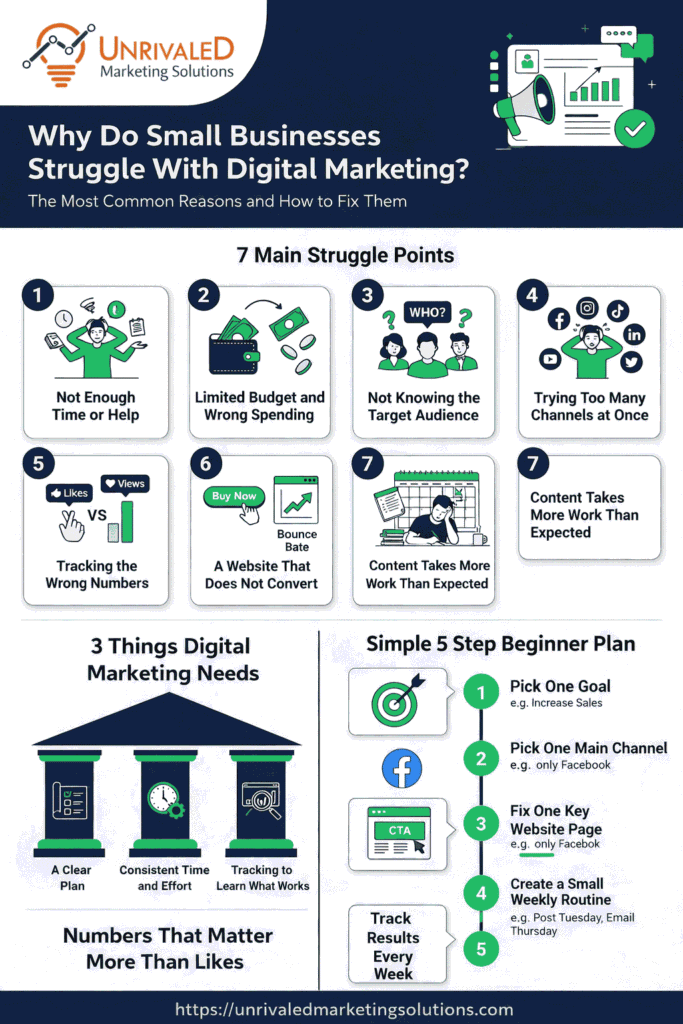
Why do small businesses struggle with digital marketing? Because digital marketing needs three things that are hard for small teams to balance.
- A clear plan
- Consistent time and effort
- Tracking to learn what works
When one of these is missing, marketing becomes guesswork. Guesswork leads to wasted money and weak results.
They do not have enough time or help
Many small businesses are run by one person or a tiny team. They are doing everything.
- Serving customers
- Managing inventory or bookings
- Answering phones and emails
- Paying bills
- Running the business day to day
Digital marketing is not a one time task. It is ongoing. You have to post, reply, update your website, write content, and check results. When you are already stretched thin, marketing is the first thing to get pushed aside.
What it looks like in real life
A business might post on social media for one week, then disappear for two months. Or they might launch a new website but never update it again. Customers notice that, and trust can drop.
They have a limited budget and do not know where to spend it
Money is a big reason why small businesses struggle. Many owners cannot afford a full time marketer, designer, and ad manager. They also might not have money to test ads long enough to learn what works.
Another issue is confusion about spending. Some people spend on the wrong things first, like paying for fancy designs before fixing basic problems like clear messaging, fast page speed, and simple calls to action.
Common budget mistakes
- Paying for ads before the website is ready to convert visitors into leads or sales
- Paying for services without clear goals, like “more followers” instead of “more calls”
- Stopping too early, before results have time to build
They do not know their audience well enough
Before you pick a platform, you need to know who you are trying to reach and what they care about. Many businesses skip this step. They try to market to everyone, which usually means they connect with no one.
If you do not understand your audience, your marketing will feel random.
Basic audience questions to answer
- Who is your best customer right now?
- What problem are they trying to solve?
- What words do they use to describe that problem?
- Where do they look for help, like Google, Facebook, Instagram, or YouTube?
- What makes them trust a business like yours?
When you can answer these, your marketing gets easier and more effective.
They try too many channels at the same time
Digital marketing has a lot of options. A small business might try all of these in one month.
- TikTok
- Blogging
- Google ads
- SEO
The result is often burnout and scattered results. Each channel has its own rules, content style, and learning curve. When you try to do everything, nothing gets enough attention to work well.
A better approach
Pick one main channel based on where your customers are most likely to be. Build a simple routine. Once that channel is working, add the next one.
They do not track the right numbers
A lot of small business owners feel like digital marketing is a mystery because they are not tracking results in a clear way. They might track likes and views, but those numbers do not always lead to sales.
What matters most depends on your business, but usually you want to track actions that lead to revenue.
Numbers that often matter more than likes
- Website visits from search and social
- Calls, form fills, and bookings
- Email sign ups
- Cost per lead if you run ads
- Sales from specific campaigns
When you track these numbers, you can improve faster because you can see what is working.
Their website is not doing its job
Many people think digital marketing is only about getting attention. But attention is only step one. Your website or landing page must turn visitors into customers.
Small businesses often struggle because their website has common issues.
- It loads slowly
- It is hard to use on a phone
- The message is not clear
- The contact button is hard to find
- It does not build trust with reviews, photos, or clear details
The main website job
A website should help a visitor quickly answer these questions.
- What do you offer?
- Who is it for?
- Why should I trust you?
- What should I do next?
If your website answers those clearly, your digital marketing gets stronger.
Creating content takes more work than people expect
Content marketing sounds simple, but it takes planning and consistency. Writing posts, taking photos, filming short videos, and answering comments all take time.
Many small businesses also feel stuck because they do not know what to post. They worry they will sound boring or say the wrong thing.
Easy content ideas for beginners
- Answer common customer questions
- Show behind the scenes, like how you make or deliver your product
- Share customer stories and reviews
- Explain what makes your service different
- Post simple tips related to your industry
Content works best when it is helpful and real, not perfect.
The rules keep changing, and that causes frustration
Digital platforms change often. Algorithms shift. Ad costs go up and down. SEO best practices evolve. A strategy that worked last year might not work the same way today.
This is another reason people ask, “Why do small businesses struggle with digital marketing?” It is not just hard work. It has also changed.
The good news
You do not need to chase every trend. If you focus on basics like a clear offer, strong reviews, helpful content, and consistent tracking, you can still win.
A simple beginner plan that actually works
If you feel overwhelmed, use this step by step plan. Keep it simple for 30 days.
Step 1 Pick one goal
Examples include:
- Get 20 more calls per month
- Get 10 more bookings per month
- Get 50 email sign ups per month
Step 2 Pick one main channel
Choose the channel where your customers already look.
- Google search if people are actively looking for your service
- Facebook or Instagram if your business is local and visual
- Email if you already have repeat customers
Step 3 Fix one key website page
Start with your home page or your main service page. Make sure it includes:
- Clear headline with what you do
- Simple list of services
- Reviews and trust signals
- One clear call to action like Call now or Book today
Step 4 Create a small weekly routine
A simple routine could be:
- One helpful post per week
- One customer review shared per week
- One hour per week to check results
Step 5 Track results every week
Write down a few numbers in a simple note or spreadsheet.
- Website visits
- Leads, calls, or bookings
- Sales from marketing
After four weeks, you will know more than most beginners, because you will have real data.
Conclusion:
Why do small businesses struggle with digital marketing? Most of the time it is not because they are doing nothing. It is because they are trying to do too much without a clear plan, enough time, or tracking that shows what is working.
If you want to improve your results, start small and stay consistent. Pick one goal, choose one channel, fix your website basics, and track a few important numbers every week.
Take 20 minutes today and write your one main goal, your main customer, and your one marketing channel for the next 30 days. Then commit to one small action each week. Consistency beats complexity in digital marketing.
Frequently Asked Questions (FAQ)
What does digital marketing mean for a small business?
Digital marketing means using online tools to reach customers. This can include a website, Google search results, social media, email, and online ads. The goal is to get more calls, leads, bookings, or sales.
Why do small businesses struggle with digital marketing?
Small businesses often struggle because they have limited time, small budgets, and no clear plan. Many also try too many platforms at once or do not track results, which makes it hard to know what is working.
Do I need to be on every social media platform?
No. It is better to choose one or two platforms where your customers actually spend time. Doing fewer channels consistently usually works better than doing many channels once in a while.
What should I track to know if my marketing is working?
Focus on numbers that connect to sales, such as website visits, calls, form submissions, bookings, email sign ups, and sales from ads or promotions. Likes and views can be helpful, but they are not the main goal.
Can digital marketing work with a small budget?
Yes. A small budget can still work if you start with the basics. Make sure your website is clear, claim and improve your Google Business Profile, ask for reviews, and create simple helpful content. Small steps done consistently can lead to real growth.