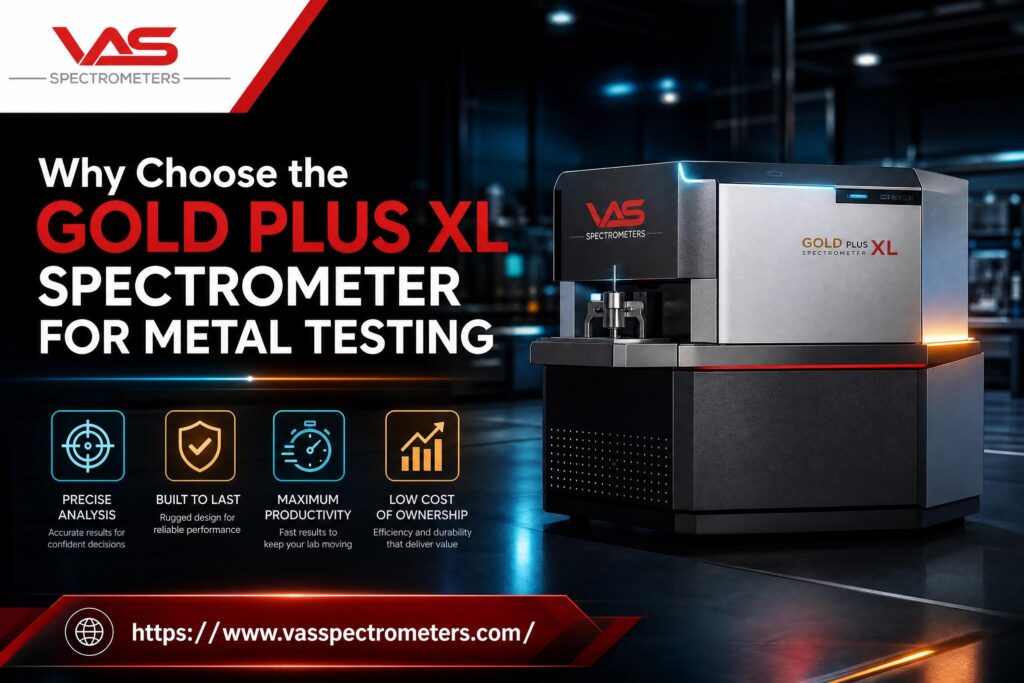

If your business depends on accurate metal composition data — whether you’re running a foundry, a rolling mill, a scrap yard, or a quality lab — the spectrometer you choose can make or break your production quality. Among the metal analyzers on the market today, the Gold Plus XL spectrometer from VAS Spectrometers has earned a strong reputation as a premium, high-performance optical emission spectrometer (OES) built for demanding testing environments. In this guide, we’ll break down what makes the Gold Plus XL stand out, how it compares to its sibling model, the Gold Plus X OES, and how to decide which one fits your operation.
What Is the Gold Plus XL Spectrometer?
The Gold Plus XL spectrometer sits at the top of VAS Spectrometers’ Premium Series lineup. It’s designed from the ground up to handle the most demanding metal testing requirements in industry, and it comes with nitrogen (N2) purge analysis as standard — a feature that helps stabilize the optical path and improves the accuracy of readings for elements in the far ultraviolet range, such as carbon, phosphorus, and sulfur.
In simple terms, this is a stationary, benchtop optical emission spectrometer built for facilities that need lab-grade precision on the production floor, run high sample volumes, or test a wide range of alloy families in a single day.
Key Features That Set the Gold Plus XL Apart
1. V-MAP Excitation Source for Consistent Sparking
At the heart of the Gold Plus XL is its V-MAP current-controlled excitation source, which runs a true 100kHz real-time regulation system. This fully software-controlled, multi-frequency spark source (up to 1kHz) delivers a high-energy, condensed spark that improves precision test after test. Because the excitation parameters are selected automatically by the software, operators don’t need to manually tune settings for each sample — the instrument handles it.
2. High-Resolution Optical System
The Gold Plus XL uses a Rowland circle optical arrangement with a high-performance holographic diffraction grating and a resolution greater than 3 picometers. It covers a wavelength range of 136nm to 720nm, captured across multiple CCD detector arrays with 3,694 pixels each. This wide range and high resolution allow the instrument to separate closely spaced spectral lines accurately, which matters when you’re distinguishing between similar alloy grades.
The entire optical chamber is temperature-stabilized and sealed against dust and contamination, and the system runs automatic, real-time profiling to maintain calibration accuracy over time.
3. Built for Reliable, Maintenance-Free Operation
The spark stand uses an argon-flushed chamber with automatically adjusted low flow in both standby and analytical modes, a tungsten electrode, and a multi-directional optimized flow design that helps keep the chamber clean between tests. A mechanical quick-engage sample clamp accommodates both large and small sample sizes, and the sample base is easily removable for cleaning and maintenance — a small design detail that saves real time on a busy shop floor.
4. User-Friendly Software and Reporting
The Gold Plus XL ships factory calibrated, with automatic inter-element interference corrections built into the analysis software. Operators can view Mean, SD, or RSD values, standardize each analytical program individually, and log every analysis for later retrieval. Reports can be generated directly or exported to Excel, and the system connects via Gigabit Ethernet for fast, reliable data transfer to a connected Windows-based PC (Windows 7 and above).
5. Compact Footprint, Serious Performance
Despite its performance class, the instrument has a manageable footprint — roughly 1000 x 700 x 380 mm and about 80kg without the utility base — making it practical for most lab and production-floor layouts. It runs on standard single-phase 230V AC power, and specifications are available for different international power standards.
Gold Plus XL vs. Gold Plus X OES: What’s the Difference?
VAS Spectrometers offers the Gold Plus X OES as part of its Core Series — a compact desktop spectrometer/metal analyzer built specifically for production applications. It shares the same DNA as the Gold Plus XL, including the V-MAP excitation source, automatic software-controlled spark parameters, and a similarly designed spark stand with a C-shaped sample plate engineered to resist warping over long-term use.
The main differences come down to positioning and scope:
- Optical range: The Gold Plus X covers a wavelength range of 163nm to 417nm, narrower than the Gold Plus XL’s 136nm to 720nm range, which affects the breadth of elements each unit can resolve at the highest precision.
- N2 purge capability: The Gold Plus XL’s N2 analysis feature is a defining upgrade for labs that need maximum stability and accuracy on far-UV elements, which is especially useful for critical carbon and sulfur determination.
- Connectivity: The Gold Plus XL uses Gigabit Ethernet connectivity for data transfer, while the Gold Plus X relies on Ethernet and USB connectivity.
- Positioning: VAS markets the Gold Plus XL as its Premium Series flagship for the most demanding testing needs, while the Gold Plus X sits in the Core Series — a stable, dependable workhorse designed for everyday production-line testing where extreme performance isn’t the primary requirement.
In short: if your facility tests a wide variety of alloys, needs the tightest possible precision on light elements, or runs high sample throughput where consistency is critical, the Gold Plus XL is the stronger fit. If you need dependable, day-to-day production testing without the premium price tag, the Gold Plus X OES is a very capable alternative.
Industries and Applications Where the Gold Plus XL Excels
Because it’s built to handle a broad range of alloy families, the Gold Plus XL spectrometer is well suited to several core industries:
- Ferrous metals: alloy steels, stainless steels, cast iron, ductile iron, structural steel, and TMT bar analysis.
- Aluminium: both die-cast and wrought aluminium alloy verification.
- Copper alloys: brass, bronze, and copper-nickel alloy testing.
- Zinc: pure zinc and Zamak alloy analysis.
- Nickel alloys: composition verification for high-performance nickel-based materials.
- Commercial testing laboratories: third-party labs that need to certify a wide range of incoming customer materials with confidence.
Why Businesses Choose the Gold Plus XL Spectrometer
Beyond the technical specifications, there are practical business reasons buyers gravitate toward this instrument.
- Reduced downtime: The maintenance-free excitation source, self-cleaning-friendly spark stand design, and factory calibration mean less time troubleshooting and more time testing.
- Operator-friendly workflow: Automatically selected analytical parameters and a straightforward software interface mean new operators can be productive quickly, without months of specialized training.
- Traceable, exportable data: Built-in logging and Excel export make it easier to maintain quality records, respond to audits, and share certificates of analysis with customers.
- Support ecosystem: VAS Spectrometers backs its instruments with service plans such as Total Shield, Precision Plus, and Flexi Plan, along with laboratory and NABL consultancy services — useful for businesses working toward formal accreditation.
- Long-term value: As part of a Premium Series built for heavy, continuous use, the Gold Plus XL is positioned to handle high sample volumes over years of operation without frequent part replacement.
Is the Gold Plus XL Right for Your Facility?
Choosing between the Gold Plus XL and other models in the range really comes down to your testing volume, the breadth of alloys you handle, and how critical light-element precision is to your quality process. A few questions worth asking:
- Do you test multiple alloy families — ferrous, aluminium, copper, zinc, and nickel — regularly, or mostly one material type?
- Is precise carbon or sulfur determination critical to your grading or certification process?
- What’s your daily sample volume, and how much downtime can your operation afford?
- Do you need to issue certified test reports to customers or regulatory bodies?
If your answers point toward high volume, broad material coverage, and strict accuracy requirements, the Gold Plus XL spectrometer is built for exactly that kind of demanding environment. If your needs are more focused and cost-efficiency is the priority, it’s worth comparing it directly against the Gold Plus X OES before making a final decision.
Frequently Asked Questions
What does N2 analysis mean on the Gold Plus XL?
N2 analysis refers to nitrogen purging of the optical path, which displaces air and reduces interference in the far-ultraviolet wavelength range. This improves the accuracy and stability of readings for elements like carbon, phosphorus, and sulfur, which are notoriously difficult to measure precisely.
Does the Gold Plus XL require special facility setup?
The instrument runs on standard single-phase 230V AC power and operates best within a controlled temperature range of 20 to 25°C. Beyond stable power and a reasonably climate-controlled room, no major infrastructure changes are typically needed.
Can one instrument test multiple types of metal?
Yes. The Gold Plus XL is designed to handle multiple alloy families — including ferrous metals, aluminium, copper, zinc, and nickel alloys — through separate calibrated analytical programs, so a single instrument can often replace the need for multiple specialized units.
How does data get from the spectrometer to my quality records?
Results can be logged automatically, retrieved from historical data, and exported directly to Excel, making it straightforward to build certificates of analysis or feed data into a broader quality management system.
Final Thoughts
Metal testing accuracy isn’t just a compliance requirement — it directly protects your production quality, your customer relationships, and your reputation in the market. The Gold Plus XL spectrometer brings together a stable excitation source, a high-resolution optical system, maintenance-friendly hardware, and user-focused software into one dependable package built for serious, high-throughput metal analysis.
Whether you ultimately choose the Gold Plus XL or step down to the Gold Plus X OES, both instruments reflect the same engineering philosophy: consistent, accurate, and operator-friendly metal analysis you can build your quality process around. The right choice simply depends on how demanding your day-to-day testing environment really is.