
Crypto presales are no longer a niche activity reserved for early adopters in developer Telegram groups. In 2026, they have become a mainstream entry point for retail investors across emerging markets, including India, where blockchain adoption is accelerating at a pace that few predicted even two years ago. With that growth has come a parallel surge in risk.
According to a 2025 report by Chainalysis, crypto fraud losses reached an estimated $17 billion globally and presale-related scams accounted for a significant and growing share of that figure. Impersonation scams, fake token launches, and rug pulls disguised as legitimate presales rose sharply, with some analysts projecting even higher losses in 2026 as AI-generated fake teams and fabricated whitepapers become harder to detect. For investors, enthusiasm without due diligence has proven repeatedly to be the most expensive mistake in this space.
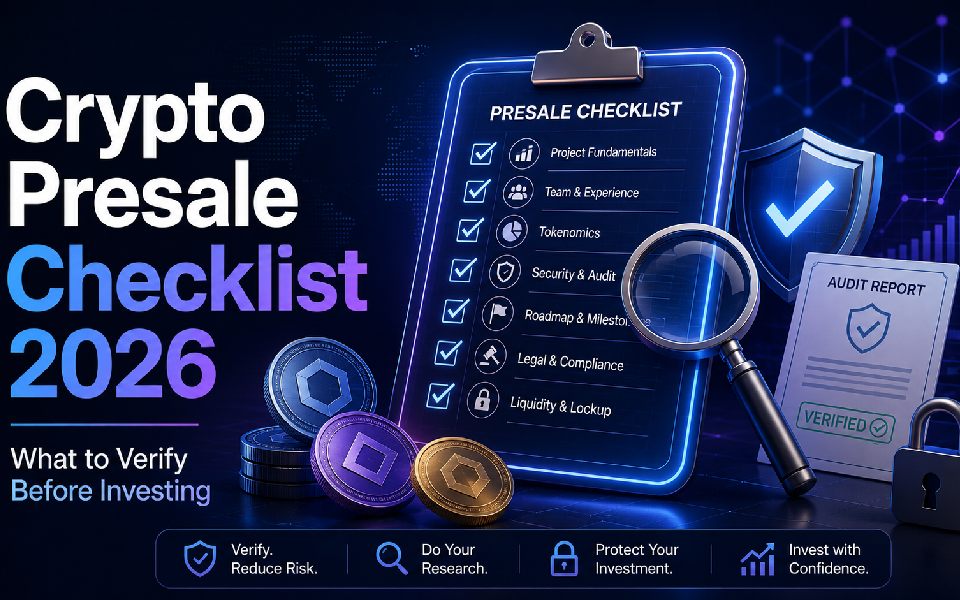
This guide is designed to help anyone evaluating a crypto presale whether a first-time participant or a seasoned Web3 investor develop a structured verification process before committing capital. The checklist below covers six critical areas that separate credible early-stage token projects from the ones that disappear after the sale closes.
Why presale due diligence is different from exchange investing
When you buy a token on a centralized exchange, several layers of vetting have already occurred. The exchange has reviewed the project, a listing fee has been paid, and basic liquidity exists. A presale offers none of those protections.
In a presale, you are purchasing tokens before any independent market has formed, typically before the product is live, and often before regulatory classification of the token has been established. You are essentially making a bet on a team’s ability to execute and on their intention to do so honestly. That asymmetry of information between the founding team and the investor is precisely where fraud flourishes.
A 2026 study by CoinLaunch found that 45 percent of rug pulls in token sales occurred in projects where liquidity was not genuinely locked. Another analysis highlighted that 32 percent of failed presales involved smart contracts with hidden administrative functions that allowed founders to drain funds post-launch. These are not obscure technical failures. They are deliberate traps, and they are avoidable with the right checklist.
The six-point verification framework
1. Team identity and professional track record
The single most important signal in any presale is whether the founding team is publicly identifiable and professionally verifiable. Anonymous teams are not automatically fraudulent some legitimate privacy-focused projects have operated with pseudonymous founders but anonymity in 2026 should trigger heightened scrutiny, not automatic trust.
Verify each named founder on LinkedIn, GitHub, and Twitter. Check for a history of contributions to open-source blockchain projects. Look for prior startup experience, conference appearances, or published research. A team that existed professionally before this project is a substantially different risk profile from one whose entire online presence was created in the month before the presale announcement.
Pay particular attention to advisors. Many projects list high-profile names on their website without those individuals being genuinely involved. A brief search for whether the named advisor has mentioned the project publicly is often sufficient to identify fake advisory boards.
2. Whitepaper depth and technical honesty
A whitepaper is a project’s foundational document. It should explain the problem being solved, the technical architecture of the solution, the tokenomics model, and the roadmap. If a whitepaper reads more like a marketing brochure than a technical specification, treat that as a warning sign.
Check whether the whitepaper is original. Plagiarism detection tools can identify whitepapers that have been copied or lightly modified from other projects a common tactic among bad actors who lack the technical knowledge to write their own. Also examine the roadmap critically: vague milestones with no technical specificity (“Q3 2026: launch mainnet”) without any explanation of what that requires technically suggests the team either has not planned the work or does not want scrutiny of it.
Legitimate projects are typically willing to discuss their technical architecture in public channels. If founders become evasive or deflect detailed questions with hype, the whitepaper is likely the ceiling of their actual planning.
3. Smart contract audit status
This is non-negotiable. Any presale in 2026 that has not published a smart contract audit from a reputable third-party security firm should be approached with extreme caution.
Reputable audit firms in the blockchain space include CertiK, SlowMist, Hacken, and Trail of Bits, among others. A legitimate audit will identify vulnerabilities, document findings, and provide a verification hash that can be checked on-chain. A project that claims to have been “audited” without providing a publicly accessible audit report should be treated as if no audit exists.
Use block explorers such as Etherscan or Solscan to verify that the contract address provided by the project matches the one in the audit report. Check whether admin keys have been renounced or are controlled by a multisig wallet. Contracts where a single wallet address retains unlimited minting or withdrawal authority after launch are a structural risk regardless of what the team has said publicly.
4. Tokenomics and vesting schedule transparency
Tokenomics the economic design of the token determines whether early investors are entering a project with aligned incentives or one where they will immediately become exit liquidity for the founding team.
A 2026 analysis found that projects with opaque or non-existent vesting schedules saw a 60 percent higher likelihood of price collapse within six months of launch. The mechanism is straightforward: if the team, advisors, and private sale investors can sell their tokens immediately after the public launch, they will, and the price will collapse under that selling pressure.
Evaluate the following in every presale token model:
- What percentage of total supply is allocated to the team and early investors?
- What is the lock-up period before those tokens can be sold?
- What percentage of supply will be circulating at the time of the public launch?
- Is the vesting schedule enforced by the smart contract or based on a voluntary commitment?
A team allocation above 20 percent with no multi-year vesting is a structural red flag. A low initial circulating supply paired with a high fully diluted valuation means early buyers are priced against a much larger eventual supply a dynamic that has crushed many presale participants even in projects that were not outright scams.
5. Community activity and authentic engagement
Community is both a signal of genuine adoption and one of the most easily faked metrics in crypto. Telegram groups with tens of thousands of members can be purchased for a few hundred dollars. Twitter follower counts mean nothing without engagement data behind them.
The quality to look for is organic, substantive conversation. When community members ask hard technical questions, do the founders respond directly and knowledgeably? Are there independent voices discussing the project critically, or does the community aggressively suppress any skepticism? Closed communities that remove users for asking questions about tokenomics or smart contract security are not confidence-inspiring environments.
Look at the project’s GitHub repository if one exists. Commit history, the number of active contributors, and the recency of meaningful code pushes are signals that development is genuinely occurring. A repository with one contributor and no commits in months, combined with a launch countdown timer, is a profile worth questioning.
6. Listing on reputable token tracking platforms
One of the most practical and underused verification steps is checking whether the project appears on established crypto presale directories and token tracking platforms before you commit. These platforms aggregate ongoing token sales, display fundraising progress in real time, and often perform basic verification checks before listing.
Platforms that track active presales such as dedicated crypto presale directories that compile ICOs, IDOs, and IEOs in one place provide a useful cross-reference layer. A project that refuses to list on any established platform, that cannot be found on CoinGecko or CoinMarketCap even during an active sale, or that exists only in its own ecosystem of social media accounts should raise questions about why it is avoiding platforms with user review mechanisms.
This does not mean that listing on a tracking platform guarantees legitimacy it does not. But the absence of any independent listing presence, combined with urgency tactics like “this round closes in 48 hours,” is a classic pressure pattern used across presale fraud cases in 2025 and 2026.
Red flags that should stop you immediately
Beyond the structured checklist, certain signals should end the evaluation process regardless of how attractive the investment case appears:
Guaranteed returns. No legitimate blockchain project can promise fixed ROI. Any presale materials that use language like “earn 10x guaranteed” or “minimum 500% return” are making claims that are mathematically impossible to underwrite and legally problematic in most jurisdictions.
Extreme urgency without substance. Countdown timers and “last 2% remaining” pressure tactics are designed to short-circuit the due diligence process. Legitimate projects that are genuinely oversubscribed do not need manufactured urgency.
Unsolicited outreach with investment opportunities. If you received information about a presale through a direct message from someone you do not know on Telegram, Discord, Twitter, or WhatsApp the probability of it being a legitimate opportunity is very low. This vector accounts for a large proportion of presale scams reported in the past two years.
No verifiable exchange listing plan. A project raising capital through a presale with no publicly documented path to liquidity whether a DEX listing, a CEX application, or an IDO on a named launchpad is either in very early development or has no intention of providing an exit.
A note on the Indian regulatory context
For Indian investors specifically, the landscape around crypto participation continues to evolve. The Income Tax Act’s treatment of virtual digital assets, the reporting requirements under PMLA, and SEBI’s ongoing engagement with crypto regulation all create a framework where retail participation in token sales carries both financial and compliance dimensions.
Understanding that presale tokens may be classified as virtual digital assets with corresponding tax obligations and that losses from fraudulent presales are generally not recoverable through formal mechanisms makes the case for thorough pre-participation verification even stronger. The Indian startup ecosystem has produced serious Web3 builders, and supporting credible blockchain projects through early participation is a meaningful contribution to that ecosystem. Doing so without the verification framework above is simply an avoidable risk.
Conclusion
The crypto presale market in 2026 is simultaneously one of the most accessible and most dangerous investment environments available to retail participants. Access has never been easier a wallet, some ETH or SOL, and an internet connection is all that is technically required. But access without structure produces the outcomes that Chainalysis has been documenting year after year.
The six-point framework above team verification, whitepaper depth, smart contract audit, tokenomics analysis, community quality, and independent listing presence does not eliminate risk. Early-stage investing in any sector carries inherent uncertainty. What this framework does is separate the structural risks that are visible before you invest from the market risks that are genuinely unknowable.
Apply it consistently, ask the difficult questions before the sale closes rather than after, and treat any project that discourages scrutiny as one that has already answered your most important question.
About the Author: This article was written by a blockchain analyst and Web3 content researcher with experience covering token economics, decentralized infrastructure, and crypto market structure. For ongoing updates on active token sales, presale listings, and project due diligence resources, visit ICO Announcement a crypto presale and token sale tracking platform covering ICOs, IDOs, and IEOs across major blockchains.
Disclaimer: This article is for informational purposes only and does not constitute financial or investment advice. Participation in crypto presales involves significant risk, including the potential loss of capital. Always conduct your own research before making investment decisions.