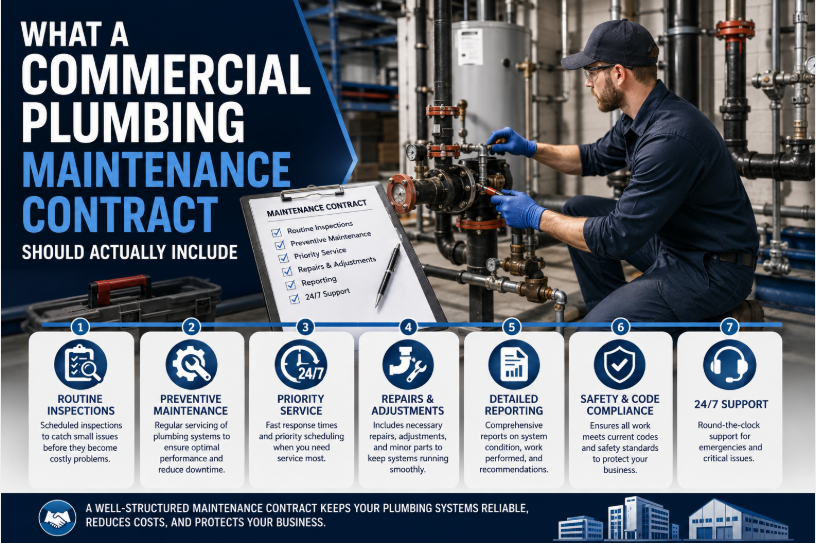

Most commercial property managers sign a plumbing maintenance contract without reading past the price and service frequency. That is a mistake, since the specific terms inside a maintenance contract determine how well it actually protects a building from costly, disruptive failures. A handful of contract elements separate a maintenance agreement that genuinely prevents problems from one that is essentially a scheduling formality.
Response Time Guarantees, Not Just General Availability
A contract promising priority service means little without a specific, defined response window. Look for language guaranteeing a response within a specific number of hours for emergency calls, not vague assurances of prompt attention. Ask directly what happens contractually if that window is missed, since a guarantee without a consequence is not really a guarantee. A specific, enforceable response time is one of the clearest signals a contract will actually function during a real emergency rather than just sound reassuring on paper.
Scope of Preventive Inspections, Defined Specifically
Water damage remains one of the most common and costly property insurance claims, according to the Insurance Information Institute, with average claims running into the thousands of dollars. A maintenance contract’s preventive inspection scope should specify exactly what gets checked, backflow preventers, water heaters, pipe connections in vulnerable areas, rather than a vague promise of general system checks. Specificity here is what actually catches small issues before they become expensive claims.
Code Compliance Documentation Included in the Service
Commercial plumbing systems face inspection and code requirements that residential systems do not, and a strong maintenance contract should include documentation supporting compliance, not just the repair work itself. Ask whether the contract includes providing compliance records for insurance or regulatory purposes, since assembling this documentation after the fact, during an audit or claim, is far more difficult than having it maintained continuously as part of routine service.
Clear Terms for Multi-Unit or Multi-Tenant Properties
A property with multiple tenants or units needs contract language addressing how service calls get prioritized when multiple units report issues simultaneously, and how costs get allocated between building-wide systems and unit-specific repairs. A contract silent on this allocation creates ambiguity precisely when a building manager needs clarity most, during a widespread issue affecting several tenants at once.
Renewal Terms and Price Escalation Clauses
Many maintenance contracts include an automatic renewal clause along with a price escalation formula for each subsequent term, details that are easy to overlook when focused on the initial year’s pricing. Understanding how much a contract’s price can increase at renewal, and whether that increase is capped or tied to a specific index, prevents an unpleasant surprise a year or two into the relationship. A property manager who negotiates these terms upfront has considerably more leverage than one who accepts whatever the renewal terms happen to say once the contract is already signed.
Who Actually Performs the Work Matters Too
Some maintenance contracts allow the contracting company to subcontract portions of the work to third parties, which can mean a building never sees the same technician twice and loses the benefit of a plumber who knows the property’s specific quirks and history. Asking whether the same crew handles the account consistently, or whether work gets distributed to whichever subcontractor is available that week, reveals whether a contract is built around genuine relationship continuity or just administrative convenience for the contracting company.
How Reporting and Communication Should Work
A well-structured contract specifies how and when a property manager receives updates: a report after every visit, a summary of issues found and addressed, and a running record accessible without having to request it separately each time. Contracts that leave reporting informal or ad hoc tend to leave property managers reconstructing maintenance history from memory during an insurance claim or a tenant dispute, exactly the moment when accurate records matter most and are hardest to recreate after the fact.
What to Ask Before Signing
- What is the specific guaranteed response time for emergency calls?
- What exactly gets inspected during routine preventive visits?
- Is compliance documentation included as part of the service?
- How are costs allocated for issues affecting multiple tenants or units?
- What are the renewal terms and any price escalation provisions?
The Bottom Line
A commercial plumbing maintenance contract is only as valuable as its specific terms. Response guarantees, defined inspection scope, compliance documentation, cost allocation, and renewal terms together determine whether a contract actually prevents costly failures or simply schedules occasional visits without real protection behind them. Reading past the price line before signing is worth the extra time it takes.