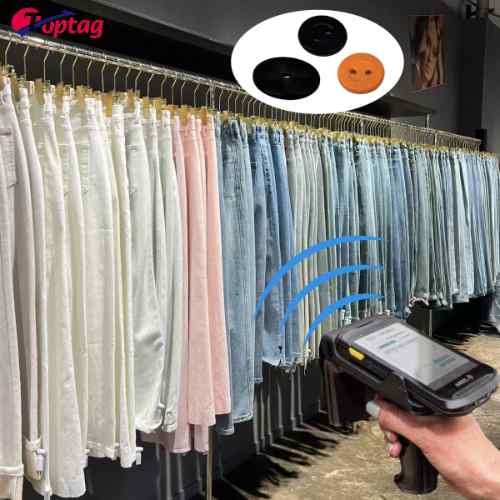

The smallest item can cause the largest delay in busy apparel and textile operations. A size run that’s out of place, the wrong colour count, or a slow stock check has a quick impact on service and profit. That’s where a UHF RFID laundry tag can help; it provides each garment with a unique digital identity that can be read without touching it.
The benefit for retailers, laundries and uniform programmes is that it speeds up the handling process, keeps records clean and reduces manual errors from intake to return.
Why RFID Tags On Products Matter In Apparel Operations
Teams eliminate manual typing and slow visual inspections when they use RFID tags on products. In the apparel industry, this is important because the style, size, colour, production date and batch number must remain associated with the correct product. This also applies to hotel linen, staff uniforms, T-shirts, shoes and bags, where it is just as crucial to be quick and accurate. These tags allow for stock movements to be recorded in seconds, making replenishment and traceability much easier.
The applications of this type of solution are not theoretical, but practical. Readability of data, reliability of performance, and customizability in various operating situations are the focus. The reason is that clothing programs don’t remain simple. Sizes vary, batches are being transferred between premises, and returns have to be identified and processed promptly. The objective is to have all the stages visible from creation to packing, sales to after-sales processing.
What The Tag Is Built To Do
This is an RFID Cloth Tag that is custom-sized and is described as being either ABS or paper. It operates at 13.56MHz and 860-960MHz UHF, allowing the same family of tags to be compatible with various reader deployments and setups. There is support for ISO 15693 and ISO 18000-6C protocols. The chips are ICODE SLI (13.56MHz), ICODE SLIS (13.56MHz), H3, Monza 3, 4 or 5 (UHF), and others are available on request.
Reading distance is 0-3m as per the reader and the environment. The range of the tag makes it ideal for controlled scanning in back-of-house areas, quick identification and batch checking. The tag also has a few custom crafts: a special anti-metal layer for special cases, custom printing or laser engraving of logos or artwork, ID number printing via jet dot printing and ID number printing with a read-only lock option for URL, text or numbers. The information is important because garment control may rely on both durability and identification.
Where The Format Works Best
The UHF RFID laundry tag systems are most useful in real-world scenarios where objects are transported frequently and need to be inspected rapidly. This includes production monitoring, warehouse intake, outbound registration and return processing. A tag may contain a unique ID for care instructions, material information or a production batch; if there is a problem later on, teams are able to trace it back to the tag very easily. In a hectic apparel site, traceability stops misunderstandings and decreases the danger of rework.
Retail and consumer workflows are supported as well with the same tag. When RFID tags on products are read quickly, without any line of sight, it improves fit room checks, self-service checkout and stock verification. Unique IDs verify authenticity for anti-counterfeit use, and access alarms help minimise theft risk. A second UHF RFID laundry tag scan can help after-sales teams expedite returns and exchanges as the product identity is verified instantaneously.
That’s where a clean workflow comes in handy. A reader can retrieve data without physically
touching a tag, and several tags can be read at once. This makes the tag beneficial for larger inventories where speed, accuracy and less handling are all important. When used in the appropriate system, UHF RFID laundry tags can also enable replenishment alerts and smarter shelf control to help balance stocks.
Practical Product Details Buyers Should Note
Apart from the tag, the business information is simple. Payment is done by TT, Paypal, irrevocable L/C at sight. It can be sent from Nanning, Shenzhen or Guangzhou in China. Delivery time is subject to order volume; for larger orders, it is advisable to plan for the lead time. That planning will help ensure that the hotel laundry room, uniform store, and textile service team are all in sync and won’t fall behind schedule during peak times. In that regard, RFID tags on products simplify audits throughout departments and shifts.
The best question to ask for someone considering garment solutions is if the tag is equivalent to the reader, fabric, and operating speed. A retail floor tag may not function as well in laundries, hotels or mixed uniform fleets. This is why it is important to have custom sizing, chip selection, and print options. Set up properly, the tag becomes an integral part of the process, not an additional chore.
FAQ
Q. Is The Tag able to store more than an item number?
Yes, it can carry encoded text, numbers, URLs, and read-only data, thus teams can carry more than just a label.
Q. Will it be oK for repeated handling?
Yes, Designed for anti-pollution and wear resistance, suitable for environments where clothing and textiles are handled frequently.
Q. Can it be used with Different Readers?
Yes, The tag can be read with either HF or UHF readers, and the final fit will depend on the reader and the environment.
Q. Is It Return and Exchange Friendly?
Yes, A fast scan helps to determine product identity and speeds up the return process, while also ensuring quick and accurate product identification.
Why This Tag Deserves A Place In Your Workflow
When speed, traceability and cleaner records are critical to your operation, a well-defined UHF RFID laundry tag can make a significant difference. It eliminates manual checking, facilitates inventory management and provides a certain identity to every garment from the initial stage to the final stage. RFID tags on products are a viable solution for volume consistency where accuracy is required. Top Tag combines this with custom selection, simplifying the task of associating the tag with the job. Call today to help you determine the optimal format for your clothing, readers and workflow.