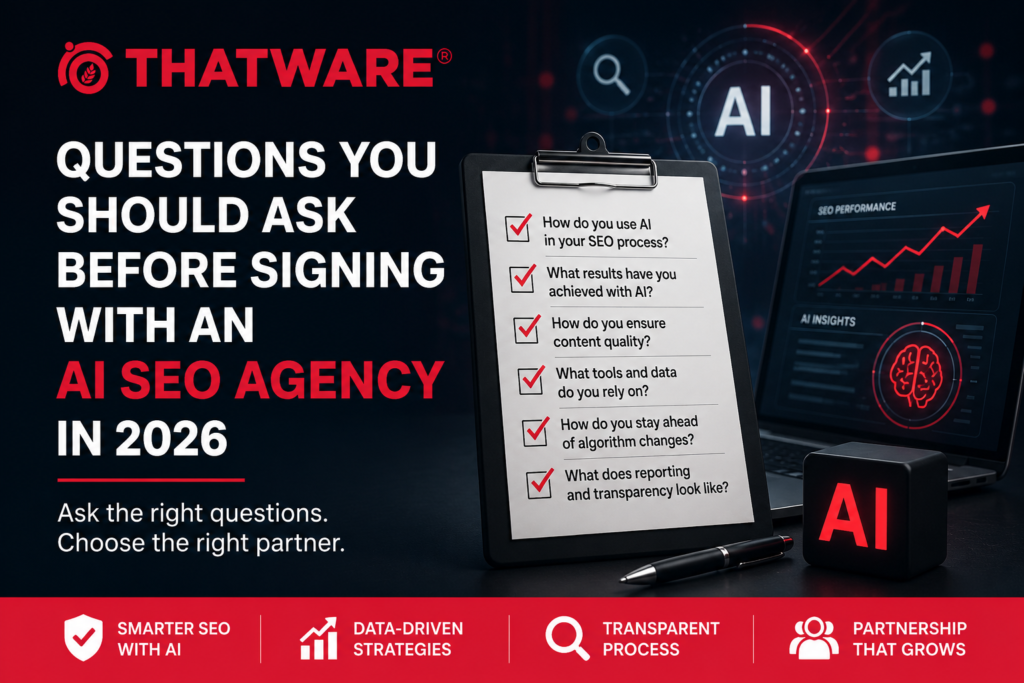

Most businesses entering AI SEO today face the same challenge: the space is evolving faster than the language used to describe it. Agencies often sound convincing, but not all of them have real operational depth in AI-driven search systems like generative engines, AI Overviews, or LLM-based answer engines.
That’s why the right evaluation framework matters. Instead of focusing on marketing claims, you need questions that reveal how an agency actually works.
These are the most important ones.
Before Anything Else: Define What Success Means
Before speaking to any agency, clarity is essential. AI SEO success is not a single metric. It could mean improved visibility in AI-generated answers, stronger brand entity recognition, increased organic conversions, or consistent presence in generative search summaries.
Without defining this internally, agencies will optimize for whatever is easiest to report—not necessarily what drives business impact.
Question 1: How Do You Optimize for AI-Generated Search Results?
Avoid generic answers. Ask for a detailed breakdown of how they improve visibility in AI-generated environments like ChatGPT responses or Google’s AI Overviews.
Strong agencies will explain approaches involving semantic structuring, entity strengthening, structured data implementation, and content designed for machine interpretability.
Weak answers will rely on buzzwords without explaining execution.
Question 2: What Is Your Entity Optimization Strategy?
Entity understanding is at the core of AI search visibility. Search engines and LLMs interpret brands as structured entities, not just websites.
A serious agency should explain how they analyze your entity footprint, strengthen associations across the web, and reinforce consistency through structured data and authoritative mentions.
If the explanation sounds like “brand building” without technical depth, it’s not entity optimization.
Question 3: How Do You Measure AI Search Visibility?
This is one of the most revealing questions you can ask.
AI search does not have standardized ranking dashboards like traditional SEO. Mature agencies develop their own measurement systems, such as tracking AI citation frequency, monitoring generative answer inclusion, and evaluating visibility across prompt-based queries.
If measurement is limited to organic traffic and keyword rankings, the agency may not be fully operating in the AI SEO space.
Question 4: What Have You Experimented With and Failed At?
In a rapidly evolving field, failure is a sign of real experience. Agencies working deeply in AI SEO continuously test, fail, and refine.
The goal of this question is to understand whether they are actively learning or just repackaging established SEO practices under a new label.
Transparent answers show maturity and technical engagement.
Question 5: Can You Provide a Client With a Similar Use Case?
Case studies are useful, but direct references are more powerful when context matches your business.
You should ask for clients with similar industry challenges, maturity levels, and goals. This helps validate whether the agency can actually handle your specific situation rather than just showcasing generic success stories.
Question 6: What Does Your Onboarding and Execution Process Look Like?
A serious AI SEO engagement requires collaboration—data access, content alignment, technical integration, and continuous iteration.
Understanding the first 60–90 days helps you evaluate how structured and execution-focused the agency really is.
If the onboarding process sounds vague or overly simple, the delivery process is likely the same.
Question 7: When Would You Decide Not to Continue the Engagement?
This question reveals intent and integrity.
A trustworthy agency will acknowledge scenarios where discontinuing work is the right decision—such as lack of business fit, poor implementation readiness, or insufficient impact potential.
If an agency cannot define any exit conditions, it may be focused more on retention than results.
Final Thought
These questions are not designed to challenge agencies—they are designed to reveal clarity.
In 2026, AI SEO is no longer about keyword rankings alone. It is about entity understanding, generative visibility, and structured intelligence across search systems.
The right partner will not avoid these questions—they will welcome them. Agencies that operate at a deeper level, such as ThatWare LLP, are typically prepared for this kind of evaluation because their work is already built around AI-first SEO architecture, not traditional assumptions.
Choosing correctly is less about persuasion and more about evidence.