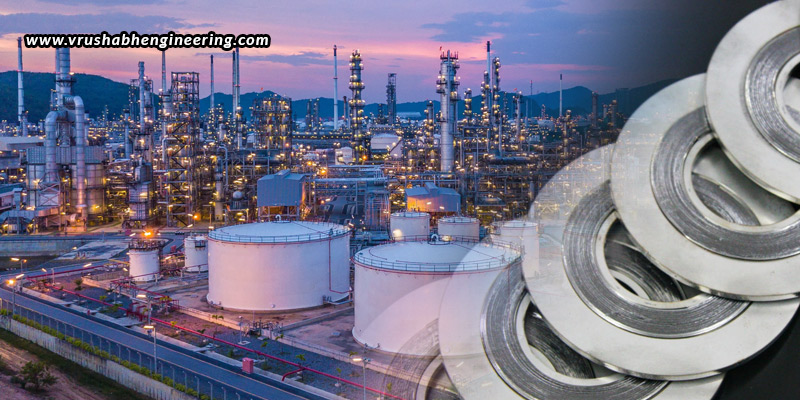

The oil and gas industry performs in some of the most challenging environments like high pressure, extreme temperatures, and corrosive substances, which demands unwavering reliability. Gaskets have revolutionized the oil and gas industry by serving an important, yet frequently underestimated function in preserving system integrity. These sealing components are situated between flanges and other mating surfaces to avert the leakage of gases or fluids; even a slight malfunction can lead to safety risks, production setbacks, or environmental damage. Employed throughout pipelines, refineries, offshore platforms, and processing facilities, gaskets differ based on service conditions. This blog explores the main types of gaskets used in the oil and gas industry.
Metal gaskets
Metal gaskets are high-strength sealing solutions made from solid metals like stainless steel, carbon steel, copper, and specialty alloys like Inconel and Monel. They are available in various profiles like flat rings, corrugated shapes, or other precision-engineered designs.
Metal gaskets have exceptional strength and durability even under extreme pressure. They also have high resistance to temperature fluctuations and thermal shock. They perform brilliantly in corrosive and aggressive environments, and have minimal risk of blowout. However, they require precise flange machining and proper installation to ensure optimal sealing performance.
With a long service life in even heavy-duty industrial operations, metal gaskets can be efficiently used in high-pressure pipeline systems, offshore drilling and subsea equipment, valve and pump assemblies, refinery pressure vessels, and critical flange connections in hydrocarbon processing.
Ring Type Joint (RTJ) gaskets
Ring Type Joint gaskets are solid metal rings made from materials like soft iron, stainless steel, or alloy steel. They are designed to fit into specially machined grooves on flanges.
The metal-to-metal sealing of Ring Type Joint gaskets ensure reliability and offer exceptional sealing under even very high pressures. These gaskets are resistant to vibration and shock loads, but they require precision machining and correct installation to ensure a perfect seal.
Ring Type Joint gaskets are utilized in the applications of offshore drilling rigs, high-pressure pipelines, and subsea systems.
Spiral wound gaskets
Spiral wound gaskets are among the most widely used sealing solutions in the oil and gas industry, owing to their excellent resilience and ability to handle extreme pressure and temperature conditions. These gaskets are made by winding alternating layers of metal and soft filler material like graphite or PTFE; the combination providing both strength and flexibility.
Spiral wound gaskets have excellent resistance to high temperatures and pressures, and can handle fluctuating load conditions. They also have a strong recovery after compression cycles, and are compatible with a wide range of chemicals. Spiral wound gaskets are especially useful in dynamic systems where thermal expansion and contraction are common.
These benefits make spiral wound gaskets absolutely suitable to be used in critical applications like heat exchangers, high-pressure pipelines, valve and pump flanges, and refinery piping systems.
Non-asbestos fibre gaskets
Non-asbestos fibre gaskets are made from aramid fibres, glass fibres, and elastomeric binders, replacing traditional asbestos-based materials that have seen to create health issues. But, these fibres are helpful only for general-purpose sealing where extreme pressures are not present.
The aramid and glass fibres, and elastomeric binders are environmentally safe and asbestos-free, making them an improved option than asbestos gaskets. They are also easy to cut and customize, making them a cost-effective option.
Despite being easy to use and cheaper, non-asbestos gaskets have good chemical resistance, making them preferred to be used in refineries, processing units, oil storage tanks, auxiliary systems in plants, and in low-to-medium pressure pipelines.
Graphite gaskets
Graphite gaskets are made from expanded graphite sheets, sometimes reinforced with metal inserts for added strength. They are widely recognized for excellent thermal stability and strong resistance to a wide range of industrial chemicals, making them highly reliable.
Graphite gaskets have strong chemical compatibility, and excellent temperature resistance. They maintain effective sealing performance even under thermal cycling conditions and provide long service life, ensuring consistent reliability in demanding industrial environments with fluctuating operating stresses.
Graphite gaskets can be used effectively in heat exchangers, refinery process units, high-temperature steam lines, and hydrocarbon processing systems. Their ability to withstand extreme conditions makes them suitable for critical applications where both thermal endurance and chemical resistance are essential.
PTFE gaskets
PTFE gaskets, made from polytetrafluoroethylene, are chemically inert, non-reactive, and highly resistant to most industrial chemicals. However, they offer lower mechanical strength compared to metal-based gaskets, limiting their use in very high-pressure applications.
These gaskets have extremely high chemical resistance, and long-term durability in corrosive environments. Their low friction and non-stick properties make them ideal for handling aggressive media, ensuring reliable sealing performance even in challenging industrial conditions.
The versatility of PTFE gaskets makes them suitable for a wide range of chemical-intensive industrial applications, such as corrosive fluid pipelines, chemical injection systems, acid and solvent handling units, and offshore chemical processing systems.
Rubber gaskets
Rubber gaskets are made from materials like NBR (Nitrile Rubber), EPDM, neoprene, and Viton each selected based on specific chemical and temperature resistance requirements in industrial applications.
Rubber gaskets provide excellent flexibility and compression, allowing them to form effective seals even on uneven surfaces. They are easy to install and replace, and offer a highly cost-effective sealing solution for a wide range of low-pressure systems.
These gaskets are commonly used in low-pressure pipelines, pump housings, HVAC and auxiliary oil systems, as well as water and oil storage systems, where reliable sealing and economical performance are essential.
Gaskets may seem like minor elements in the extensive framework of the oil and gas industry, but they are crucial for maintaining safety, efficiency, and seamless operations. From spiral wound and RTJ gaskets utilized in high-pressure pipelines to PTFE and rubber gaskets used in chemical processing and low-pressure systems, each type fulfils a specific engineering purpose. The choice of gasket is influenced by factors such as pressure, temperature, and chemical exposure. A properly selected gasket prevents leaks, reduces downtime, and enhances operational reliability throughout pipelines, refineries, and processing facilities, making it a key component in preserving the integrity of oil and gas systems. You can make the right purchase at Vrushabh Engineering, the trusted choice for high-quality gasket for oil and gas industry applications, ensuring superior sealing performance under extreme pressure and temperature conditions.