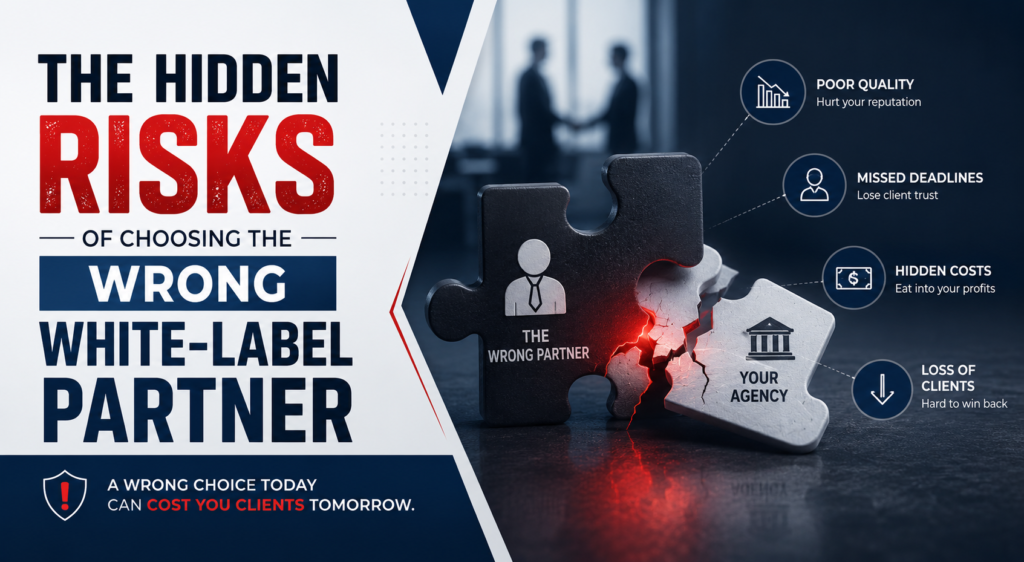

Most agency owners who get burned by a white-label partner don’t get burned on price. They get burned on the stuff that never showed up in the sales call: missed deadlines nobody warned them about, reporting that doesn’t match what the client was promised, or work that turns out to have been subcontracted three layers deep to someone with no idea what the account actually needed.
I touched on this briefly in how agency owners can scale without hiring in-house talent, where the whole argument was that outsourcing fulfillment is how agencies grow without burning out their team. That’s still true. But it comes with a condition attached: it only works if the partner is actually good. A bad one does more damage than not outsourcing at all, because the failure happens under your brand, in front of your client, with your name on it.
The risk that actually kills agencies: client churn
Here’s the number that should worry every agency owner considering a white-label partner: average client retention across agencies sits around 84%, with top-quartile agencies hitting 92-95%. The gap between average and top-quartile isn’t small, and a big part of what separates them is delivery consistency.
When clients do leave, the top reasons are almost always the same: lack of communication, failure to show ROI, team turnover on the account, and missed deadlines. Separately, industry research on agency churn found that 57% of departing clients pointed to poor communication and transparency as their reason for leaving. Every one of those failure points gets worse, not better, when a white-label partner drops the ball, because you’re now managing a communication problem you didn’t create and can’t fully see from the outside.
The financial stakes here are real too. Acquiring a new client typically costs five to twenty-five times more than retaining an existing one, and even a modest five-point improvement in retention can lift agency profits by 25 to 95%. A bad white-label experience that costs you one client isn’t just an awkward conversation. It’s a direct hit to the metric that determines whether your agency grows or treads water.
Risk #1: Subcontracting you never agreed to
This is the one that catches agency owners off guard the most. You vet a provider, like their case studies, sign the contract. Then the actual deliverables come from someone that provider hired last-minute on a freelance marketplace, with none of the training or quality control the provider showed you in the sales process.
The work you’re paying for and the work you’re getting can be two different things, and you often don’t find out until a client complains about quality or a strategy that doesn’t match what was promised. Ask directly who performs the work, and get specific: is it an in-house team, a fixed roster of contractors, or open subcontracting with no consistency guarantee? Vague answers here are a warning sign, not a technicality.
Risk #2: Reporting that doesn’t hold up under client scrutiny
White-label reporting has one job: make you look competent and in control when the client opens it. A partner that hands you generic, templated reports without the specifics your client actually cares about puts you in the position of explaining gaps in real time, in front of the person paying you.
Good partners build reporting around what you tell them the client needs. If a provider can’t customize reporting, or pushes back on doing so, that’s a sign their systems are built for their convenience, not your client relationships.
Risk #3: No clear communication protocol
Remember that 57% figure. Communication failures are the single biggest driver of client churn in this industry, and a white-label partner sits directly in your communication chain even though the client never sees them. If your partner is slow to respond to you, you’ll be slow to respond to your client. If they change strategy without flagging it, you’ll be the one caught explaining an unexpected result.
Before signing anything, get clarity on response time expectations, who your point of contact is, and what happens when something needs to change mid-project. A partner who’s vague about this in the sales process will be vague about it after you’ve signed.
Risk #4: No exit plan
Some agencies get so focused on onboarding a new partner that they never ask what happens if the relationship doesn’t work out. Can you leave with 30 days’ notice? Do you own the strategy documents and keyword research, or does that stay with the provider? Are your clients’ login credentials and historical data portable if you switch providers?
A trustworthy partner will answer these questions upfront without hesitation, because they’re not worried about you leaving. A partner who gets cagey about exit terms is telling you something important before you’ve even started.
What good vetting actually looks like
None of this means outsourcing is risky by nature. It means unvetted outsourcing is risky, and vetted outsourcing is one of the safest ways to scale an agency. The difference comes down to a handful of concrete checks before you sign anything: proof of results in your specific niche, a clear answer on who does the actual work, sample reporting you can show a client today, and defined communication and exit terms in writing.
Want help vetting one before you commit?
If you’re looking at a white-label provider right now and want a second, outside opinion before you sign anything, reach out to me directly — I’m Badal Kumar, and this is exactly the kind of vetting conversation I have with agency owners regularly. I’d rather help you catch a red flag before the contract than watch you deal with the client fallout after.
FAQ
What’s the biggest risk of using a white-label digital marketing partner? Undisclosed subcontracting is one of the most common and damaging risks — paying for a vetted team’s expertise but receiving work from an unvetted subcontractor with no quality control.
How do I know if a white-label partner is reliable before signing? Ask for proof of results in your specific niche, clarify exactly who performs the work, request a sample report, and get communication response times and exit terms in writing before you commit.
Can a bad white-label partner damage my agency’s reputation? Yes. Since the client only sees your brand, any missed deadline, quality issue, or communication breakdown from the partner reflects directly on your agency, not on them.
What should be in a white-label contract to protect my agency? Clear terms on who performs the work, reporting customization, response time commitments, and exit or termination terms, including data and strategy portability if you switch providers.