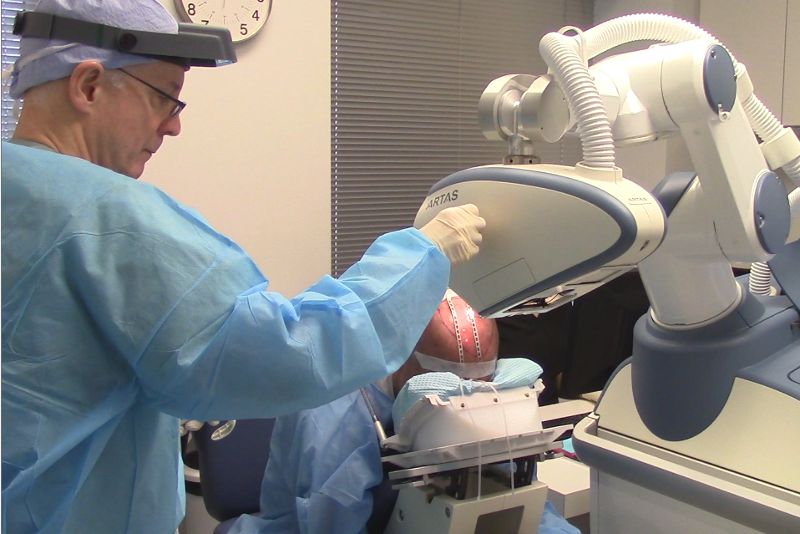

The decision to undergo a hair restoration procedure often comes with significant apprehension regarding the naturalness of the results and the reality of the recovery phase. While manual methods have existed for decades, the introduction of a robotic hair transplant in Dubai has redefined precision in follicular unit extraction. Many patients fear the “pluggy” look of older techniques or worry about the downtime associated with surgery.
This guide moves beyond marketing claims to provide a clinical perspective on how artificial intelligence assists the surgeon, what the procedure actually feels like, and a transparent timeline of the healing process based on real-world observations.
How Does Robotic Technology Change the Extraction Process?
In clinical settings, we observe that the primary advantage of robotic assistance lies in its ability to eliminate human fatigue and tremor. The system utilizes high-resolution cameras to analyze each follicular unit while it is still in the scalp, calculating the hair’s angle, depth, and exit point with micron-level accuracy.
-
Selection Algorithm: The robot identifies the most robust grafts for extraction, ensuring only high-quality follicles are moved.
-
Site Creation: AI mapping ensures that the recipient sites match the natural growth pattern of your existing hair.
-
Graft Survival: Because the robotic arm remains consistent in its depth, there is a lower rate of “transection” (damaging the bulb) compared to manual punch tools.
-
Consistency: The thousandth graft is extracted with the same precision as the first.
Is the Procedure Painful During the Robotic Session?
What is the actual pain level during surgery?
Most patients report that the only significant discomfort occurs during the initial administration of local anesthesia. Once the scalp is numb, the robotic extraction process is generally painless. You may feel a repetitive “tapping” or rhythmic pressure on the scalp, but sharp pain is rare. Many patients spend the session watching movies or resting comfortably.
Step-by-Step: Real Patient Sensations During the Procedure
Based on post-procedure follow-ups, the sensory experience follows a specific sequence that helps patients mentally prepare:
-
The Numbing Phase: A series of small injections to the donor and recipient areas. This is the most uncomfortable part, lasting about 10–15 minutes.
-
The Extraction Phase: You will hear the mechanical hum of the robot and feel a rhythmic pressure. Patients often describe this as “vibrating” or “repetitive dull tapping.”
-
The Site Creation: The surgeon or robot prepares the area where hair will be placed. You may hear a “clicking” sound as the sites are made, but you will not feel any cutting.
-
The Implantation Phase: A team of specialists manually places the grafts into the sites. This feels like a very light, repetitive touching of the scalp.
What Does the Recovery Timeline Honestly Look Like?
How long is the downtime after robotic hair restoration?
Functional downtime is minimal; most patients return to office work within 2 to 3 days. However, “social downtime” lasts about 7 to 10 days until the small scabs at the graft sites shed. You should expect localized swelling, which may descend toward the forehead and eyes by day three, before resolving by day five.
“I was terrified of people knowing I had work done. The scabs were small enough that by day eight, after a gentle wash, they were mostly gone. The swelling was the only part I had to hide with a cap,” says Omar, a recent patient.
Who Should Not Get a Robotic Hair Transplant?
While advanced, this technology is not a universal solution. In clinical observations, we find that certain factors can disqualify a candidate:
-
Inadequate Donor Hair: If the back of the head is too thin, there are not enough follicles to move.
-
Curly Hair Variations: Very tightly coiled hair can sometimes be difficult for robotic punches to track accurately.
-
Unrealistic Expectations: Patients expecting a “full head of hair” when they have advanced Grade 7 baldness.
-
Underlying Scalp Conditions: Uncontrolled alopecia areata or active scalp infections must be treated first.
-
Medical Contraindications: Severe blood clotting disorders or uncontrolled heart conditions.
Comparison: Robotic FUE vs. Manual FUE Techniques
| Feature | Robotic FUE (ARTAS/Similar) | Manual FUE |
| Extraction Precision | AI-driven, consistent | Dependent on surgeon’s hand |
| Transection Rate | Typically lower (under 5%) | Varies (5–15% based on skill) |
| Procedure Speed | Faster extraction phase | Can be slower for large cases |
| Donor Site Scars | Tiny white dots (scattered) | Tiny white dots |
| Human Error | Minimized by AI tracking | Prone to fatigue over long hours |
What Happens During the First 30 Days?
When will I see the hair start to grow?
Initially, you won’t see growth; you will see “shedding.” Between weeks two and four, the transplanted hair shafts fall out. This is a normal physiological response called “shock loss.” The follicles remain alive under the skin and enter a resting phase before beginning new growth around the third or fourth month.
“Around week three, I panicked because all the new hair fell out. My doctor reminded me this was the ‘ugly duckling’ phase. By month five, the real growth finally started,” shares Adnan.
Safety Considerations and Post-Op Risks
We prioritize transparency regarding potential side effects observed in a clinical environment:
-
Folliculitis: Small pimple-like bumps can appear as new hair breaks through the skin.
-
Temporary Numbness: Some patients feel a “pins and needles” sensation in the donor area for a few weeks.
-
Swelling (Edema): As mentioned, this is the most common side effect and is managed with sleeping at an angle.
-
Itching: As the tiny extraction sites heal, itching is common but must be managed without scratching.
Common Questions Regarding Robotic Restoral
How long does the robotic procedure take?
Most sessions last between 6 and 8 hours. Large cases involving over 2,500 grafts may require a two-day session to ensure graft viability and patient comfort.
Will the robot leave a linear scar?
No. The robotic method is a form of FUE (Follicular Unit Extraction), meaning it harvests individual follicles. There is no long, linear scar like the older FUT “strip” method.
Is the hair growth permanent?
Yes. The hairs are harvested from the “permanent zone” at the back of the head, which is genetically resistant to DHT, the hormone responsible for male pattern baldness.
Can I wear a hat after the surgery?
We recommend waiting at least 7 days before wearing a loose-fitting hat. Tight caps or helmets should be avoided for at least three weeks to prevent dislodging grafts.
Does robotic technology work on light-colored hair?
The robot’s cameras track contrast. Patients with very light blonde or white hair may need their hair dyed temporarily darker before the procedure to assist the AI tracking.
Why Choose Tajmeels Clinic
At Tajmeels Clinic, we combine the high-level precision of AI-assisted extraction with the essential artistic eye of our senior surgeons. We recognize that while a robot can harvest a follicle perfectly, it takes a human specialist to design a hairline that matures naturally with your face.
By choosing Tajmeels Clinic, you are opting for a data-driven approach to hair restoration that prioritizes both the health of your donor area and the density of your results.