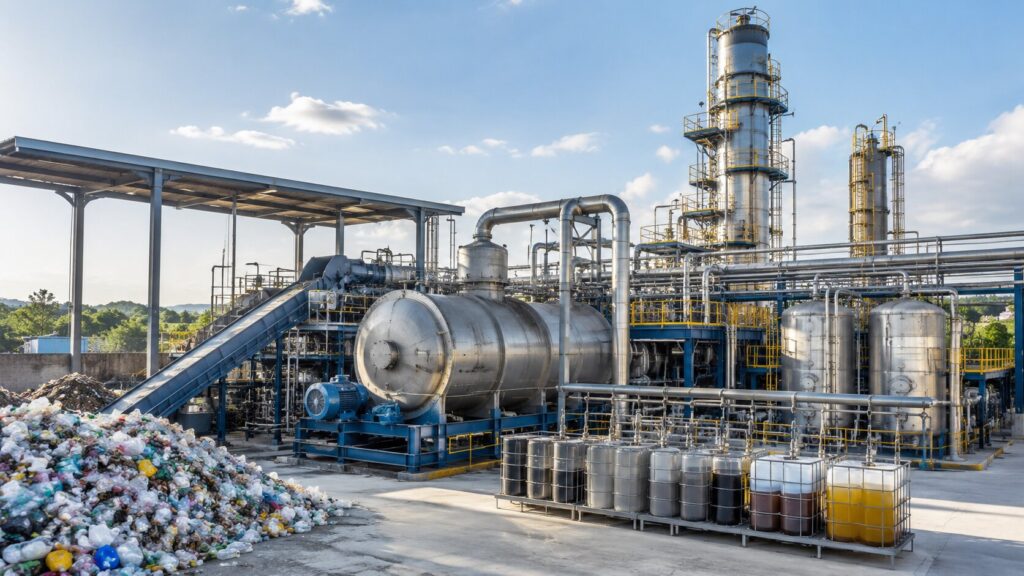

IMARC Group’s report, “Plastic Pyrolysis Production Plant Project Report 2026: Industry Trends, Plant Setup, Machinery, Raw Materials, Investment Opportunities, Cost and Revenue,” offers a comprehensive guide for establishing a production plant. The plastic pyrolysis production plant setup cost report offers insights into the manufacturing process, financials, capital investment, expenses, ROI, and more for informed business decisions.
In addition to covering operational aspects, the report offers detailed insights into the plastic pyrolysis production plant process and project economics.
- Detailed insights into the plastic pyrolysis production plant process.
- In-depth project economics and financial metrics.
- Covers capital investments and project funding.
- Analysis of operating expenses and income projections.
- Breakdown of fixed and variable costs, direct and indirect expenses.
- Evaluation of ROI (Return on Investment) and NPV (Net Present Value).
- Profit and Loss account analysis.
- Comprehensive financial analysis for decision-making.
- Provides a roadmap for successfully establishing a plastic pyrolysis production unit.
How to Start a Plastic Pyrolysis Business?
Starting a plastic pyrolysis business begins with choosing a specific niche such as pyrolysis oil production, carbon black recovery, syngas generation, or a combination of these end-products. It’s important to research the market to understand feedstock availability, local waste plastic supply chains, pricing trends for pyrolysis oil, and key competitors. You can decide whether to build a small-scale batch plant, a continuous-feed facility, or a modular unit depending on capital availability and target throughput. A clear business plan should include feedstock procurement, pre-processing, reactor selection, product refining, branding, and sales strategy. Register your business, secure environmental permits and necessary licenses, and build a reliable supply chain for waste plastic collection. Focus on delivering consistent product quality, adhering to emission standards, and promoting your outputs through fuel distributors, carbon black buyers, and industrial gas networks.
What Is Driving Plastic Pyrolysis Production?
Plastic pyrolysis is growing due to multiple factors such as the global plastic waste crisis, tightening environmental regulations, and increasing demand for alternative fuel sources. Higher landfill disposal costs and bans on single-use plastics in many countries are pushing industries to seek viable plastic waste valorization solutions. Growing awareness of the circular economy and corporate sustainability commitments are accelerating investments in chemical recycling technologies. Advancements in reactor design, catalyst development, and continuous pyrolysis systems are improving fuel yield, product quality, and overall process efficiency. At the same time, rising crude oil prices and demand for sustainable carbon black and low-sulfur fuel oil are further driving the plastic pyrolysis industry’s growth.
Request for a Sample Report: https://www.imarcgroup.com/plastic-pyrolysis-manufacturing-plant-project-report/requestsample
Key Insights Covered in the Plastic Pyrolysis Production Plant Report
Market Coverage:
- Market Trends: Analysis of current and emerging trends in the plastic pyrolysis and chemical recycling market.
- Market Segmentation: Breakdown of the market by feedstock type (HDPE, LDPE, PP, PS, mixed plastics), product type, and end-use application.
- Regional Analysis: Distribution and performance of the plastic pyrolysis market across various regions including Asia-Pacific, North America, Europe, and the Middle East.
- Price Analysis: Evaluation of pricing trends for pyrolysis oil, carbon black, syngas, and key feedstocks.
- Impact of COVID-19: Examination of the effects of the COVID-19 pandemic on the plastic waste management and chemical recycling market.
- Market Forecast: Outlook and projections for the plastic pyrolysis production industry.
Key Aspects Required for Setting Up a Plastic Pyrolysis Plant
Detailed Process Flow:
- Product Overview: Comprehensive description of pyrolysis oil, recovered carbon black (rCB), and syngas outputs, their characteristics, and target specifications.
- Unit Operations Involved: Step-by-step breakdown of the various operations including feedstock sorting and shredding, drying, pyrolysis reactor operation, vapor condensation, oil distillation, carbon black processing, and gas scrubbing.
- Mass Balance and Raw Material Requirements: Calculations for material inputs and outputs, along with required quantities of waste plastic feedstock, catalysts, and process utilities.
- Quality Assurance Criteria: Standards and procedures to ensure the quality of pyrolysis oil (flash point, viscosity, sulfur content) and carbon black, in line with applicable fuel and material standards.
- Technical Tests: Essential tests and evaluations including proximate/ultimate analysis, calorific value testing, and emission monitoring to maintain product consistency and regulatory compliance.
Project Details, Requirements, and Costs Involved
- Land, Location, and Site Development: Assessment of land requirements, optimal location selection near plastic waste aggregation points, and site development costs including civil works, effluent treatment pits, and emission control infrastructure.
- Plant Layout: Design and layout planning for efficient plant operations including shredding area, feeding systems, reactor zone, condensation units, product storage tanks, and safety buffer zones.
- Machinery Requirements and Costs: Identification of key equipment including shredders, dryers, pyrolysis reactors (batch, semi-continuous, or continuous), condensers, distillation columns, carbon black conveyors, and gas scrubbers, along with associated costs.
- Raw Material Requirements and Costs: Determination of types and quantities of waste plastic feedstock (sorted or mixed), catalysts, and auxiliary chemicals required and their procurement costs.
- Packaging Requirements and Costs: Specifications for fuel oil storage and dispatch (tankers, IBC containers, drums) and carbon black bagging, including associated expenses.
- Transportation Requirements and Costs: Logistics planning and cost estimation for the inbound transport of waste plastics and outbound dispatch of pyrolysis oil, carbon black, and syngas.
- Utility Requirements and Costs: Analysis of utility needs (electricity, water, fuel for initial heating, compressed air) and their associated costs.
- Human Resource Requirements and Costs: Workforce planning including plant operators, process engineers, quality control technicians, safety officers, and management, along with costs for labor and training.
Project Economics
- Capital Investments: Initial costs required for setting up the plastic pyrolysis plant, including land, civil construction, reactor systems, auxiliary equipment, and infrastructure.
- Operating Costs: Ongoing expenses for running the plant, such as waste plastic feedstock procurement, labor, utilities, catalyst replenishment, and equipment maintenance.
- Expenditure Projections: Detailed forecasts of all costs over the short and long term.
- Revenue Projections: Expected income generated from the sale of pyrolysis oil, recovered carbon black, and syngas or its use as process fuel.
- Taxation and Depreciation: Analysis of tax obligations, green energy incentives, carbon credits, and asset depreciation over time.
- Profit Projections: Estimated profitability based on costs, revenues, feedstock availability, and market conditions.
- Financial Analysis: Comprehensive evaluation of the plant’s financial viability, including cash flow analysis, return on investment (ROI), and break-even point.
Ask Analyst for Customization: https://www.imarcgroup.com/request?type=report&id=19440&flag=C
Customization Options Available:
- Plant Location: Selection of optimal location for the plastic pyrolysis production plant.
- Plant Capacity: Customization based on desired daily plastic waste throughput (tonnes per day).
- Machinery: Choice between batch, semi-continuous, or fully continuous pyrolysis reactor configurations.
- List of Machinery Providers: Identification of suitable reactor and auxiliary equipment suppliers.
Key Questions Addressed in This Report:
- How has the plastic pyrolysis and chemical recycling market performed so far and how will it perform in the coming years?
- What is the market segmentation of the global plastic pyrolysis market by feedstock and product?
- What is the regional breakup of the global plastic pyrolysis market?
- What are the price trends of pyrolysis oil, carbon black, and key plastic waste feedstocks?
- What is the structure of the plastic pyrolysis industry and who are the key players?
- What are the various unit operations involved in a plastic pyrolysis production plant?
- What is the total size of land required for setting up a plastic pyrolysis production plant?
- What is the layout of a plastic pyrolysis production plant?
- What are the machinery requirements for setting up a plastic pyrolysis plant?
- What are the raw material requirements for setting up a plastic pyrolysis plant?
- And more…
How IMARC Can Help?
IMARC Group is a global management consulting firm that helps the world’s most ambitious changemakers to create a lasting impact. The company provides a comprehensive suite of market entry and expansion services. IMARC offerings include thorough market assessment, feasibility studies, company incorporation assistance, factory setup support, regulatory approvals and licensing navigation, branding, marketing and sales strategies, competitive landscape and benchmarking analyses, pricing and cost research, and procurement research.
Services:
- Plant Setup
- Factory Auditing
- Regulatory Approvals, and Licensing
- Company Incorporation
- Incubation Services
- Recruitment Services
- Marketing and Sales
Contact Us:
IMARC Group
134 N 4th St. Brooklyn, NY 11249, USA
Email: sales@imarcgroup.com
Tel No: (D) +91 120 433 0800
United States: (+1-201-971-6302)