
Options trading offers flexibility, but understanding the potential outcome of a trade is essential before putting capital at risk. Whether you are a beginner learning derivatives or an experienced trader building advanced strategies, knowing how profits and losses can change under different market conditions helps you make smarter decisions.
An options payoff shows how much a trader can gain or lose from an options position at expiration or during different price movements of the underlying asset. By analyzing payoff structures, traders can evaluate risk, estimate possible returns, and choose strategies that match their market expectations.
With the right tools and analysis, traders can move beyond guessing and create strategies based on probability, risk tolerance, and defined goals.
What Is an Options Payoff?
An options payoff represents the financial result of an options contract based on the price of the underlying asset. It explains the relationship between the asset’s price movement and the potential profit or loss of a trade.
Every options strategy has a unique payoff profile. For example, buying a call option may create unlimited profit potential if the stock price rises significantly, while buying a put option can benefit from a falling market.
A payoff analysis typically considers:
- Entry price of the option
- Strike price
- Premium paid or received
- Expiration date
- Final price of the underlying asset
Understanding these factors allows traders to visualize possible outcomes before entering a position.
How Options Payoff Works in Trading
Options payoff calculations depend on whether you are buying or selling options and whether you are using calls or puts.
Call Option Payoff
A call option gives the buyer the right, but not the obligation, to purchase an asset at a specific strike price. Traders usually buy calls when they expect the price of the underlying asset to increase.
For a call buyer:
- Maximum loss is generally limited to the premium paid.
- Profit potential increases as the asset price moves above the strike price.
- The trade becomes profitable after reaching the breakeven point.
Put Option Payoff
A put option gives the buyer the right to sell an asset at a predetermined price. Traders often use puts when they expect a decline in the market.
For a put buyer:
- Risk is limited to the premium paid.
- Profit increases as the underlying asset price falls.
- The strategy can provide downside protection in a portfolio.
By comparing different payoff scenarios, traders can better understand how market movements affect their positions.
Why Payoff Analysis Is Important for Options Traders
Many traders focus only on predicting market direction. However, successful options trading also requires understanding risk and reward.
An options payoff analysis helps traders:
- Manage Risk More Effectively
Before entering a trade, investors can identify the maximum possible loss and potential reward. This prevents unexpected outcomes and encourages disciplined decision-making.
- Compare Different Strategies
Options provide many strategies, including:
- Covered calls
- Protective puts
- Vertical spreads
- Iron condors
- Straddles and strangles
Each strategy has a different risk profile. Comparing payoff diagrams helps traders select the approach that fits their outlook.
- Improve Trade Planning
A clear payoff structure allows traders to set realistic expectations. Instead of relying on emotions, they can create a plan based on possible price movements and probabilities.
Using Payoff Diagrams to Visualize Trade Outcomes
A payoff diagram is a visual representation of how an options position performs at different prices of the underlying asset.
The horizontal axis usually represents the asset price, while the vertical axis shows potential profit or loss.
These diagrams help traders quickly identify:
- Profit zones
- Loss limits
- Breakeven levels
- Maximum gains
- Maximum risks
For complex strategies involving multiple contracts, payoff charts can simplify decision-making by showing the overall position in one view.
Factors That Influence Options Payoff
Several factors can affect the final outcome of an options trade.
Underlying Asset Price Movement
The biggest factor is the price change of the stock, ETF, or index connected to the option. Even small price movements can significantly impact certain strategies.
Time Decay
Options lose value as expiration approaches, a concept known as theta decay. This is especially important for traders who sell options or hold positions for longer periods.
Implied Volatility
Changes in market expectations can influence option prices. Higher volatility often increases option premiums, while lower volatility can reduce them.
Strike Price Selection
Choosing the right strike price affects probability, cost, and potential returns. Traders must balance affordability with the likelihood of success.
How Technology Can Help Analyze Options Payoff
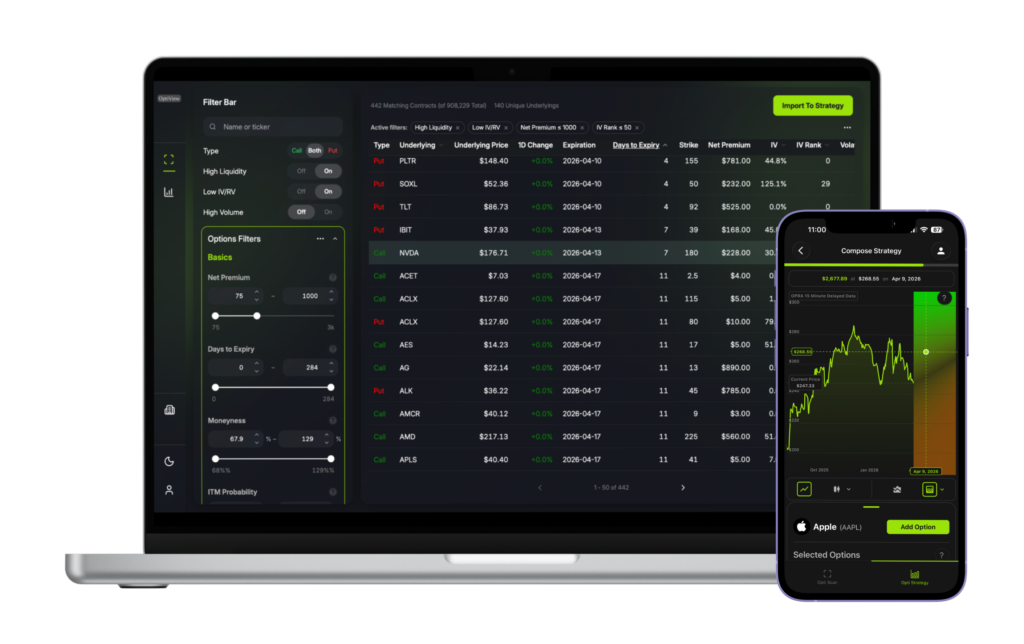
Modern trading platforms and analytical tools make it easier to evaluate strategies before executing trades. Advanced scanners and options analysis tools can help traders compare setups, analyze risk, and identify opportunities based on market conditions.
Platforms like Opti-View provide features designed to help traders study options strategies, evaluate potential outcomes, and make more informed decisions.
Using technology alongside proper research can help reduce emotional trading and improve strategy development.
Tips for Building Better Options Strategies
To improve your options trading process:
- Always calculate potential profit and loss before entering a trade.
- Understand the impact of volatility and time decay.
- Avoid risking more than you can afford to lose.
- Test different strategies using payoff analysis.
- Review trades regularly to improve future decisions.
A disciplined approach is often more valuable than simply predicting whether a market will rise or fall.
Frequently Asked Questions About Options Payoff
What does options payoff mean?
Options payoff refers to the profit or loss generated from an options position based on the price of the underlying asset at a specific time.
How do traders calculate options payoff?
Traders calculate payoff by considering the option premium, strike price, and final asset price. The result shows whether the position creates a profit or loss.
Is an options payoff diagram useful for beginners?
Yes. Payoff diagrams make complex strategies easier to understand by visually showing possible gains, losses, and breakeven points.
Can options payoff predict future profits?
No. Payoff analysis does not guarantee profits. It only shows possible outcomes based on different market scenarios.
Why should traders analyze payoff before buying options?
Analyzing payoff helps traders understand risk exposure, potential returns, and whether a strategy matches their trading goals.
Conclusion: Make Smarter Decisions With Options Payoff Analysis
Understanding options payoff is a key part of becoming a more confident and disciplined options trader. It helps investors evaluate risk, compare strategies, and prepare for different market scenarios before committing capital.
Instead of relying on assumptions, traders can use payoff analysis to create structured plans and improve their decision-making process. Whether you are exploring simple calls and puts or advanced multi-leg strategies, understanding potential outcomes is an important step toward better trading.
Start analyzing your strategies, explore different possibilities, and use reliable tools to make more informed options trading decisions.