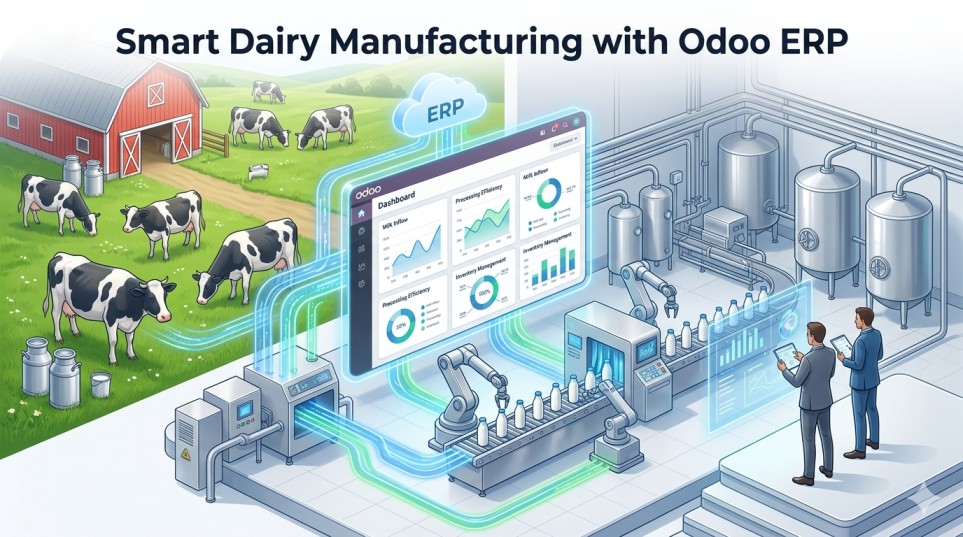

The dairy industry is one of the most demanding sectors to manage. Milk doesn’t wait. It spoils, fluctuates in quality, moves through multiple hands, and touches dozens of processes before it reaches a customer’s fridge. For dairy businesses still relying on spreadsheets, paper registers, or disconnected software, the pressure of scaling while staying profitable is becoming harder every year.
This is where a proper Odoo dairy manufacturing ERP changes the game. It brings procurement, processing, quality control, inventory, and distribution onto a single platform, giving dairy owners real visibility and real control over operations that were previously impossible to track in real time.
What Is Odoo for Dairy Manufacturing?
Odoo is an open-source, modular ERP platform that can be tailored to the exact needs of a dairy business. Unlike generic ERPs built for manufacturing in general, Odoo can be configured and extended to handle the unique workflows of a dairy, from morning milk collection at village centers to cold-chain delivery of finished products.
Think of it as a central nervous system for your dairy. Every farmer entry, every batch processed, every litre dispatched, and every invoice raised flows through one connected system. No more switching between tools, no more reconciliation headaches at month-end.
Key Challenges the Dairy Industry Faces Today
Before understanding the solution, it helps to look honestly at the problems most dairies deal with daily:
- Perishability: Milk has a short shelf life, leaving no room for delays or inefficiencies.
- Fluctuating supply: Farmer collections vary by season, weather, and cattle health.
- Quality variation: Fat and SNF levels differ from one farmer to another, affecting pricing and final product quality.
- Complex procurement: Thousands of small farmers, each with different rates, advances, and loyalty balances.
- Traceability pressure: Regulators and customers increasingly demand to know where their milk came from.
- Distribution complexity: Route planning, subscription deliveries, and last-mile logistics are hard to manage manually.
- Thin margins: Every inefficiency directly eats into profitability.
For a dairy processing even 10,000 litres a day, managing this with notebooks and Excel sheets is no longer realistic.
How Odoo Solves These Challenges
A well-implemented Odoo ERP for dairy industry workflows addresses these issues by automating and connecting every stage of the operation. Instead of relying on staff memory or fragmented records, everything is captured digitally the moment it happens.
Farmer collections, fat testing, payments, production batches, quality checks, dispatch, and accounting all talk to each other. When a batch fails quality testing, the system immediately flags which farmers contributed to it, which products were affected, and which customers need to be notified. That level of traceability simply isn’t possible without integrated software.
Core Features of Odoo Dairy ERP
Here’s how the system supports each critical area of a dairy business.
1. Milk Procurement Management
Every morning and evening collection at village centers can be recorded digitally, with automatic fat and SNF-based rate calculations. Farmer ledgers update instantly, and payment cycles become transparent. No disputes, no missing entries.
2. Production and Processing
From pasteurization to homogenization, standardization, and packaging, each production stage is tracked batch by batch. Raw material consumption, wastage, and output yields are recorded automatically, helping plant managers spot inefficiencies quickly.
3. Quality Control
Quality checks happen at multiple points, incoming milk, during processing, and before dispatch. Odoo lets you define quality parameters, log test results, and block substandard batches from moving forward. This is critical for compliance and brand reputation.
4. Inventory and Cold Storage Management
Dairy products need strict temperature control. The ERP tracks stock levels, expiry dates, storage zones, and movement in real time, reducing spoilage and ensuring FIFO dispatch.
5. Supply Chain and Distribution
Whether you run direct home delivery, retail distribution, or wholesale supply, Odoo helps plan routes, manage subscriptions, handle returns, and track driver performance. Customers get consistent deliveries, and the business gets clean records.
6. Financial Management
All transactions, farmer payments, customer invoices, expenses, tax filings, are integrated with the accounting module. Month-end reconciliation that used to take days gets done in hours.
Benefits of Using Odoo in Dairy Manufacturing
The advantages go beyond just automation. A properly deployed dairy management ERP system delivers real business outcomes:
- Complete traceability from farmer to final customer
- Reduced spoilage and wastage through better inventory control
- Accurate farmer payments based on real quality data
- Faster production cycles with real-time visibility
- Stronger compliance with food safety and regulatory standards
- Better cash flow management through integrated accounting
- Data-driven decisions using built-in reports and dashboards
- Scalability as your dairy grows from one plant to multiple locations
These benefits compound over time. What starts as better record-keeping eventually becomes better forecasting, better pricing, and better profitability.
A Real-World Scenario
Consider a mid-sized dairy in Gujarat that collects milk from around 1,200 farmers across 40 villages, processes about 25,000 litres a day, and supplies packaged milk, curd, and ghee to retailers across three districts.
Before moving to Odoo, their biggest pain was reconciliation. Collection registers from village centers reached the office two days late. Fat testing was done manually and often disputed by farmers. Production losses were hard to track because raw material entries didn’t match batch outputs. Distribution was managed through phone calls and handwritten challans.
After implementing a customized Odoo setup, collection data started flowing in real time through tablets at each center. Farmers received SMS updates about their daily litres and fat percentages. Production batches were linked directly to procurement data, so wastage could be tracked down to the shift level. Dispatch became route-optimized, and retailers began getting consistent delivery windows.
Within six months, the dairy reduced milk wastage by nearly 18 percent and cut month-end reconciliation time from five days to less than one. That’s the kind of impact the right milk production ERP software can deliver.
Why Customization Matters in Dairy ERP
No two dairies operate exactly alike. Some focus on liquid milk, others on value-added products like paneer, curd, or ghee. Some handle cooperatives with thousands of small farmers, while others source from a handful of large suppliers. A generic ERP, even a powerful one, rarely fits these workflows out of the box.
This is why customization matters. Odoo’s modular architecture makes it possible to adjust features to match specific business needs without rebuilding the entire system. Whether it’s custom fat-SNF pricing formulas, region-specific compliance reports, or integration with milk analyzers and weighing machines, a tailored setup ensures the ERP actually supports how your dairy runs.
Experienced partners like Master Software Solutions help dairy businesses map their existing processes and shape Odoo around them, rather than forcing the business to change how it works.
Conclusion
The dairy industry runs on narrow margins, strict quality standards, and time-sensitive logistics. Managing all of it with disconnected tools is no longer sustainable, especially as customer expectations and regulatory demands keep rising. A well-implemented Odoo for dairy business setup brings the clarity, control, and efficiency that modern dairies need to grow confidently.
If your dairy is planning to scale, improve traceability, or simply stop losing hours to manual work, exploring a dairy-focused Odoo implementation is a conversation worth having with an experienced ERP partner.
Frequently Asked Questions
1. Can Odoo handle both small cooperatives and large dairy plants? Yes.
Odoo’s modular structure allows it to scale from small collection centers managing a few hundred farmers to large processing plants handling multiple product lines and distribution networks. Features can be enabled gradually as the business grows.
2. How long does it typically take to implement Odoo for a dairy business?
For a mid-sized dairy, a standard implementation usually takes between 8 and 16 weeks, depending on customization needs, data migration complexity, and the number of modules involved. Phased rollouts often work best.
3. Does Odoo support integration with milk analyzers and weighing machines?
Yes. With proper customization, Odoo can integrate with milk analyzers, electronic weighing systems, and fat testing equipment, allowing data to flow directly into the ERP without manual entry.