
Introduction
In today’s competitive business environment, Indian organizations are under increasing pressure to improve quality, strengthen customer confidence, and demonstrate operational excellence. As a result, many businesses are turning to international management system standards to achieve these goals. The term ISO India has therefore become a common way to describe the complete certification journey from selecting the appropriate standard to implementing a management system and maintaining certification over the long term.
Unlike the past, certification is no longer viewed as merely a marketing tool. Instead, it has evolved into a strategic business investment that helps organizations improve efficiency, manage risks, and gain access to new markets. Furthermore, customers, regulators, investors, and supply chain partners increasingly expect businesses to operate according to internationally recognized frameworks.
Whether an organization aims to expand internationally, improve internal processes, or strengthen its reputation, ISO certification can provide substantial benefits. However, achieving those benefits requires commitment from leadership, employee involvement, and a focus on continual improvement. This guide explains what ISO India means in practice, why certification matters more than ever, and how organizations can successfully navigate the certification process.
What ISO India Really Means
For many businesses, ISO certification is often associated with a certificate displayed in a reception area. In reality, ISO India represents something much more significant. It refers to the process of establishing structured management systems that help organizations consistently meet customer, regulatory, and business requirements.
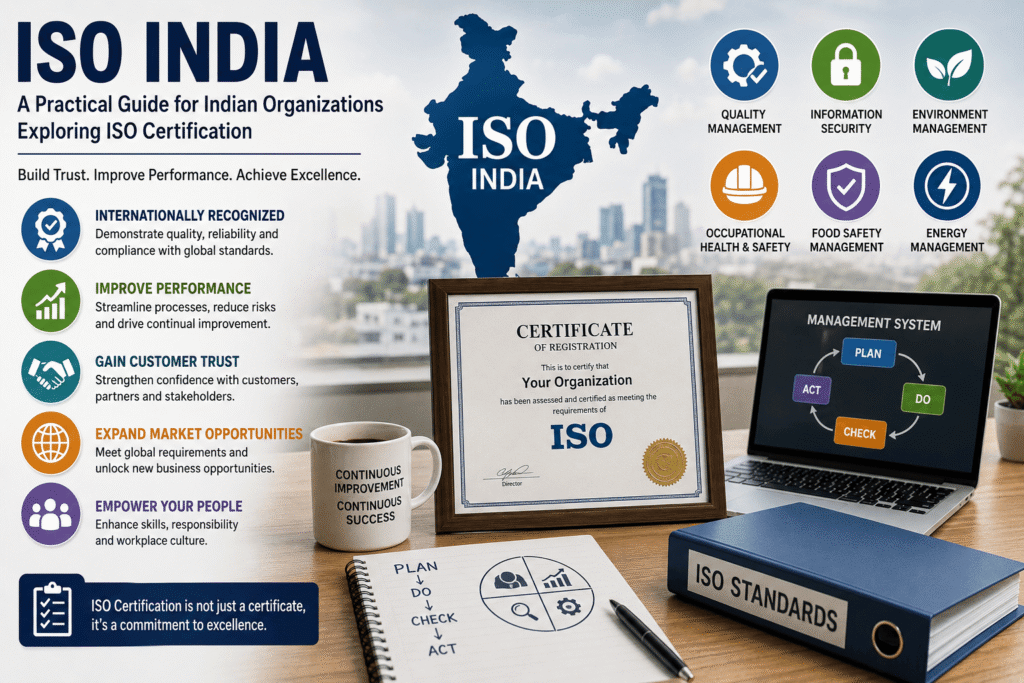
International standards provide a framework for managing various aspects of an organization, including quality, information security, environmental performance, workplace safety, food safety, and energy efficiency. Although the standards define what needs to be achieved, they do not prescribe exactly how an organization should operate. Consequently, each business has the flexibility to design processes that suit its specific needs while still meeting international requirements.
Once the management system has been implemented, an accredited certification body evaluates whether the organization’s processes conform to the selected standard. If the requirements are met, certification is awarded. Therefore, the certificate serves as evidence that the organization has established an effective and systematic approach to managing its operations.
Why ISO Matters for Indian Organizations Today
Business expectations have changed dramatically over the past decade. While product quality and competitive pricing remain important, customers increasingly want assurance that suppliers operate through reliable and well-controlled systems. Consequently, ISO certification has become an important differentiator in many industries.
In addition, global customers frequently use certification as part of their supplier evaluation process. Organizations seeking to expand into international markets often discover that certification improves credibility and creates new business opportunities. Likewise, large domestic enterprises increasingly favor certified suppliers when awarding contracts and long-term partnerships.
Beyond commercial advantages, certification also drives operational improvements. For example, documented procedures help employees perform tasks consistently, while internal audits identify weaknesses before they affect customers. Furthermore, management reviews provide leadership teams with valuable performance data that supports informed decision-making.
Most importantly, ISO standards encourage organizations to adopt a culture of continual improvement. Rather than reacting to problems after they occur, businesses learn to identify risks proactively and implement preventive measures. As a result, certified organizations often experience improvements in efficiency, customer satisfaction, compliance, and overall business performance.
Standards Commonly Pursued by Indian Organizations
Different organizations pursue different standards depending on their industry, objectives, and customer requirements.
Quality Management
Quality management remains one of the most widely adopted standards worldwide. Because it focuses on customer satisfaction and process consistency, it is suitable for organizations across virtually every sector.
Information Security Management
As cyber threats continue to increase, information security has become a priority for many organizations. Therefore, IT companies, financial institutions, and businesses handling sensitive data frequently pursue this certification.
Environmental Management
Organizations seeking to reduce environmental impact often implement environmental management systems. In particular, manufacturers and infrastructure companies benefit from improved compliance and sustainability performance.
Occupational Health and Safety Management
Protecting employees is essential in high-risk industries. Consequently, construction firms, manufacturing plants, and energy companies commonly adopt occupational health and safety standards.
Food Safety Management
India’s growing food and beverage sector increasingly relies on food safety certification to ensure compliance and consumer confidence. Therefore, food manufacturers, processors, distributors, and restaurants frequently pursue this standard.
Energy Management
Organizations looking to reduce energy costs and improve sustainability often implement energy management systems. As a result, they can achieve both environmental and financial benefits.
The ISO Certification Process
Although every organization is unique, the certification journey generally follows a similar path.
Define the Scope
First, the organization determines which products, services, locations, and processes will be covered by the management system. A clearly defined scope ensures that everyone understands the boundaries of certification.
Conduct a Gap Analysis
Next, the organization compares its existing processes against the requirements of the chosen standard. This assessment helps identify strengths, weaknesses, and improvement opportunities.
Develop Documentation
After identifying gaps, policies, procedures, work instructions, and records are developed. However, documentation should always reflect actual business practices rather than idealized processes.
Implement the System
Once documentation is complete, employees begin applying the management system in their daily activities. During this stage, records are generated and evidence of implementation is collected.
Perform Internal Audits
Before certification, trained internal auditors review processes to verify compliance and identify areas for improvement. Consequently, organizations can address issues before the external audit takes place.
Conduct Management Review
Senior leadership must evaluate the effectiveness of the management system. Therefore, management review meetings examine audit results, performance indicators, customer feedback, risks, and opportunities.
Certification Audit
An accredited certification body conducts the external audit in two stages. First, auditors review documentation and readiness. Subsequently, they evaluate the effectiveness of implementation throughout the organization.
Achieve Certification
Following successful completion of the audit and closure of any nonconformities, certification is granted. Nevertheless, certification marks the beginning rather than the end of the improvement journey.
Common Challenges and How to Avoid Them
Many organizations encounter similar challenges during implementation. Fortunately, these issues can be avoided with proper planning.
One common mistake is creating documentation that does not reflect actual operations. Consequently, employees struggle to follow procedures and auditors quickly identify inconsistencies.
Another challenge involves treating certification as a one-time project. In reality, management systems require continuous attention, monitoring, and improvement.
Furthermore, some organizations underestimate the importance of leadership involvement. Without active management support, implementation efforts often lose momentum.
Finally, selecting a certification body based solely on price can create long-term problems. Therefore, organizations should always verify accreditation and industry experience before making a decision.
Sustaining Certification Over the Long Term
Achieving certification is only the beginning of the journey. To maintain compliance and maximize value, organizations must continuously improve their management systems.
Regular internal audits help identify opportunities for improvement before external audits occur. Likewise, management reviews ensure that leaders remain engaged and informed about system performance.
In addition, employee training should be updated regularly to reflect process changes and emerging risks. Corrective actions must also be tracked carefully to ensure issues are resolved effectively.
When organizations embed these activities into their normal operations, certification becomes a business advantage rather than an administrative burden.
Conclusion
For Indian organizations, ISO certification represents much more than a certificate on the wall. Instead, it provides a structured framework for improving quality, reducing risks, increasing customer confidence, and driving continual improvement.
As competition continues to intensify across domestic and international markets, businesses that invest in robust management systems are better positioned for long-term success. Furthermore, certification can strengthen credibility, support business growth, and improve operational performance.
Ultimately, the greatest value of ISO India lies not in the certificate itself but in the disciplined management practices that support it. Organizations that embrace this mindset often discover that certification becomes a catalyst for sustainable growth, stronger customer relationships, and lasting competitive advantage.