
Your cat decided your leather sofa, jacket, or bag was a scratching post. It happens. And before you resign yourself to expensive repairs or a replacement, there is a simple kitchen ingredient that genuinely helps with surface-level cat scratches: olive oil.
This guide explains how to use olive oil on cat-scratched leather properly, what kind of damage it actually fixes, and what you should do when the scratches are too deep for a home remedy.
Does Olive Oil Actually Work on Cat Scratches?
Yes — for light surface scratches. Olive oil works by penetrating the top layer of the leather, rehydrating the fibers and making the scratch less visible. It does not fill the scratch or bond to the leather in any structural way. What it does is restore some of the natural oils that were disrupted when the surface was scuffed.
A few things worth knowing before you start:
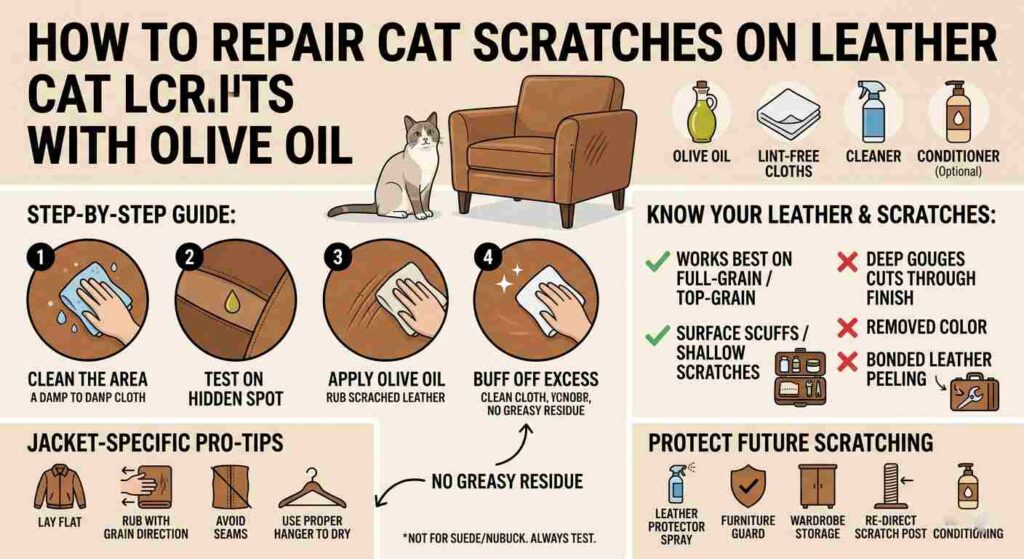
- Olive oil works best on full grain and top grain leather where the hide is intact
- Light scuff marks and shallow scratches respond well — deep gouges that cut through the hide do not
- Olive oil can slightly darken leather temporarily — always test on a hidden area first
- It is not a permanent fix on its own for scratches that have lifted or removed color from the surface
- Most cat scratches on leather furniture and jackets are surface-level and fall within the range olive oil can improve
What You Need
- Extra virgin olive oil (standard kitchen grade works fine)
- Two soft, lint-free cloths — one for application and one for buffing
- A mild leather cleaner or damp cloth for the cleaning step
- A leather conditioner to follow up after treatment (recommended but optional)
Step-by-Step: How to Fix Cat Scratched Leather with Olive Oil
Step 1: Clean the scratched area
Before applying anything, clean the surface around the scratches. Dirt and oils from handling can interfere with the olive oil absorbing correctly. Use a mild leather cleaner or a barely damp cloth and wipe gently. Let it dry completely before moving on.
Step 2: Test on a hidden area
Apply a very small amount of olive oil to an inconspicuous spot — the underside of a collar, the inner hem, or the back of a cushion. Wait 10 minutes and check the color. If it darkens significantly and does not recover, proceed cautiously or opt for a dedicated leather conditioner instead.
Step 3: Apply olive oil to the scratches
- Put a few drops of olive oil on your soft cloth — not directly onto the leather
- Rub gently over the scratched area using small circular motions
- Work the oil into the scratch itself by pressing lightly and moving along the length of the mark
- Do not over-apply — a thin layer is more effective than a heavy coat
- Let it sit for 10 to 15 minutes to absorb into the leather fibers
Step 4: Buff off the excess
Use a clean dry cloth to buff off any remaining oil. Leaving too much olive oil on the surface attracts dust and can leave a greasy residue. The leather should feel soft and slightly nourished, not slick.
Step 5: Follow up with a leather conditioner
Olive oil is a temporary measure. A proper leather conditioner after the olive oil treatment helps seal the result and protects the area from future damage. Apply evenly across the whole surface, not just the scratched section, for consistent finish.
Cat Scratches on a Leather Jacket: Special Considerations
A leather jacket has different surface characteristics than a sofa or bag. Jackets flex constantly during wear, which means a poorly repaired scratch can crack and reopen with movement. The olive oil method works well for surface scuffs on jackets, but for anything deeper, a dedicated repair kit is more reliable. Leather Jacket Black has a detailed guide on how to fix scratched leather by cat on jackets at home, covering both olive oil and repair compound approaches depending on the scratch depth.
When treating cat scratches on a jacket specifically:
- Work with the jacket flat on a surface, not while wearing it — you need even pressure across the scratch
- Pay attention to the grain direction and rub with it, not against it
- Areas near seams or stitching need lighter application — oil can seep into stitching and weaken thread over time
- Let the jacket dry hanging on a proper hanger before wearing to avoid creasing the treated area
When Olive Oil Is Not Enough
Not every cat scratch is a surface scuff. If the damage is more serious, olive oil will not do much and you need a different approach.
- Scratches that have completely removed the surface color need leather dye or a color repair kit matched to the leather shade
- Deep cuts that penetrate through the finish into the raw hide need leather filler before any conditioning
- Multiple overlapping scratch lines across a large area may benefit more from a full leather repair kit than olive oil alone
- Bonded or genuine leather that is already showing signs of peeling will not respond to olive oil and typically needs professional assessment
- Approximately 70% of cat scratch cases on full grain or top grain leather respond positively to the olive oil method
How to Protect Leather from Future Cat Scratching
- Apply a leather protector spray with a surface sealant — this creates a harder top layer cats find less satisfying to scratch
- Use double-sided tape or furniture scratch guards on corners and edges — areas cats target most often
- Store leather jackets in a wardrobe with the door closed rather than draped on chairs or racks cats can reach
- Keep cat scratch posts near leather furniture to redirect scratching behavior
- Regular conditioning keeps leather supple — well-conditioned leather shows scratches less severely than dry, brittle surfaces
Frequently Asked Questions
Can olive oil remove deep cat scratches from leather?
No. Olive oil works on surface-level scuff marks by rehydrating the leather and reducing the contrast of the scratch. Deep cuts that go through the finish layer or into the raw hide need a leather filler compound, color repair, or a professional. Olive oil will not fill structural damage.
Will olive oil darken my leather permanently?
It may cause temporary darkening that fades as the oil absorbs fully. The effect is more noticeable on lighter-colored leather. Always test on a hidden area first. If permanent darkening is a concern, use a clear leather conditioner instead — it provides similar nourishing benefits with less color impact.
How many times can I apply olive oil to the same scratch?
One to two applications is usually enough. If the scratch is still visible after two rounds, olive oil has done what it can and a repair kit or professional help is the next step. Over-applying olive oil can leave a greasy buildup that attracts dust and may affect the leather’s surface finish over time.
Is olive oil safe for all types of leather?
It is generally safe for full grain and top grain leather. Use caution on suede and nubuck — olive oil will stain these surface types and the damage is very difficult to reverse. For patent leather or heavily coated leather, a dedicated leather care product is always a safer choice.
My cat keeps scratching the same spot. Will repair last?
Not if the behavior continues. Any repair — olive oil, conditioner, or filler — is undone the moment a cat scratches the same area again. Repair and protection go together. Use a leather protector spray after treatment and address the scratching behavior with redirecting tools like a dedicated scratch post placed near the item.
Final Thoughts
Olive oil is a practical, low-risk first step for cat scratches on leather. It is not magic and it does not work on everything — but for the surface scuffs that make up most cat damage, it does a surprisingly good job at reducing visibility and restoring some suppleness to the area.
Clean the area, test first, apply lightly, buff off the excess, and follow up with a conditioner. That sequence gives you the best result with the lowest risk of making things worse.