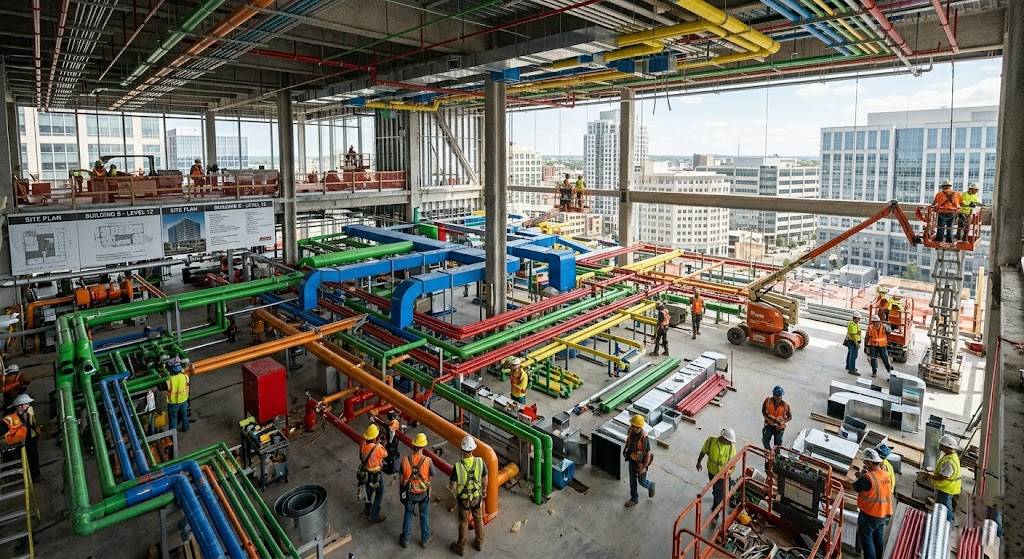

On-site coordination errors in MEP construction are expensive, time-consuming, and all too common. In the United States construction industry, rework caused by clashes between MEP systems and structural components costs billions of dollars each year. The growing adoption of MEP shop drawing services powered by Revit is helping MEP engineers, BIM coordinators, general contractors, and subcontractors dramatically reduce these errors before a single wrench is turned on the job site.
The Real Cost of MEP Coordination Errors on US Construction Projects
According to Autodesk research, poor project data and coordination failures account for a significant portion of rework costs on US construction projects. On large commercial, healthcare, and industrial projects, MEP systems often occupy the same building zones as structural beams, ceilings, and architectural elements. Without proper coordination, subcontractors arrive on site only to find that HVAC duct routing conflicts with a steel beam, or a plumbing riser clashes with a conduit run.
The downstream consequences include schedule delays, cost overruns, change orders, and damaged relationships between trades. Revit modeling services help resolve these conflicts before they reach the field.
How Revit MEP Shop Drawings Reduce On-Site Coordination Errors
Clash Detection Before Construction Begins
The most powerful advantage of using Revit for MEP coordination in BIM is automated clash detection. When all MEP disciplines are modeled in a shared Revit environment or federated using Autodesk Navisworks, Building Information Modeling software can identify hard clashes (physical intersections), soft clashes (clearance violations), and workflow clashes (sequencing conflicts) across all systems simultaneously.
BIM coordinators and BIM managers can run clash detection reports at multiple stages of design development, resolving conflicts in the digital model before subcontractors mobilize. A single resolved clash in BIM can prevent thousands of dollars in rework on site.
Accurate HVAC Duct Routing and Spatial Coordination
HVAC duct routing is one of the most spatially demanding aspects of MEP coordination. Ductwork must navigate around structural members, beams, and ceiling systems while maintaining code-required clearances and maintaining access for maintenance. Revit allows HVAC engineers and BIM modelers to plan exact duct paths in 3D, accounting for fittings, transitions, and offsets.
The resulting shop drawings show exact elevations, offsets, hanger spacing, and connection details, giving sheet metal subcontractors the information they need to prefabricate ductwork accurately. Prefabricated duct sections built to Revit-based shop drawings fit together on site with minimal adjustment, reducing installation time and errors significantly.
Multi-Trade Coordination in Tight Building Spaces
In US commercial construction, mechanical rooms, ceiling plenums, and corridor ceiling spaces are shared by multiple MEP trades at once. Plumbing pipes, electrical conduit, fire protection sprinkler mains, and HVAC ductwork all compete for the same limited overhead space. MEP coordination in BIM enables each trade to see exactly where the other systems run, so installation priorities and clearances are agreed upon before work begins.
General contractors benefit directly from this process. By requiring subcontractors to submit Revit-coordinated shop drawings before mobilization, GCs can enforce coordination standards, reduce trade conflicts, and maintain more predictable project schedules.
Prefabrication Support and Reduced Field Labor
One of the most tangible benefits of Revit-based shop drawings is support for off-site prefabrication. When ductwork, piping assemblies, or electrical conduit runs are modeled accurately in Revit, fabrication drawings can be produced directly from the model with dimensions verified against the coordinated design.
Prefabricated MEP assemblies arrive on site ready to install, which reduces the amount of cutting, fitting, and field modification required. This directly reduces the chance of on-site errors introduced by improvised work, while also improving site safety and labor efficiency.
Coordination Drawings That Every Trade Can Understand
Revit MEP shop drawings are produced in clear, standardized drawing sets that foremen and field installers can read on the job site without ambiguity. Section views, isometric drawings, enlarged plan views, and spool drawings extracted from the Revit model give installers complete spatial context.
For BIM engineers and BIM modelers, the ability to produce multiple drawing types from a single Revit model is a significant productivity advantage. Any change to the model is instantly reflected in all associated drawings, eliminating the risk of outdated or inconsistent drawing sets being used in the field.
BIM for General Contractors: Managing Risk Through MEP Coordination
For general contractors managing large US construction projects, BIM for General Contractors increasingly a contractual requirement and a risk management strategy. Owners and construction managers specify BIM execution plans that require all trade subcontractors to participate in model coordination before work begins.
When Revit modeling services are used across all MEP trades and coordinated through a common BIM platform, the GC gains a verified, coordinated model that serves as the single source of truth for installation. This reduces RFIs, speeds up submittal approvals, and gives the project team confidence that the design will be buildable as drawn.
Choosing the Right Revit Modeling Services for Your MEP Project
Not all Revit modeling services are equal. MEP-focused BIM firms with US construction experience understand local code requirements, trade coordination standards, and project delivery workflows. When evaluating a service provider, look for the following capabilities:
- Expertise in Revit MEP modeling for mechanical, electrical, and plumbing systems
- Experience with Navisworks clash detection and BIM coordination workflows
- Ability to produce fabrication-ready shop drawings for sheet metal, piping, and electrical trades
- Familiarity with US project delivery methods including design-build, IPD, and GMP contracts
- Track record on commercial, healthcare, industrial, and institutional projects in the US market
Conclusion
Revit MEP shop drawings represent a proven, practical approach to eliminating the coordination errors that drive up costs and delay schedules on US construction projects. By investing in quality MEP shop drawing services early in a project, MEP engineers, BIM coordinators, general contractors, and subcontractors all benefit from fewer surprises in the field, more efficient installations, and stronger collaboration across trades.
In a construction market where every dollar and every day matters, Revit-based MEP coordination in BIM is not a luxury. It is a fundamental component of delivering high-quality, on-time, on-budget projects.