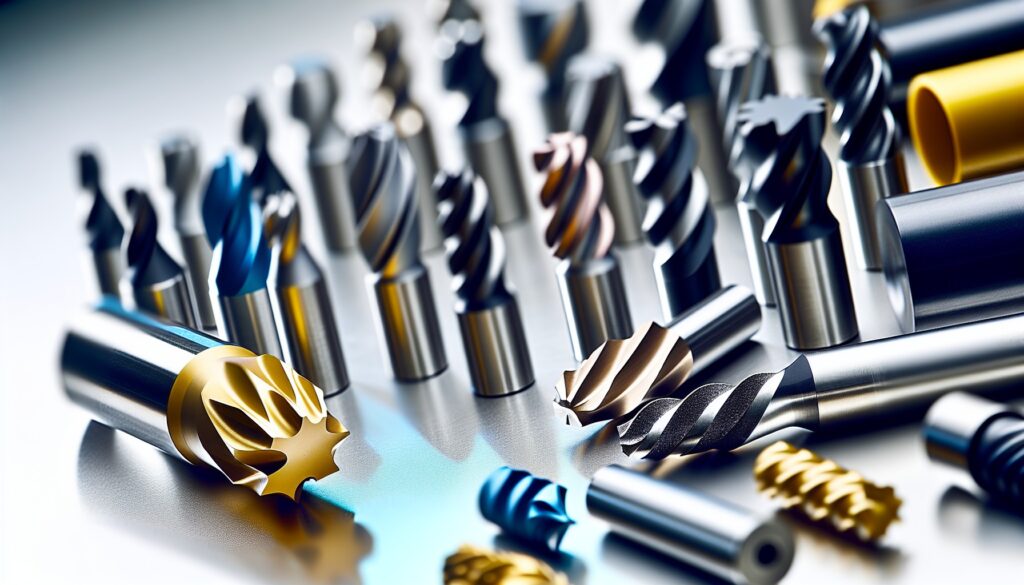

Cutting tools operating at elevated speeds and without coolant face extreme thermal and mechanical stress. As spindle speeds increase and coolant is removed from the equation, the coating on the tool becomes the primary line of defense against premature wear, edge breakdown, and adhesive buildup. Selecting the right high-performance coatings for these conditions requires matching hardness, oxidation resistance, and thermal stability to the specific demands of the cut.
Why Dry And High-Speed Machining Demands More From A Coating
In conventional machining, coolant dissipates heat and flushes chips from the cutting zone. Remove coolant, and temperatures at the tool-chip interface can exceed 800°C during aggressive cuts in steels, superalloys, and hardened materials. At these temperatures, general-purpose coatings like TiN (max working temp 600°C, HV 2,400) begin to oxidize and lose hardness. The result: accelerated flank wear, built-up edge, and shortened tool life that drives up cost per part.
High-speed machining compounds the problem. Faster feed rates generate more heat per unit of time, and the coating must maintain its protective properties through sustained thermal cycling. This is where performance coatings engineered for oxidation resistance and thermal stability make a measurable difference.
Three Coatings Built For The Heat
AlTiN (Aluminum Titanium Nitride)
AlTiN is a widely specified PVD coating for dry and high-speed operations. With a hardness of 3,400–3,600 HV and a max working temperature of 700°C (1,300°F), it forms a thin aluminum oxide layer at elevated temperatures that improves its protective properties during cutting. AlTiN performs well on carbide end mills, drills, and inserts used in steels and copper alloys. For many shops, it represents the first meaningful step up from TiN or TiCN when transitioning to reduced-coolant or dry strategies.
AlTiSiN (Aluminum Titanium Silicon Nitride)
AlTiSiN takes the aluminum-based approach further with a nano-composite structure that reaches 4,500 HV and a max working temperature of 1,200°C (2,200°F). This makes it one of the hardest commercially available high-performance coatings for cutting applications. It excels in dry milling of hardened steels, aerospace superalloys, and abrasive materials like glass-filled plastics. The silicon content in the nano-structure improves hot hardness retention, meaning the coating resists softening even under sustained thermal load.
nACO (TiAlSiN-Based Proprietary Coating)
nACO shares AlTiSiN’s extreme hardness (4,500 HV) and temperature ceiling (1,200°C / 2,200°F) but is formulated for broader substrate compatibility across steels, alloys, hardened steels, and cast iron. It is categorized as an “extremely high hardness” coating and is well-suited to both dry milling and high-speed operations where the tool encounters varying material hardness within the same production run.
How To Choose Between Them
Coating selection depends on the specific application, substrate, and cutting conditions. The following comparison highlights the key differentiators:
- AlTiN (HV 3,400–3,600 | COF 0.60 | Max 700°C): Best general-purpose option for shops moving to dry or high-speed machining on steels. Good balance of hardness and availability.
- AlTiSiN (HV 4,500 | COF 0.45 | Max 1,200°C): Best for the most demanding cuts — hardened steels above 50 HRC, nickel-based superalloys, and abrasive composites where heat and wear peak simultaneously.
- nACO (HV 4,500 | COF 0.45 | Max 1,200°C): Best when the production mix includes multiple material types and the shop requires one coating that performs across varying conditions without frequent changeovers.
For operations cutting titanium or Inconel specifically, VOLT (HV 2,900, max 500°C) is another option worth evaluating, as its formulation targets the adhesive wear patterns common with these sticky alloys.
What This Means For Your Operation
Switching from a general-purpose coating to an application-matched performance coatings strategy does more than extend tool life. It reduces the number of tool changes per shift, lowers scrap rates from premature edge failure, and can eliminate coolant costs and the maintenance burden that comes with coolant management systems.
The key is working with a coating partner that provides data-backed recommendations rather than defaulting to a single coating for every job. When hardness values, COF, and max working temperatures are matched to your actual cutting conditions, the coating works with the process instead of limiting it. That alignment is where measurable gains in tool life and cost per part begin.