
Modern fisheries monitoring programs generate data at scales that would have been unimaginable two decades ago. A single mid-sized salmon monitoring program operating across a networked detection system may accumulate millions of individual detection records annually — each carrying timestamp, location, tag identity, and environmental metadata that must be stored, validated, analyzed, and reported in formats satisfying multiple regulatory frameworks simultaneously.
The challenge is not merely storing this data. It is transforming raw detection records into actionable scientific intelligence while simultaneously satisfying compliance reporting requirements from federal agencies, tribal governance bodies, international treaty organizations, and research grant administrators — each demanding different data formats, different analytical summaries, and different reporting timelines.
Without purpose-built management tools, this data transformation burden falls on research personnel who spend more time manipulating spreadsheets than conducting science. Critical compliance deadlines are missed. Analytical errors introduced during manual data processing compromise report credibility. And the longitudinal datasets that represent years of field investment remain locked in formats too disorganized to support the sophisticated analyses that conservation decisions require.
Modern fisheries software designed for monitoring and compliance management addresses these challenges systematically — automating data transformation, enforcing quality control, generating compliance reports, and unlocking analytical capabilities that manual data management approaches cannot achieve. Understanding what separates genuinely effective fisheries software from inadequate alternatives is essential for any program where data complexity is growing faster than administrative capacity.
The Compliance Landscape: Why It Has Become So Complex
Multiplying Regulatory Frameworks
Fisheries monitoring programs operating in the contemporary regulatory environment must satisfy compliance requirements from multiple overlapping authorities simultaneously. In the United States alone, a salmon monitoring program may face reporting obligations under the Endangered Species Act administered by NOAA Fisheries, the Clean Water Act administered by the EPA, hydropower licensing conditions administered by the Federal Energy Regulatory Commission, tribal co-management agreements administered under treaty rights, and state fish and wildlife regulations administered by multiple state agencies.
Each regulatory framework specifies different data elements, different reporting frequencies, different analytical methods, and different submission formats. A program managing compliance obligations across five regulatory frameworks without dedicated fisheries software typically assigns 20–30% of available research personnel time to compliance reporting alone — time diverted from the field work and analysis that produces the scientific value the program exists to generate.
Increasing Data Volume and Complexity
The widespread adoption of PIT tagging and automated detection networks has dramatically increased both the volume and complexity of data that compliance reports must synthesize. Regulatory agencies increasingly require individual-level detection data rather than aggregate population summaries — demanding that compliance submissions include complete detection histories for tagged cohorts rather than simple passage count totals.
This shift toward individual-level compliance reporting makes manual data compilation approaches not merely inefficient but practically impossible at meaningful program scales. A compliance report requiring individual detection histories for 50,000 tagged fish across 20 detection sites over a 12-month period contains data volumes that no spreadsheet-based workflow can process reliably.
International Coordination Requirements
Programs monitoring diadromous species that cross national boundaries face additional compliance complexity from international treaty frameworks. Atlantic salmon programs must satisfy reporting requirements from the North Atlantic Salmon Conservation Organization. Pacific salmon programs operating under the Pacific Salmon Treaty must coordinate data submissions between United States and Canadian management authorities. These international compliance obligations add jurisdictional complexity that program-specific national compliance management tools cannot adequately address.
Core Functions That Effective Fisheries Software Must Deliver
Automated Data Ingestion and Validation
The foundation of effective fisheries software is automated data ingestion — the ability to receive detection records directly from field equipment, validate them against quality control rules, and load them into the program database without manual intervention at any stage of the process.
Automated validation at ingestion applies rules including:
- Duplicate detection screening — identifying records where the same tag appears at the same reader within physically impossible inter-detection intervals
- Impossible location checks — flagging records where tag movement between detection sites exceeds species-specific maximum swimming speed
- Metadata completeness verification — ensuring all required data fields are populated before records are accepted into primary database tables
- Antenna performance monitoring — comparing incoming detection rates against historical baselines to identify equipment malfunction signatures
Programs that implement automated ingestion and validation consistently achieve higher data quality standards than those relying on manual review — particularly as detection volumes scale beyond the practical capacity of individual data managers to audit comprehensively.
Survival Rate Estimation and Population Modeling
The analytical core of most fisheries monitoring programs is survival rate estimation — calculating the probability that individual fish survive between successive detection points in the monitoring network. These calculations require sophisticated statistical methods, including Cormack-Jolly-Seber mark-recapture models and their derivatives, that are mathematically complex and computationally intensive when applied to large individual-level datasets.
Effective fisheries software implements these analytical methods in automated pipelines that apply consistent model specifications across multiple cohorts, time periods, and detection site combinations — producing survival estimates with associated confidence intervals and goodness-of-fit statistics that meet peer-reviewed publication standards.
Manual implementation of these analytical methods in general-purpose statistical software requires substantial statistical expertise and produces results that are difficult to audit, replicate, or update when new detection data arrives. Purpose-built fisheries software encapsulates statistical best practices in reproducible automated workflows that research staff with limited statistical programming backgrounds can operate reliably.
Compliance Report Generation
Purpose-built fisheries software transforms the compliance reporting burden from a labor-intensive manual compilation process into an automated generation workflow. Predefined report templates aligned with specific regulatory framework requirements — ESA Section 7 biological opinion reporting, hydropower license condition compliance, tribal co-management data sharing agreements — can be populated automatically from the program database and generated on user-defined schedules without manual data compilation.
Automated compliance report generation eliminates the transcription errors that plague manual reporting processes, ensures consistent application of regulatory-specified analytical methods across reporting periods, and maintains complete audit trails that document the data sources and computational methods underlying each submitted figure.
Data Visualization and Exploration
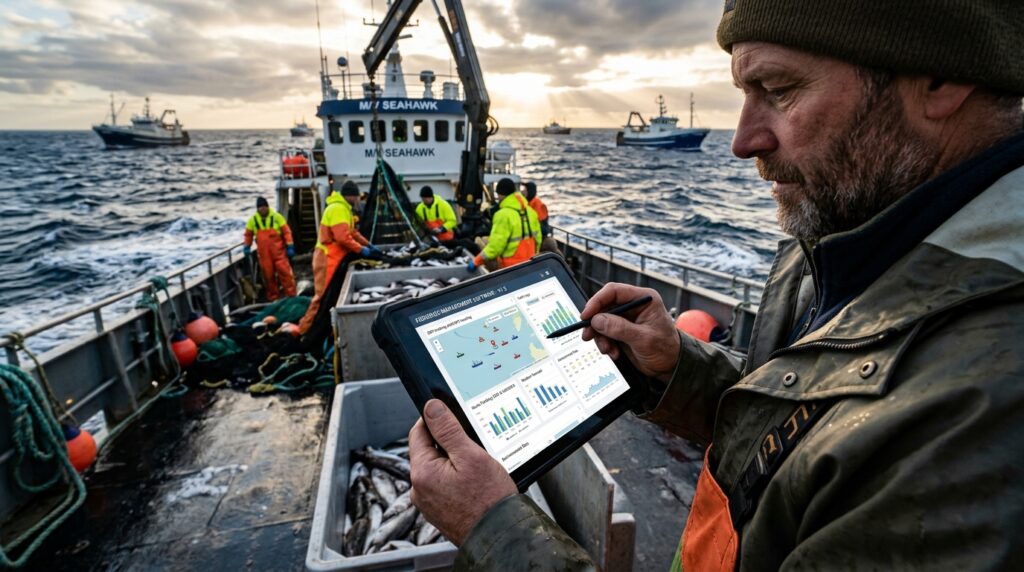
Beyond formal compliance reporting, effective fisheries software provides interactive data visualization tools that allow research staff to explore detection datasets, identify unexpected patterns, and generate analytical summaries for internal review without requiring database query programming skills.
Interactive migration timing visualizations, spatial detection mapping, cohort comparison dashboards, and anomaly detection displays transform raw detection records into interpretable scientific intelligence that informs adaptive management decisions in real time — rather than waiting for formal annual report compilation cycles.
Integration Capabilities: Connecting Fisheries Software to the Broader Monitoring Ecosystem
Hardware Integration
Effective fisheries software integrates directly with field detection hardware — RFID tag readers, environmental sensors, and data transmission systems — through standardized communication interfaces that eliminate manual data transfer steps. Direct hardware integration ensures that detection records flow from field equipment to the program database continuously, without accumulating in local reader memory where storage failures can cause permanent data loss.
Hardware integration also enables bidirectional communication — allowing fisheries software to push configuration updates to networked readers, retrieve real-time equipment status information, and trigger automated alerts when hardware performance metrics indicate developing equipment issues.
Environmental Data Integration
Fish behavior and survival are strongly influenced by environmental conditions — water temperature, flow rate, dissolved oxygen, and turbidity all affect migration timing, route selection, and physiological stress. Fisheries software that integrates environmental sensor data with detection records enables researchers to correlate individual fish behavior with concurrent environmental conditions — analyses that reveal climate-driven behavioral shifts invisible to detection-only datasets.
Integration with national environmental data networks — including USGS stream gauge networks, NOAA oceanographic monitoring programs, and state water quality monitoring systems — extends environmental context beyond program-specific sensor deployments, enriching analytical capabilities without proportionally increasing monitoring infrastructure costs.
GIS and Spatial Analysis Integration
Basin-scale fisheries monitoring programs require spatial analytical capabilities that connect detection data to geographic information about river network structure, habitat quality, barrier locations, and land use context. Fisheries software with integrated GIS functionality — or robust export capabilities to standard GIS platforms — enables spatial analyses including habitat use mapping, barrier impact assessment, and migration corridor identification that detection-only analytical approaches cannot support.
VodaIQ, VodaIQ, develops fisheries software solutions with integrated hardware connectivity, environmental data ingestion, and spatial analysis capabilities — providing fisheries programs with a unified data management platform that eliminates the fragmented tool ecosystem that complicates multi-source data integration in complex monitoring programs.
Addressing Multi-Agency Data Sharing Requirements
Standardized Data Exchange
Multi-agency monitoring programs — where detection data is contributed by multiple independent organizations and shared through centralized databases — require fisheries software capable of receiving, harmonizing, and redistributing data in standardized formats that all participating organizations can use.
PTAGIS, the Columbia River Basin’s multi-agency detection database, has developed standardized data submission schemas that participating organizations must follow for detection records to be accepted into the shared database. Fisheries software used by PTAGIS-participating programs must support these submission schemas natively — generating properly formatted submission files automatically rather than requiring manual format conversion that introduces transcription error risk.
Role-Based Data Access Control
Multi-agency programs frequently involve data sharing arrangements where different participating organizations have different access rights to different data subsets. Tribal fisheries programs may have access to detection data from river reaches within their treaty territory that is restricted from public access. Commercially sensitive aquaculture monitoring data may require access restrictions that differ from publicly funded research program data.
Effective fisheries software implements role-based access control systems that enforce data sharing agreements programmatically — ensuring that each user and organization accesses only the data subsets their participation agreements authorize, without requiring manual data filtering by database administrators for each data access request.
Audit Trail Maintenance
Multi-agency data sharing arrangements require comprehensive audit trails that document who accessed which data, when, and for what purpose — both for regulatory compliance and for resolving disputes about data use that may arise between participating organizations.
Fisheries software with integrated audit logging provides complete, tamper-evident records of all data access, modification, and export events — documentation that protects all participating organizations and supports the transparency commitments that publicly funded monitoring programs must maintain.
Scalability: Fisheries Software That Grows With the Program
Handling Growing Detection Volumes
Fisheries monitoring programs typically grow over time — expanding geographic coverage, adding detection sites, tagging more fish annually, and accumulating increasingly large historical datasets. Fisheries software that performs adequately at initial program scale but degrades as data volumes grow creates operational crises at precisely the program maturity phases when analytical capabilities are most needed.
Scalable database architectures — using relational database management systems designed for high-volume transactional data, or cloud-based distributed storage platforms for programs with very large detection volumes — maintain query performance and analytical responsiveness as program datasets grow from millions to tens of millions to hundreds of millions of detection records.
Supporting Evolving Analytical Requirements
Conservation science evolves. Analytical methods considered state-of-the-art at program initiation are superseded by more sophisticated approaches as the field advances. Regulatory reporting requirements change as agencies update their guidance frameworks. Climate change creates new research questions requiring new analytical approaches not anticipated during initial software design.
Fisheries software built on flexible, extensible architectures — with open APIs that support custom analytical module development, configurable report templates that adapt to evolving regulatory requirements, and user-accessible scripting interfaces that allow research staff to implement new analytical methods without vendor-dependent software modification — provides the adaptability that long-running monitoring programs require.
Real-World Impact: Fisheries Software Delivering Results
Columbia River Basin Compliance Management
NOAA Fisheries’ biological opinion compliance monitoring for Columbia River hydropower operations requires annual synthesis of detection data from millions of PIT-tagged juvenile salmon and steelhead across the full Snake and Columbia River migration corridor. Purpose-built database and analytical software maintained by PTAGIS processes this data volume into compliance-grade survival estimates that directly inform annual dam operation decisions — demonstrating the regulatory consequence that effective fisheries software can support.
European Union Eel Regulation Reporting
EU member states obligated to report on silver eel downstream passage under the EU Eel Regulation use national monitoring databases that compile PIT detection records from river barrier monitoring installations across entire national river networks. Fisheries software capable of aggregating these nationally distributed datasets into the standardized reporting formats required by the European Commission enables member states to satisfy international compliance obligations from monitoring programs that would be unmanageable through manual data compilation.
New Zealand Freshwater Fisheries Management
New Zealand’s national freshwater fisheries management framework, administered under the Resource Management Act and the National Policy Statement for Freshwater Management, increasingly requires monitoring data in formats that support quantitative environmental limit setting. Fisheries software that generates population trend analyses and habitat use summaries aligned with these regulatory frameworks supports the evidence-based freshwater management decisions that New Zealand’s legislative framework demands.
Selecting Fisheries Software: Key Evaluation Criteria
Programs evaluating fisheries software options should assess candidates against:
- Detection volume scalability — verified performance benchmarks at data volumes representing the program’s projected ten-year scale
- Regulatory template coverage — pre-built compliance report templates aligned with the specific regulatory frameworks the program must satisfy
- Hardware integration breadth — compatibility with the specific reader and sensor equipment deployed in the program’s monitoring network
- Statistical method implementation — documentation of the survival estimation and population modeling methods implemented, with validation against published benchmark datasets
- Multi-agency data sharing support — role-based access control, standardized exchange format support, and audit logging capabilities
- Vendor support quality — technical support response times, software update frequency, and user community resources
- Total cost of ownership — licensing fees, implementation costs, training requirements, and ongoing support expenses across a realistic multi-year program timeline
Conclusion: Fisheries Software as a Strategic Program Investment
The data management and compliance challenges facing modern fisheries monitoring programs are not administrative inconveniences — they are strategic threats to program effectiveness that grow more severe as monitoring networks expand and regulatory frameworks evolve. Programs that address these challenges with manual workflows and general-purpose tools consume research capacity in data management tasks that should be automated, miss compliance deadlines that undermine regulatory relationships, and fail to extract the analytical value from their detection datasets that conservation decisions require.
Effective fisheries software — purpose-built for the data structures, analytical methods, and compliance reporting requirements of aquatic monitoring programs — transforms the data management burden from a program constraint into a program capability. By automating ingestion, validation, analysis, and compliance reporting, modern fisheries software frees research personnel to focus on the scientific work that generates conservation value, while simultaneously improving the data quality, analytical rigor, and regulatory credibility of program outputs.
In an era when fisheries conservation faces mounting pressure from climate change, habitat degradation, and competing resource demands, the programs that most effectively translate monitoring investment into conservation impact will be those whose fisheries software infrastructure is as carefully designed as their field detection systems.