
Book whale watching in Maui at least 2–4 weeks in advance for the early or late season, and 6–10 weeks ahead if you’re visiting during peak season in January or February. Kayak whale watching and sunrise tours sell out the fastest often 8–10 weeks before the date. The moment your travel dates are confirmed, your tour booking should be the very next thing you do.
Understanding Maui’s Whale Season
Humpback whales begin arriving in Hawaiian waters as early as November, with numbers building through December. The season peaks between mid-January and mid-February, when whale density in the Au’au Channel between Maui and Lanai is at its highest. Activity stays strong through March before the whales begin heading back to Alaska in April.
This means whale watching in Maui isn’t a single narrow window it’s a spectrum. November and early December are quieter, with fewer crowds and easier reservations. January and February are spectacular but intensely competitive. March and April offer a sweet spot of great sightings with slightly more booking flexibility.
How Far in Advance Should You Book?
For November and early December travel, two to three weeks ahead is generally fine. Demand is lower and most reputable whale watching tours in Maui still have availability within that range.
Mid-December is when the holiday surge hits. Book four to six weeks in advance to secure quality options. For January and February peak whale season in Maui standard catamaran tours need six to eight weeks of lead time. Small-group raft tours need eight weeks minimum. And for kayak whale watching, book eight to ten weeks out, no exceptions.
March and April ease back to three to four weeks. Waitlists clear, and last-minute spots occasionally open up that would have been impossible to find in February.
Sunrise departures launching between 6:00 and 7:30 AM are the most sought-after slots because whale surface activity peaks in the early morning. These book 10–12 weeks out during peak season. If a sunrise tour is on your list, it should be the first reservation you make, ahead of restaurants, activities, everything.
Why Whale Watching Tours in Maui Sell Out So Fast
Maui sits at the center of the Hawaiian Islands Humpback Whale National Marine Sanctuary, making it the most productive humpback viewing destination in the United States. The island draws over three million visitors annually, with a large portion timing trips specifically around whale season. Quality operators deliberately cap group sizes to protect both the guest experience and the whales which means total available spots across the island are finite in a way that demand never is.
Kayak whale watching faces an additional layer of scarcity. Paddling operations in whale-active waters are regulated by permit, and only a handful of operators can legally offer the experience. Groups typically run four to eight paddlers at a time. If maui kayak whale watching is on your radar, it needs to be your first booking, full stop.
Which Type of Tour Is Right for You?
Large catamaran and sailing tours carry 60–150 passengers, depart from Lahaina and Ma’alaea harbors, and are the most accessible option for families and first-timers. They’re reliable, well-organized, and run multiple departures daily throughout the season.
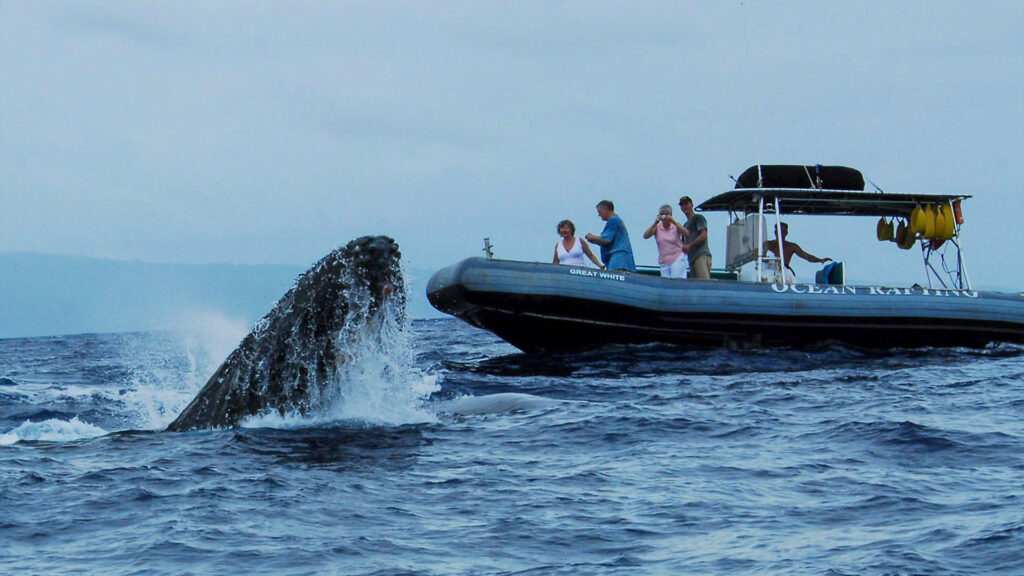
Small-group raft tours carry 6–18 passengers on rigid inflatable vessels that sit low to the waterline. The proximity to the water transforms the experience you feel the ocean, hear it clearly, and encounter whales with a physical immediacy a larger boat simply can’t offer.
Kayak whale watching is where whale watching in Maui reaches its most personal form. You’re at sea level, paddling in near silence through the same water the whales inhabit. There are no engines, no crowds, no PA announcements just the sound of your paddle and, on a calm January morning in the Au’au Channel, the distant exhale of a humpback surfacing nearby. Federal law prohibits approaching whales within 100 yards, so guides position the group in areas of whale activity and let the animals approach on their own terms. The encounters that result often feel far more intimate and genuine than anything a motorized tour can produce.
What Makes a Tour Worth Booking
The presence of a certified marine naturalist is one of the strongest signals of a quality operator. These aren’t just narrators they provide scientific context that turns a sightseeing trip into something genuinely educational. Hydrophone equipment, which lets passengers hear actual whale song underwater while watching the animals at the surface, is another mark of a serious operation.
Beyond that, look at group size caps, cancellation policies, and whether the operator follows responsible wildlife viewing guidelines. Smaller groups almost always mean better experiences. Operators who offer rain-check or refund guarantees are telling you something about their confidence in what they deliver.
Practical Booking Tips
Book directly through the operator rather than a third-party platform availability is more accurate, and you have a direct line if anything needs to change. Get written confirmation immediately and save it. If your preferred tour is sold out, get on the waitlist without hesitation; cancellations during peak season are more common than people expect, and waitlist spots frequently convert.
If you’re traveling with children, confirm age and physical requirements in advance. Kayak whale watching and some raft tours have minimums that large catamaran tours don’t. And regardless of which tour you choose, arrive early operators begin briefings before boarding, and showing up late can cost you your spot.
Common Questions
Are sightings guaranteed? No operator can guarantee wildlife, but most report sighting rates of 95% or higher during January and February. Many offer complimentary rebooking if no whales appear.
Can you see whales from shore? Yes, McGregor Point and Papawai Point on the Honoapiilani Highway are excellent land-based spots. But being on the water, and especially doing kayak whale watching at sea level, is an entirely different experience.
How long do tours run? Catamaran tours run two to three hours. Raft tours are typically two hours. Kayak whale watching experiences run three to four hours including briefing, paddling, and time spent in whale-active areas.
What should you bring? Reef-safe sunscreen, a light windbreaker, polarized sunglasses, and motion sickness medication if you’re susceptible. For maui kayak whale watching, bring a waterproof case for your phone and clothes you don’t mind getting wet.
The Bottom Line
Whale watching in Maui is not a tourist checkbox. The humpback whales that return to these waters every winter are breeding, bonding with newborn calves, and resting before a months-long migration and witnessing any part of that, whether from a boat deck or a kayak just feet above the water, is genuinely moving in a way that’s hard to prepare for.
The logistics are simple: book your whale watching tours in Maui the moment your dates are set. If kayak whale watching is even a possibility, book it first. The season is finite, the spots are limited, and the whales don’t wait.