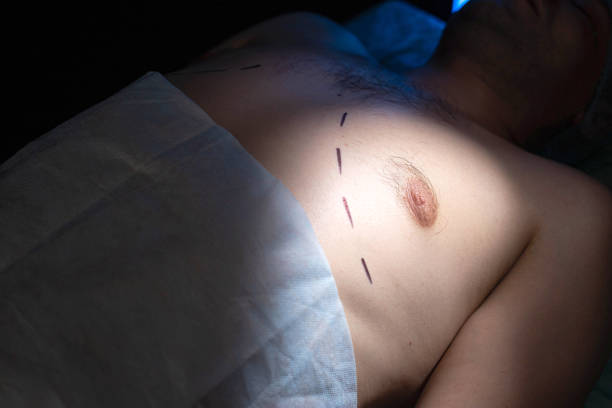

It is a common clinical observation that gynaecomastia rarely affects both sides of the chest with perfect symmetry. Many men seek Gynaecomastia Surgery in Dubai specifically to address “unilateral” enlargement—where one side is significantly more prominent—or “asymmetrical” growth, where the gland shape and fat distribution differ between the left and right pectoral. Achieving a balanced, masculine chest requires a high degree of surgical artistry and volume-mapping to ensure that the final contours match in height, projection, and nipple placement.
In clinical settings, we find that correcting asymmetry is not just about removing tissue; it is about “matching” the tissue that remains. By utilizing different intensities of VASER liposuction on each side, practitioners can create a harmonious, synchronized appearance that restores the patient’s physical balance and confidence.
Clinical Approaches to Unilateral and Asymmetrical Growth
Correcting a “lopsided” chest requires a bespoke surgical plan that acknowledges the unique biological baseline of each side.
-
Volume Mapping: Before the procedure, the surgeon maps the specific “high-density” zones on each pectoral. This ensures that the amount of fat and gland removed is mathematically calculated to result in bilateral symmetry.
-
Differential Liposuction: In clinical settings, we often use more aggressive VASER energy on the larger side, while using a “feathering” technique on the smaller side to ensure the final skin thickness is identical.
-
Nipple-Areolar Alignment: If one nipple is lower due to the weight of the excess tissue, the surgical excision is designed to provide an “internal lift,” bringing the areolar complexes into better horizontal alignment.
-
Glandular Matching: If a gland is only present on one side, we perform a unilateral excision while using micro-liposuction on the opposite side to maintain a natural, non-surgical look.
What is the Actual Pain Level During Asymmetry Correction?
Is recovery more uncomfortable when one side is treated more?
Based on post-procedure follow-ups, patients rate the pain of asymmetrical Gynaecomastia Surgery in Dubai at a 3/10. Interestingly, patients often report that the more “active” surgical side—the one that required more tissue removal—feels slightly more tender and “tight” than the other. This sensation is described as a localized muscle ache. However, the overall recovery experience is not significantly more painful than a standard bilateral procedure, as the same long-acting local anesthetics and compression protocols are used to manage the chest as a single unit.
Who is Not a Candidate for Asymmetry Correction?
Are there safety limits for fixing an uneven chest?
We do not recommend immediate surgery for teenagers whose chest asymmetry is a result of “Active Pubertal Flux,” as the smaller side may still grow to match the larger one. In clinical settings, we also exclude men with “Skeletal Asymmetry” (such as Pectus Carinatum or scoliosis) who expect surgery to fix the underlying bone structure. While a Gynaecomastia Surgery in Dubai can improve the soft tissue appearance, it cannot move the ribs or sternum. Additionally, patients with unilateral enlargement must undergo a clinical scan to rule out rare underlying pathologies before the procedure is deemed strictly cosmetic.
Step-by-Step Patient Sensations: The Balancing Journey
The experience of correcting asymmetry involves watching the “gap” between the two sides slowly close during recovery.
-
Hours 1–24 (The “Equilibrium” Phase): You will feel the firm pressure of the compression vest. Due to the anesthesia, both sides will feel equally numb, regardless of which side had more work.
-
Day 5 (The “Differential Swelling” Milestone): You may feel more “fullness” on the side that was larger. In clinical settings, we observe that the side with more tissue removal often swells more intensely for a short period.
-
Week 4 (The “Alignment” Milestone): As the primary swelling fades, you will feel the physical “weight” of the chest becoming balanced. You will no longer feel the “drag” of the larger side.
-
Month 6 (The “Symmetrical” Result): The tissues have fully settled. You will feel total confidence in your profile, marking the successful completion of your Gynaecomastia Surgery in Dubai.
Why Choose Tajmeels Clinic for Gynaecomastia Surgery in Dubai?
At Tajmeels Clinic, we specialize in “Symmetrical Precision.” We understand that a Gynaecomastia Surgery in Dubai is only successful if the patient feels balanced and natural. Our practitioners utilize advanced 3D-mapping and VASER technology to ensure that every milliliter of tissue removed contributes to a synchronized masculine contour. We prioritize “Anatomic Harmony,” ensuring that your new chest looks natural from every angle. By choosing Tajmeels Clinic, you are opting for a medical team that combines surgical technicality with an artist’s eye for detail, providing you with a chest that is as balanced as it is defined.
Genuine Patient Perspectives
“My left side was always much larger than my right. I was so self-conscious about it. The team at Tajmeels explained exactly how they would balance me out. The pain was just like a bruise on one side, but the result is perfectly even. I finally feel normal.” — Omar
“I thought surgery would just make me ‘smaller but still uneven.’ I was wrong. The practitioners at Tajmeels are artists. They matched both sides perfectly. The recovery was easy, and the staff made sure I knew that the uneven swelling at the start was totally normal.” — Faisal
FAQ: Correcting Asymmetry in Dubai
Is it common for gynaecomastia to be on only one side?
Yes. In clinical settings, unilateral gynaecomastia is frequently seen and is often the primary reason men seek a Gynaecomastia Surgery in Dubai.
Will the scars be different on each side?
If the techniques used are the same, the scars will be identical (typically 3mm–5mm). If only one side needs excision, that side will have a small semi-circular mark.
Does insurance cover unilateral gynaecomastia?
Generally, no. Most insurance providers view this as a cosmetic correction of a benign condition, even if it is asymmetrical.
How do you ensure the nipples match?
We use “Recumbent Mapping” before the surgery to mark the nipple position, ensuring they sit at the same horizontal level once the excess weight is removed.
What if my ribcage is uneven?
We will use liposuction to “camouflage” the bone asymmetry as much as possible, though the underlying skeletal structure remains unchanged.
When will I see the final “balance”?
While the improvement is immediate, the final “symmetrical” look is usually achieved at 4 to 6 months once all differential swelling has subsided.