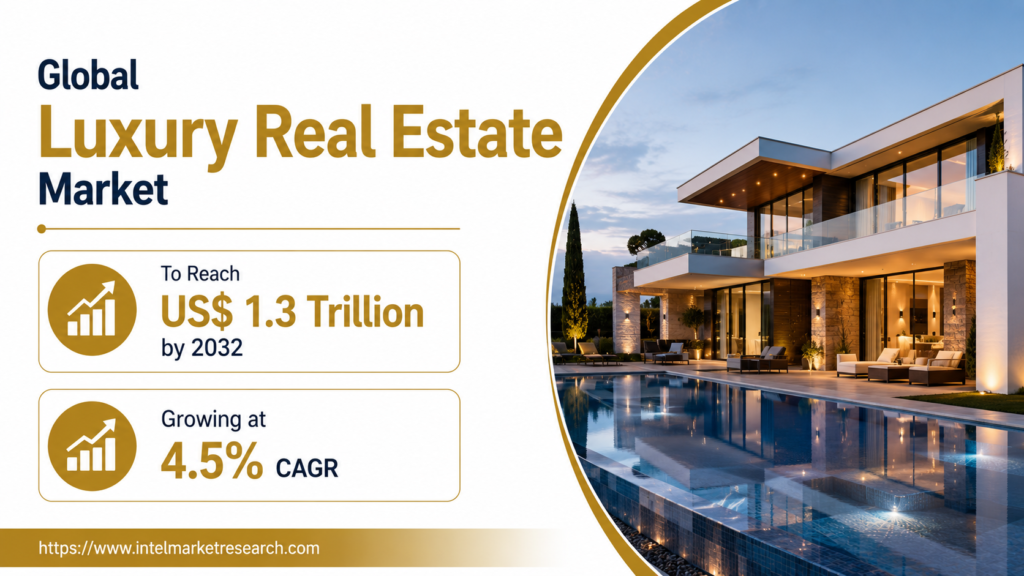

According to new market research, the global luxury real estate market US$ 1.3 trillion by 2032, growing at a Compound Annual Growth Rate (CAGR) of 4.5% during the forecast period (2024-2032). This sustained growth reflects increasing disposable incomes among high-net-worth individuals (HNWIs), wealth creation in emerging economies, and the growing appeal of luxury properties as stable, tangible assets in volatile financial markets.
What Defines Luxury Real Estate?
Luxury real estate represents the premium segment of property markets, characterized by exceptional quality, architectural distinction, prime locations, and superior amenities. These properties range from penthouse suites in global financial hubs to waterfront villas and historic estates, typically featuring smart home technologies, premium materials, and exclusive services. According to industry benchmarks, luxury properties typically command prices in the top 5-10% of their local markets, with ultra-luxury segments starting at $10 million in major global cities
Key Market Drivers
1. Expansion of High Net Worth Individuals
The swelling ranks of millionaires and billionaires – particularly in Asia-Pacific and Middle Eastern markets – continues to drive demand. Recent wealth reports indicate the number of ultra-high-net-worth individuals (those with $30M+ in assets) grew by 6.2% globally in 2023, with China and India showing the fastest growth rates. These buyers increasingly view luxury properties as both status symbols and inflation-resistant assets.
2. Globalization of Wealth and Investment
Cross-border property investments now account for nearly 27% of luxury purchases as wealthy buyers diversify portfolios internationally. Cities like Dubai, London, and Miami benefit from favorable tax policies, stable governance, and world-class infrastructure that appeals to global citizens. The pandemic accelerated this trend, with remote work enabling more flexible living arrangements across multiple luxury properties.
Market Challenges
The sector faces headwinds from rising interest rates, which have increased financing costs for high-value purchases, and geopolitical uncertainties affecting cross-border transactions. Additionally, regulatory changes in markets like Canada and Singapore – where foreign buyer restrictions have been implemented – have cooled some segments. Luxury markets also face pressures from economic slowdowns in key regions like China, where property sector troubles have impacted domestic demand.
Emerging Opportunities
Several trends are reshaping the luxury landscape. The rise of sustainable luxury has created demand for eco-conscious properties with green certifications. Secondary markets like Portugal’s Algarve coast and Mexico’s Riviera Maya are gaining popularity as alternatives to traditional hubs. Perhaps most significantly, the blended living concept – combining residential, hospitality, and workspaces – is redefining luxury expectations post-pandemic.
Regional Market Insights
- North America maintains its dominance with robust markets in New York, Los Angeles, and Miami. Toronto and Vancouver remain attractive despite foreign buyer taxes, thanks to their safe-haven status and education systems appealing to global families.
- Europe showcases resilience in London and Paris, while Mediterranean markets like Mallorca and the French Riviera benefit from remote work trends. Switzerland continues to attract wealth preservation buyers through its stable economy and privacy protections.
- Asia-Pacific displays divergent trends – Chinese buyers are repatriating some wealth due to capital controls, while Indian and Southeast Asian buyers are increasingly active globally. Singapore’s luxury market remains strong due to its safe-haven status.
- Middle East markets, particularly Dubai, continue their ascent with investor-friendly policies and major developments like Palm Jumeirah attracting global capital. African hubs like Cape Town appeal to buyers seeking value and lifestyle.
Competitive Landscape
- Brookfield Asset Management leads in integrated luxury developments, with landmark projects across North America and Asia blending residential, retail, and hospitality concepts.
- Dar Global has emerged as a powerhouse in Middle Eastern luxury, with billion-dollar developments featuring partnerships with brands like Aston Martin and Trump.
- Recent months have seen strategic expansions by major players, including DLF’s ₹25,000 crore Gurugram project and Vonrosen’s $500 million Dubai villa development venture.
Market Segmentation
By Property Type:
- Luxury Apartments/Condominiums
- Villas & Mansions
- Penthouse Suites
- Luxury Townhouses
- Waterfront Properties
- Historic/Restored Estates
By Price Segment:
- Ultra-Luxury ($10M+)
- High Luxury ($5M-$10M)
- Affordable Luxury ($1M-$5M)
By Buyer Profile:
- Primary Residence Buyers
- Investors/Second Home Buyers
- International/Cross-border Buyers
Download FREE Sample Report: Luxury Real Estate Market Sample
View Full Report: Global Luxury Real Estate Market 2024-2032
About Intel Market Research
Intel Market Research delivers actionable insights in technology and infrastructure markets. Our data-driven analysis leverages:
- Real-time infrastructure monitoring
- Techno-economic feasibility studies
Competitive intelligence across 100+ countries
Trusted by Fortune 500 firms, we empower strategic decisions with precision.
Asia: +91 9169164321
Website: https://www.intelmarketresearch.com
Follow us on LinkedIn: https://www.linkedin.com/c