
For manufacturers, obtaining an ISI certification is more than a regulatory requirement—it is a mark of quality, safety, and consumer trust. Products covered under mandatory Indian Standards cannot be legally manufactured or sold in India without the required certification from the Bureau of Indian Standards (BIS). While most businesses focus on the official ISI mark registration fees, they often overlook the additional expenses that arise during the certification journey.
Many first-time applicants assume that paying the application fee is enough to secure certification. However, there are several indirect costs, such as product testing, factory preparedness, documentation, compliance improvements, and surveillance requirements, that can affect the overall budget. Understanding these expenses beforehand helps manufacturers plan more effectively and avoid unexpected delays.
This guide explains the hidden costs associated with ISI Certificate Registration, the complete certification process, common mistakes, and how Agile Regulatory helps businesses achieve certification efficiently.
What is ISI Certificate Registration?
ISI Certificate Registration is the process through which manufacturers obtain authorization from the Bureau of Indian Standards (BIS) to use the ISI Mark on products covered under mandatory Indian Standards.
The ISI Mark indicates that a product conforms to the applicable Indian Standard and has been evaluated through testing, factory inspection, and quality control assessment.
Products such as electrical appliances, cement, steel products, kitchen equipment, LPG cylinders, switches, cables, and many other regulated products require ISI certification before they can be sold in the Indian market.
Why ISI Certification is Important
Obtaining ISI certification offers several advantages for manufacturers.
Some major benefits include:
- Demonstrates compliance with Indian Standards
- Enhances product credibility
- Builds consumer confidence
- Improves market acceptance
- Supports participation in government procurement
- Reduces regulatory risks
- Strengthens quality assurance systems
For products covered under mandatory certification schemes, obtaining approval is also a legal requirement.
Understanding ISI Mark Registration Fees
One of the first questions businesses ask is about ISI mark registration fees. While BIS prescribes official fees for applications and licensing, applicants should understand that these are only one part of the total certification cost.
The overall expense depends on several factors, including:
- Product category
- Applicable Indian Standard
- Product testing
- Factory readiness
- Quality control systems
- Number of product variants
- Compliance improvements
- Surveillance requirements
Proper planning helps businesses estimate the complete investment required for certification.
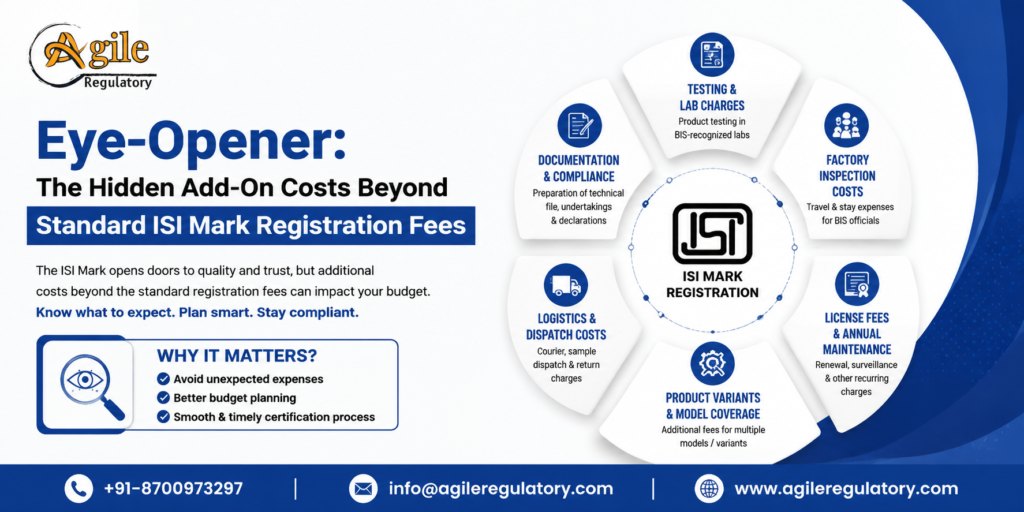
Hidden Costs Beyond Standard ISI Mark Registration Fees
Many businesses underestimate the expenses that occur during certification. Knowing these costs in advance helps avoid surprises.
Product Testing Charges
Testing is one of the most significant components of the certification process.
Products must be evaluated according to the applicable Indian Standard, and testing charges vary depending on the product category and laboratory requirements.
If products fail the initial tests, additional testing may be required after corrective actions.
Factory Infrastructure Improvements
During factory assessment, BIS verifies whether manufacturing facilities comply with quality and production requirements.
Manufacturers may need to invest in:
- Quality control equipment
- Laboratory instruments
- Calibration
- Storage improvements
- Process documentation
- Manufacturing controls
These improvements strengthen long-term product quality.
Calibration of Equipment
Testing and measuring equipment should be properly calibrated to ensure accurate quality control.
Calibration expenses are often overlooked during initial budgeting.
Documentation Preparation
Comprehensive documentation forms an essential part of ISI Certificate Registration.
Manufacturers must prepare documents relating to:
- Manufacturing process
- Raw materials
- Testing procedures
- Quality control
- Production records
- Organizational information
Professional documentation reduces the likelihood of application queries.
Internal Quality Control Systems
Many businesses introduce additional quality assurance procedures before inspection.
This may involve:
- Standard operating procedures
- Inspection records
- Testing logs
- Process monitoring
- Employee training
Although these improvements require investment, they also strengthen manufacturing operations.
Factory Inspection Readiness
Before inspection, manufacturers often upgrade production areas to meet BIS expectations.
This may include:
- Better housekeeping
- Organized documentation
- Product identification systems
- Material traceability
- Quality control arrangements
Good preparation increases confidence during inspection.
Corrective Actions
If BIS identifies non-conformities during assessment, manufacturers may need to implement corrective measures before certification is granted.
Addressing these observations can involve additional time and resources.
Ongoing Surveillance Costs
Certification does not end with approval.
BIS conducts periodic surveillance activities to verify continued compliance.
Manufacturers should maintain quality systems and documentation throughout the validity of the license.
Step-by-Step ISI Certificate Registration Process
Understanding the complete process helps businesses prepare efficiently.
Step 1: Identify the Applicable Standard
Determine whether the product falls under mandatory certification and identify the relevant Indian Standard.
Step 2: Prepare Documentation
Compile all required business, manufacturing, and quality control documents.
Step 3: Product Testing
Submit product samples for testing as per the applicable standards.
Step 4: Application Submission
Complete the application with accurate technical and organizational information.
Step 5: Factory Inspection
BIS officials assess manufacturing facilities, quality systems, and production capabilities.
Step 6: Compliance Review
The authority reviews inspection findings, product test reports, and documentation.
Step 7: Grant of License
After successful verification, the manufacturer receives approval for ISI Certificate Registration, allowing the use of the ISI Mark.
How to Get ISI Certification in India
Businesses frequently ask How to get ISI Certification in India. The process generally involves:
- Determining product eligibility
- Identifying the applicable Indian Standard
- Preparing complete documentation
- Conducting product testing
- Undergoing factory inspection
- Complying with BIS requirements
- Obtaining license approval
Proper preparation significantly improves the efficiency of the certification process.
Role of an ISI Certification Agency
Working with an experienced ISI certification agency helps manufacturers navigate the certification process more efficiently.
Professional consultants assist with:
- Product eligibility assessment
- Standard identification
- Documentation preparation
- Application filing
- Product testing coordination
- Inspection readiness
- Compliance guidance
- Query resolution
Expert assistance minimizes documentation errors and reduces approval delays.
How to Get BIS Certificate
Many businesses also search for How to get BIS certificate because BIS administers multiple certification schemes, including ISI certification for domestic manufacturers.
The process generally involves:
- Identifying the applicable BIS scheme
- Understanding regulatory requirements
- Preparing documentation
- Product testing
- Factory inspection, where applicable
- Compliance verification
- License approval
Choosing the correct certification pathway is essential for successful registration.
Understanding BIS ER Certificate
Apart from ISI certification, businesses may also come across the BIS ER certificate, which relates to specific BIS certification requirements applicable to certain categories of products and regulatory schemes.
Manufacturers should carefully determine which BIS certification applies to their products before initiating the application process.
Professional guidance helps businesses identify the correct certification route.
Common Mistakes That Increase Certification Costs
Several avoidable mistakes can increase both certification expenses and approval timelines.
These include:
- Incomplete documentation
- Incorrect product classification
- Poor factory preparation
- Inadequate quality control
- Failed product testing
- Delayed responses to BIS observations
- Lack of calibration records
- Applying under the wrong certification scheme
Addressing these issues early helps control costs and improve approval efficiency.
Why Professional Guidance Saves Money
Many manufacturers assume professional consultancy increases expenses. In reality, experienced consultants often help reduce overall costs by preventing errors that lead to rework and delays.
Professional support provides:
- Accurate documentation
- Proper planning
- Better inspection readiness
- Reduced testing failures
- Faster application processing
- Compliance management
- Long-term regulatory support
The result is a more efficient certification process with fewer unexpected expenses.
How Agile Regulatory Helps with ISI Certificate Registration
Obtaining ISI Certificate Registration requires technical knowledge, complete documentation, product testing, and compliance with BIS requirements. Managing these activities without expert guidance can increase costs and delay approvals.
Agile Regulatory provides end-to-end consulting services for manufacturers seeking BIS and ISI certifications across India.
The experienced team offers:
- Product eligibility assessment
- Documentation preparation
- Application filing
- Product testing coordination
- Factory inspection support
- Guidance on ISI mark registration fees
- Assistance on How to get ISI Certification in India
- Consultation as an experienced ISI certification agency
- Support for businesses seeking How to get BIS certificate
- Guidance regarding applicable BIS ER certificate requirements
- Post-certification compliance support
With Agile Regulatory handling the compliance process, manufacturers can focus on production while experienced professionals manage regulatory requirements efficiently.
Tips to Reduce Overall Certification Costs
Businesses can control expenses by following these best practices:
- Understand certification requirements before applying.
- Prepare complete documentation.
- Maintain strong quality control systems.
- Calibrate equipment regularly.
- Conduct internal compliance reviews.
- Ensure factory readiness before inspection.
- Respond quickly to regulatory observations.
- Seek professional guidance early in the process.
These steps help reduce delays and avoid unnecessary expenditure.
Conclusion
While official ISI mark registration fees are an important part of the certification process, they represent only a portion of the total investment required. Product testing, factory improvements, documentation, calibration, inspections, and ongoing compliance all contribute to the overall cost of obtaining certification.
Understanding these hidden expenses allows manufacturers to budget effectively and complete the certification process without unexpected financial surprises. Whether you are exploring How to get ISI Certification in India, looking for guidance from an experienced ISI certification agency, or trying to understand How to get BIS certificate requirements, proper planning is the key to success.
Agile Regulatory provides comprehensive assistance for ISI Certificate Registration, helping manufacturers manage documentation, testing, inspections, and compliance while reducing delays and ensuring a smoother certification journey.
Frequently Asked Questions (FAQs)
1. What is ISI Certificate Registration?
ISI Certificate Registration is the process through which eligible manufacturers obtain authorization from the Bureau of Indian Standards to use the ISI Mark on products that comply with the applicable Indian Standards.
2. What do ISI mark registration fees include?
ISI mark registration fees generally include official BIS application and licensing charges. However, manufacturers should also consider expenses related to testing, factory readiness, documentation, calibration, inspections, and ongoing compliance.
3. How to get ISI Certification in India?
To understand How to get ISI Certification in India, businesses must identify the applicable Indian Standard, prepare documentation, complete product testing, undergo factory inspection, and comply with BIS requirements before receiving approval.
4. Why should I hire an ISI certification agency?
An experienced ISI certification agency helps manufacturers prepare documentation, coordinate testing, manage applications, support inspections, and reduce certification delays.
5. How to get BIS certificate for my product?
The process for How to get BIS certificate depends on the applicable BIS certification scheme. Businesses should identify the correct scheme, complete testing and documentation, and comply with all regulatory requirements.
6. What is a BIS ER certificate?
A BIS ER certificate refers to a BIS certification requirement applicable to certain regulated product categories under specific BIS schemes. Manufacturers should verify the appropriate certification applicable to their products.
7. Why choose Agile Regulatory for ISI certification?
Agile Regulatory offers complete assistance with ISI Certificate Registration, documentation, product testing coordination, guidance on ISI mark registration fees, support on How to get ISI Certification in India, consultation as an experienced ISI certification agency, assistance with How to get BIS certificate, and compliance guidance for applicable BIS ER certificate requirements, ensuring a smooth and efficient certification process.