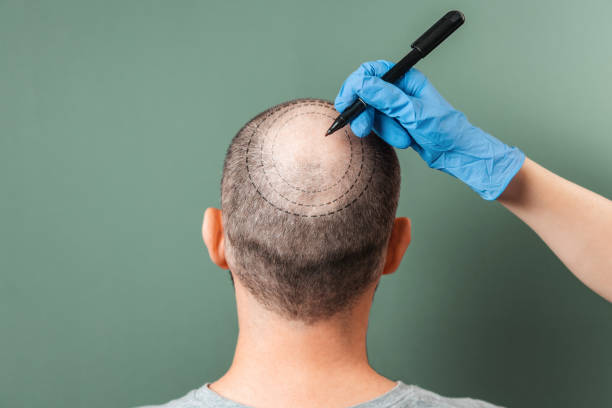

Follicular Unit Extraction (FUE) has become the gold standard for vertex restoration due to its ability to harvest individual follicles without leaving a linear scar. In the context of a Crown Hair Transplant in Dubai, FUE is particularly advantageous because it allows the surgeon to select the “sturdiest” grafts from the donor area—typically those containing three or four hairs—which are essential for creating the illusion of density in the thin-skinned crown region. In clinical settings, we observe that the FUE method provides the highest degree of flexibility when recreating the “spiral” of the crown, as each graft can be placed at a custom angle to match the patient’s original growth pattern.
The Precision of FUE in Vertex Restoration
FUE is a meticulous process that treats each hair follicle as a standalone organ. When applied to the crown, the technique follows a specific clinical logic to ensure the “whorl” looks authentic.
-
Individual Graft Selection: We specifically harvest follicles from the “permanent zone” at the back of the head, ensuring they are resistant to the DHT hormone that causes balding.
-
Minimal Tissue Trauma: Because FUE uses micro-punches (usually 0.8mm to 1.0mm), the healing of the donor area is rapid, and the “white dot” scars are virtually invisible even with short hair.
-
Customized Depth Control: The crown scalp varies in thickness. In clinical settings, we adjust the depth of the FUE punch to match the specific dermal layers of the patient, protecting the graft’s bulb.
-
Angle Accuracy: FUE allows the surgeon to change the angle of implantation for every single graft, which is vital for the 360-degree directional changes required in the crown whorl.
What is the Actual Pain Level During FUE Extraction?
Is FUE more painful than other transplant methods?
Patients typically rate the pain of FUE extraction at a 2/10. The most intense part is the “stinging” sensation of the local anesthetic. Once the donor area is numb, you will feel a “vibration” from the motorized punch and a “tugging” sensation as the grafts are removed, but no sharp pain. Based on post-procedure follow-ups, patients report that the back of the head feels “sore” or like a “mild sunburn” for 24–48 hours, which is easily managed with basic pain relief.
Who is Not a Candidate for FUE Crown Restoration?
Are there safety reasons to avoid FUE for the crown?
Not everyone is a candidate for a “FUE-only” approach. If you have very curly “Afro-textured” hair, the curved root can make FUE extraction difficult, increasing the risk of graft damage. In clinical settings, we also screen for “Donor Depletion.” If you have had multiple previous transplants and your donor area is thin, FUE may not be able to harvest enough hair to cover a large crown. Furthermore, patients with active scalp conditions like Psoriasis or Lichen Planus must resolve these inflammatory issues before FUE can be safely performed.
Step-by-Step Patient Sensations: The FUE Recovery
The FUE recovery is generally faster than older “Strip” methods, but the crown still requires specific care.
-
Day 1–2 (The “Leaking” Phase): You may notice tiny droplets of fluid from the donor site. This is the anesthetic and saline exiting the micro-punches. It is a normal clinical observation.
-
Day 3–5 (The “Prickly” Phase): As the donor area begins to heal, you will feel a “prickly” or “itchy” sensation as the surrounding hair grows back.
-
Day 7–10 (The “Scab” Phase): The micro-scabs in the crown will start to fall off. You may feel a “tightness” in the skin. We observe that a gentle baby shampoo wash on day 7 provides significant relief.
-
Month 1 (The “Dullness” Phase): The donor area and the crown may feel slightly numb or “odd” to the touch. This is the nerves regenerating and is a standard part of the healing process.
Why Choose Tajmeels Clinic for FUE Crown Excellence?
At Tajmeels Clinic, we refine the FUE process by using “Sapphire Blades” for the implantation phase. These ultra-sharp, gemstone-tipped blades create smaller, cleaner channels than traditional steel, leading to faster healing and less scabbing in the crown. Our practitioners are experts in “Donor Management,” ensuring that we harvest the exact number of grafts needed for your Crown Hair Transplant in Dubai without thinning out the back of your head. By choosing Tajmeels Clinic, you are opting for a high-precision, FUE-focused environment where your recovery is as prioritized as your final aesthetic result.
Genuine Patient Perspectives
“I was scared of having a big scar at the back of my head. The team at Tajmeels explained that with FUE, I’d just have tiny dots. The surgery was long, but it felt like I was just sitting in a chair for a day. I felt a bit sore that night, like I’d hit my head, but by day three I was back to my normal routine.” — Zain
“I was worried the FUE wouldn’t give me enough density for my bald spot. Tajmeels did a great job of picking the ‘thickest’ hairs from the back and putting them right in the middle of the whorl. It felt itchy for a week, but the scabs came off easily with the shampoo they gave me.” — Robert
Frequently Asked Questions
Will FUE leave visible scars in the donor area?
No. FUE leaves tiny, circular micro-scars that are indistinguishable from natural skin once the surrounding hair grows to a length of 1cm.
How many FUE grafts can be done in one day?
In clinical settings, we safely harvest and transplant up to 3,500 to 4,000 grafts in a single 8-hour session.
Can I sleep on my donor area after FUE?
Yes, but we recommend a soft pillow and a clean towel to absorb any minor fluid leakage during the first two nights.
Is FUE better than DHI for the crown?
Both are excellent; FUE is the extraction method, while DHI is the implantation method. We often use FUE to harvest and then decide on the best implantation tool.
When can I cut the hair in the donor area?
You can safely have a gentle haircut with scissors after 2 weeks, but avoid clippers/shavers for at least 4 weeks.
Does FUE crown hair grow at the same rate as the front?
No. Clinically, the vertex has a slower metabolic rate, meaning FUE results in the crown usually peak at 12 to 14 months.