
In today’s cloud-driven business application ecosystem, Software-as-a-Service (SaaS) has become the dominant delivery model for enterprise software. Modern businesses no longer want to deal with complex on-premises server infrastructure, manual software updates, or upfront licensing costs. Instead, decision-makers demand flexible, cloud-hosted, pay-as-you-go business management tools that can scale seamlessly with their operational growth.
Among open-source and commercial enterprise resource planning (ERP) systems, Odoo stands out as one of the most flexible and widely adopted platforms globally. Offering an integrated suite of modules covering CRM, accounting, inventory, human resources, e-commerce, and project management, Odoo serves millions of users. However, for digital agency owners, independent software vendors (ISVs), and IT service providers, transitioning from selling standalone Odoo custom development to operating a scalable, automated subscription business requires specialized technology. Converting single-tenant Odoo instances into a fully managed, multi-tenant cloud service requires a specialized odoo saas toolkit.
The Technical Architecture Behind Odoo SaaS Models
Standard Odoo installations are fundamentally engineered for single-tenant or basic multi-database deployments where an administrator manually creates and configures database schemas. Operating a commercial SaaS business, however, demands complete automation across the entire customer lifecycle:
-
Multi-Tenancy and Database Isolation: In a commercial SaaS setting, every client (tenant) must operate in a secure, isolated environment where their data cannot leak into another client’s database. Architectures can range from shared database instances with schema-level separation to dedicated containerized instances (e.g., Docker containers) running on cloud servers.
-
Automated Tenant Onboarding: When a prospective client signs up on your website, selects a subscription tier, and enters their credit card information, the system must automatically create their organization account, initialize their Odoo database, install selected module sets, and generate administrative credentials—without human intervention.
-
Custom Domain Routing and SSL Termination: Enterprise subscribers expect to access their ERP platform using their own corporate URLs (e.g.,
erp.clientdomain.com) rather than a generic subdomain. A robust saas toolkit for odoo must automatically handle reverse proxy routes, DNS mappings, and SSL certificate generation (such as Let’s Encrypt). -
Resource Monitoring and Quota Management: To maintain profit margins and protect server health, SaaS operators must enforce strict tier restrictions based on active user counts, module selections, total storage consumption, and database size limiters.
Essential Modules of an Enterprise Odoo SaaS Kit
A production-ready odoo saas kit provides the end-to-end framework necessary to turn core Odoo modules into a customer-facing subscription portal. Key functional components include:
-
Central Master Dashboard: A centralized administrative control tower that provides system operators with real-time analytics on total active tenants, monthly recurring revenue (MRR), server resource consumption, active subscriptions, and automated system alert logs.
-
Client Self-Service Portal: An intuitive portal where end-users can manage their subscription plans, upgrade user seats, purchase additional modules, manage billing details, download invoices, request database backups, or upgrade their domain settings.
-
Automated Subscription & Billing Engine: Integration with leading global payment gateways (such as Stripe, PayPal, and Razorpay) to automate recurring monthly or annual subscription charges, manage dunning processes for failed payments, and handle automatic grace periods or account suspensions.
-
Flexible Plan Builder & App Store: Ability for SaaS operators to construct tiered subscription packages (e.g., Basic, Professional, Enterprise) or offer a modular pay-per-app pricing structure where customers pay strictly for the specific Odoo apps they activate.
-
Automated Backup & Restore Operations: Scheduled, automated database backups stored securely in local or remote cloud storage buckets (Amazon S3, Google Cloud Storage). Clients gain the ability to trigger instant point-in-time database snapshots directly from their management dashboard.
Why Businesses Need a Dedicated Toolkit for Odoo SaaS Development
Attempting to engineer an in-house SaaS management wrapper around Odoo from scratch is a massive software engineering endeavor. Internal development teams often spend months writing custom scripts, configuring complex Nginx/HAProxy reverse proxies, building billing integrations, and setting up dockerized orchestration. This diverts valuable developer bandwidth away from core product innovation and customer acquisitions.
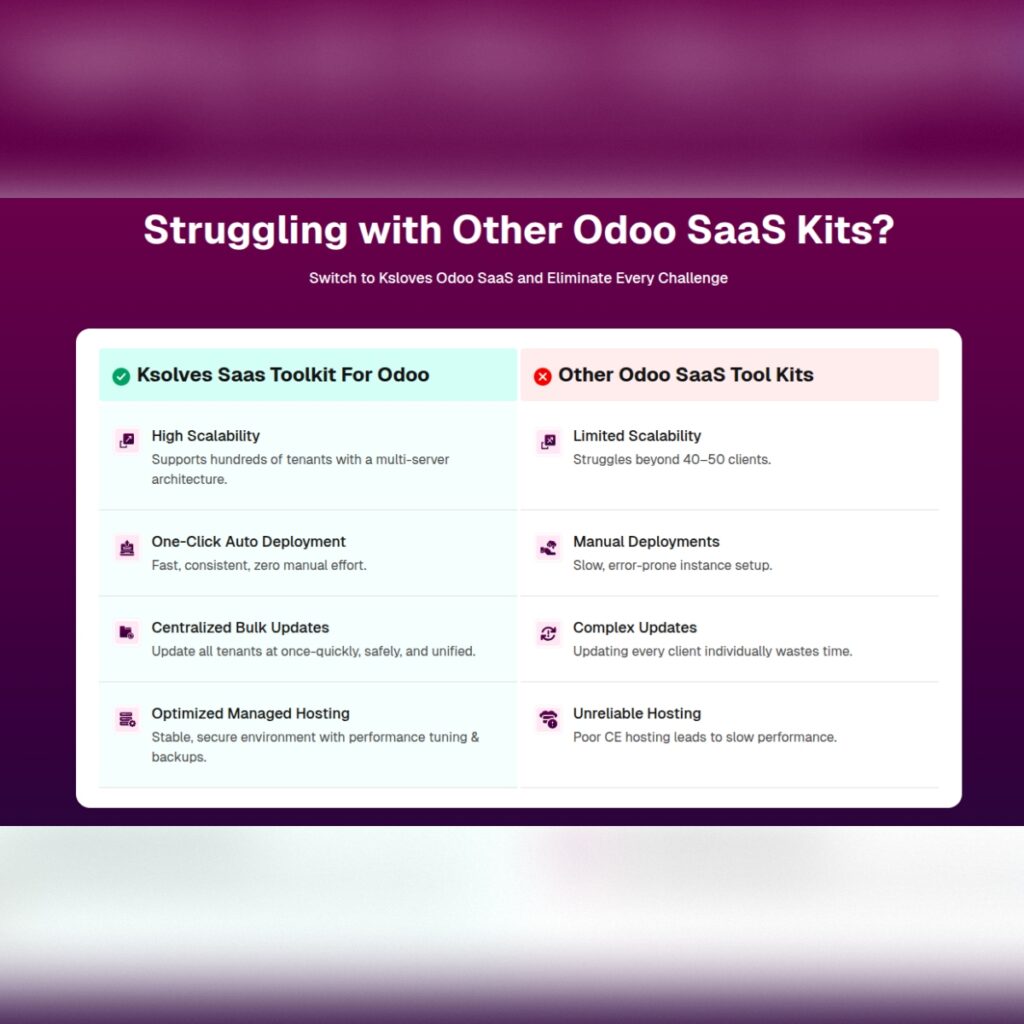
By adopting a pre-built, battle-tested toolkit for odoo saas from Ksolves, technology companies eliminate technical debt, drastically reduce time-to-market, and launch a reliable, high-margin cloud service in a fraction of the time.
Key Capabilities of the Ksolves Odoo SaaS Toolkit
Ksolves, a globally recognized leader in Big Data, cloud infrastructure, and Odoo software engineering, delivers an industry-leading odoo saas toolkit designed for maximum performance, security, and scalability:
-
Docker Container & Bare-Metal Support: Deploy tenant environments using lightweight Docker containers or direct PostgreSQL database setups, granting complete flexibility across hybrid, multi-cloud, or on-premises server environments.
-
White-Label Branding Capability: Fully customize the portal interfaces, login screens, email notifications, and administrative dashboards with your company’s logo, brand colors, and domain identity.
-
Seamless Version Compatibility: Engineered to support modern Odoo Community and Enterprise versions, ensuring smooth platform upgrades and long-term compatibility with third-party app store modules.
-
Granular Security Controls: Enforce multi-factor authentication (MFA), role-based access controls (RBAC), database isolation, and automated security patch management across all tenant environments.
Strategic Roadmap to Launching Your Odoo SaaS Business
Launching a successful Odoo SaaS service involves a structured four-phase roadmap:
-
Phase 1: Market Positioning & Pricing Architecture — Define target customer verticals (e.g., retail, manufacturing, professional services) and structure competitive subscription tiers based on feature sets, storage, and user seat limits.
-
Phase 2: Infrastructure Provisioning & Toolkit Installation — Configure cloud servers (AWS, DigitalOcean, Google Cloud), set up master Odoo instances, and install the Ksolves Odoo SaaS Toolkit framework.
-
Phase 3: Template Database Creation & Module Bundling — Build pre-configured template databases equipped with industry-specific default settings, sample data, and custom module suites ready for instant deployment.
-
Phase 4: Payment Gateway Integration & Go-to-Market Launch — Connect merchant accounts, configure automated email notifications, launch public marketing landing pages, and initiate subscription campaigns.
Conclusion
Transforming Odoo into a multi-tenant, recurring revenue SaaS business represents a massive growth opportunity for IT providers, agencies, and software creators. However, operational success hinges on automated provisioning, secure multi-tenancy, flexible subscription management, and robust infrastructure monitoring. By leveraging the advanced odoo saas toolkit from Ksolves, your business can launch a scalable, white-labeled cloud ERP platform that drives predictable recurring revenue and long-term business value.