
Introduction
In India, product quality and safety are important for both businesses and consumers. To ensure products meet national quality standards, the government introduced BIS Registration under the Bureau of Indian Standards. Whether you are a manufacturer, importer, or business owner, understanding the process of certification is essential for legal compliance and market growth. This guide explains everything about BIS Registration, the importance of the bis certification mark, and how a bis certification consultant can help businesses obtain approval smoothly.
What is BIS Registration?
BIS Registration is a certification process managed by the Bureau of Indian Standards (BIS), the national standards body of India. It ensures that products meet prescribed quality, safety, and performance standards before entering the Indian market. Manufacturers of specific products must obtain BIS approval to legally sell their goods in India. The registration process helps maintain product consistency, improve customer trust, and ensure consumer safety.
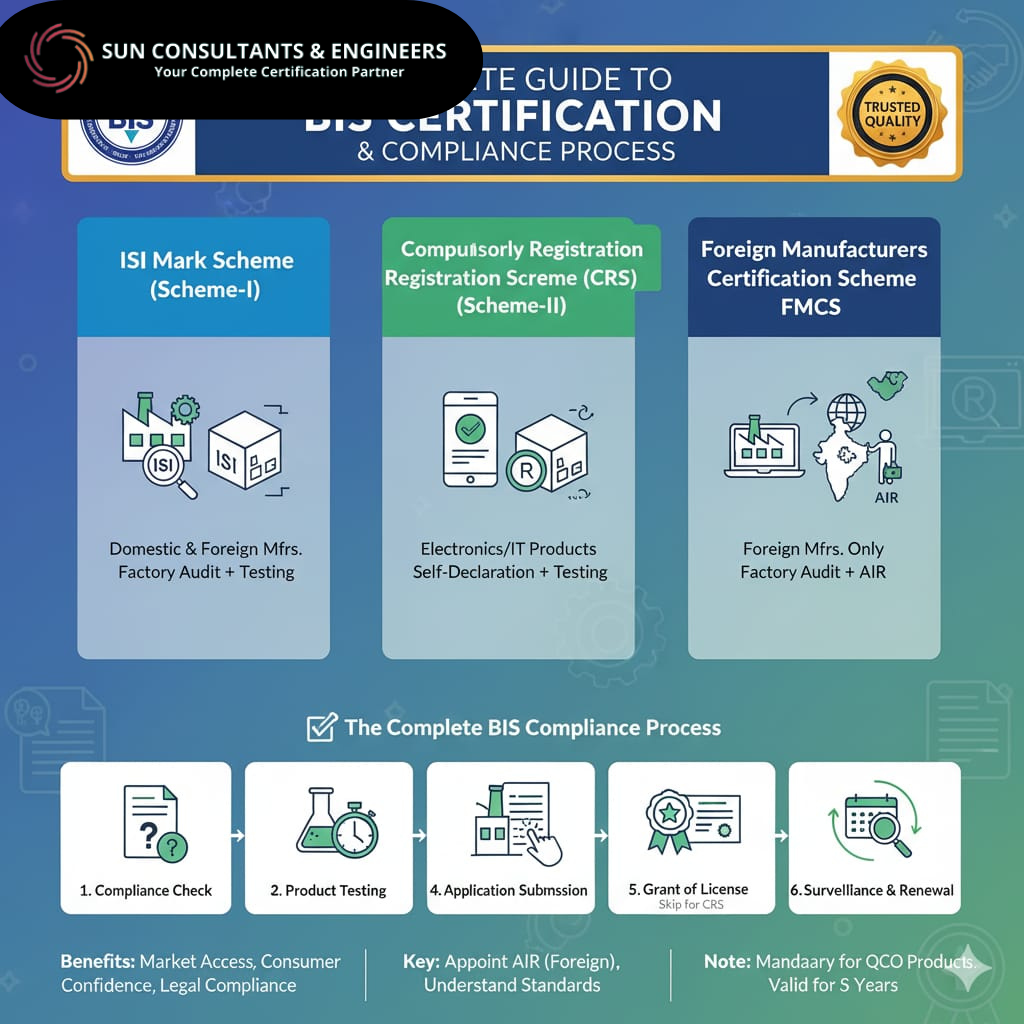
The government has implemented various schemes under BIS, including:
- Compulsory Registration Scheme (CRS)
- Foreign Manufacturers Certification Scheme (FMCS)
- ISI Mark Certification
- Hallmark Certification
Every product category follows a different compliance process depending on applicable Indian Standards.
Importance of BIS Registration in India
Obtaining BIS Registration offers multiple benefits for manufacturers and businesses.
1. Legal Market Entry
Many products cannot be sold in India without mandatory BIS approval. Non-compliance may result in penalties, product seizures, or import restrictions.
2. Consumer Trust
Customers prefer products carrying a recognized bis certification mark because it indicates quality assurance and product reliability.
3. Better Brand Reputation
Certified products often gain more credibility in competitive markets, helping businesses establish long-term trust.
4. Improved Product Quality
The certification process requires testing and quality checks, encouraging manufacturers to maintain higher production standards.
5. Business Expansion
Having proper certification enables companies to enter larger markets, government tenders, and retail chains.
What is the BIS Certification Mark?
The bis certification mark is an official symbol provided after successful certification. It confirms that the product complies with Indian quality and safety standards. The mark acts as proof that the product has undergone proper testing and inspection according to BIS requirements.
Different certifications may include:
- ISI Mark for domestic manufacturing
- CRS Registration Number for electronic products
- BIS License Number
- Standard Mark for specific regulated items
Products carrying the bis certification mark are generally considered safer and more reliable in the Indian market.
Consumers often check the certification mark before purchasing electrical products, industrial materials, and safety-sensitive items.
Who Needs BIS Registration?
Several categories of manufacturers and importers require BIS Registration, including:
Indian Manufacturers
Companies producing goods in India that fall under mandatory certification lists must obtain BIS approval.
Foreign Manufacturers
Foreign companies exporting products to India must comply with BIS standards before entering the Indian market.
Importers and Brand Owners
Businesses importing regulated products into India are responsible for ensuring BIS compliance.
Products commonly requiring registration include:
- LED lights
- Mobile phones
- Power adapters
- Electronic devices
- Toys
- Cement products
- Steel products
- Household electrical appliances
Checking product applicability before market entry is important to avoid delays.
BIS Registration Process in India
The BIS Registration process generally includes several steps.
Step 1: Product Identification
The first step is identifying whether the product falls under mandatory BIS certification.
Each product must comply with a specific Indian Standard (IS code).
Step 2: Product Testing
The product is tested in a BIS-recognized laboratory to ensure compliance with technical and safety standards.
Testing reports are an important part of the application process.
Step 3: Documentation
Applicants submit required documents, including:
- Business license
- Manufacturing details
- Product specifications
- Test reports
- Factory information
- Authorization documents
Proper documentation reduces approval delays.
Step 4: Application Submission
The application is filed through the BIS portal along with applicable fees.
Step 5: Inspection (If Applicable)
For some certification schemes, factory inspections may be required.
Step 6: Grant of Certificate
After successful verification, BIS grants the license or registration certificate.
Manufacturers can then use the bis certification mark on approved products.
Why Hire a BIS Certification Consultant?
The certification process can be technical and time-consuming. Many businesses prefer working with a bis certification consultant for faster approvals and reduced errors.
A professional consultant helps with:
Documentation Management
Incorrect paperwork is one of the biggest reasons for delays. Consultants ensure documents are properly prepared.
Product Standard Identification
Choosing the wrong standard can lead to rejection. A consultant identifies the correct Indian Standard for your product.
Testing Coordination
A bis certification consultant helps coordinate product testing with approved laboratories.
Application Filing
Experts handle application submission and communication with authorities.
Faster Approval
Professional guidance minimizes mistakes and speeds up the certification process.
For businesses unfamiliar with regulatory compliance, hiring an experienced consultant can save significant time and resources.
Common Challenges in BIS Registration
Businesses may face several issues during certification, such as:
- Incorrect documentation
- Failed laboratory testing
- Product standard confusion
- Delayed approval timelines
- Regulatory changes
Working with a professional expert helps businesses avoid these common problems.
Final Thoughts
Obtaining a bis certification consultant is an important step for manufacturers and importers who want to sell products legally in India. It ensures product quality, consumer safety, and compliance with government regulations. A valid Bis certification mark increases customer trust and improves market credibility. However, the registration process can sometimes become complex due to technical standards and documentation requirements.