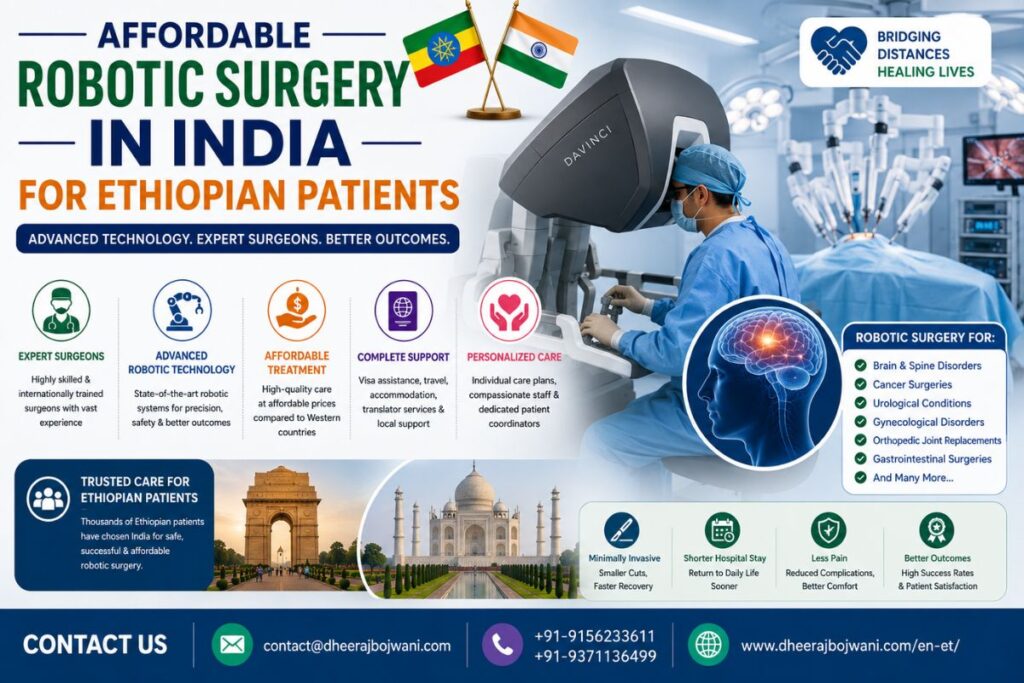

For many families in Ethiopia, deciding to travel abroad for surgery is never a simple medical decision. It often involves weeks of research, discussions with family members, financial planning, and one important question:
“Where can I receive safe treatment and recover with fewer complications?”
Over the last few years, more Ethiopian patients have started traveling to India for advanced treatment, and one major trend has become increasingly clear — a growing number of patients are choosing robotic surgery instead of conventional open surgery.
This shift is happening because modern patients are looking beyond successful treatment.
They also want less pain, quicker recovery, shorter hospital stays, fewer complications, and the confidence of returning home sooner.
This is exactly where robotic surgery has transformed the experience of modern healthcare.
What Is Robotic Surgery?
Many people believe robotic surgery means a machine performs the operation independently.
That is not correct.
In robotic-assisted surgery, a highly trained surgeon controls advanced robotic instruments through a computerized console. The robotic system simply translates the surgeon’s hand movements into highly precise surgical actions.
Unlike traditional open surgery, which usually requires large incisions, robotic surgery is performed through very small openings.
This allows surgeons to operate with far greater precision while reducing physical trauma to the body.
Patients often benefit from:
- Smaller surgical incisions
- Greater precision during surgery
- Less damage to surrounding tissues
- Faster wound healing
- Reduced physical stress on the body
The surgeon remains fully in control — technology simply improves surgical accuracy.
Also Read: Affordable Robotic Surgery in India for Ethiopian Patients
Why Ethiopian Patients Are Moving Away From Traditional Open Surgery?
Traditional open surgery has successfully treated patients for decades and remains necessary for certain medical conditions.
However, patients traveling internationally often think beyond surgery itself.
For Ethiopian families, recovery time, accommodation costs, time away from home, safety, and overall comfort are equally important considerations.
This is where robotic surgery offers major advantages.
Recovery Comparison: Robotic Surgery vs Open Surgery
The difference between robotic surgery and traditional surgery often becomes most visible during recovery.
As the comparison shows, minimally invasive robotic procedures often provide a smoother and faster recovery experience for many patients.
- Faster Recovery Means Returning Home Earlier
One of the biggest concerns for international patients is how long they need to remain abroad after surgery.
Traditional surgery often requires longer hospitalization followed by weeks of physical recovery.
Because robotic surgery is minimally invasive, patients usually recover faster.
This often means:
- Shorter hospital stay
- Lower accommodation expenses in India
- Earlier travel back to Ethiopia
- Faster return to work and normal life
For patients traveling internationally, faster recovery directly reduces both financial and physical burden.
- Smaller Incisions Mean Less Pain After Surgery
Recovery can sometimes feel more difficult than surgery itself.
Traditional open surgery requires larger incisions, which naturally causes more pain and discomfort.
Robotic surgery uses much smaller incisions.
This often results in:
- Reduced pain after surgery
- Less dependence on strong pain medication
- Easier movement during recovery
- Better comfort while healing
For elderly patients or patients traveling long distances, this can make recovery significantly easier.
- Lower Risk of Infection and Surgical Complications
Every surgery carries some level of risk.
However, larger wounds usually increase the possibility of infection, blood loss, and delayed healing.
Because robotic surgery is minimally invasive, these risks are often reduced.
Patients frequently experience:
- Lower blood loss during surgery
- Reduced infection risk
- Faster wound healing
- Fewer post-surgical complications
This becomes particularly important in cancer treatment, kidney surgery, cardiac procedures, and abdominal surgeries.
- Better Precision During Complex Procedures
Even highly experienced surgeons benefit from technology that improves accuracy.
Robotic systems allow surgeons to operate with far greater control when working near delicate nerves, blood vessels, and sensitive organs.
Today, hospitals in India perform robotic-assisted procedures for:
- Cancer surgery
- Prostate surgery
- Kidney surgery
- Heart surgery
- Gynecological procedures
- Gastrointestinal surgeries
In procedures where precision directly affects long-term recovery, better control often leads to better outcomes.
Open Surgery vs Robotic Surgery: Understanding the Difference
| Factor | Robotic Surgery | Traditional Open Surgery |
| Hospital Stay | Shorter | Longer |
| Recovery Time | Faster | Slower |
| Pain After Surgery | Less | Higher |
| Blood Loss | Minimal | More Significant |
| Infection Risk | Lower | Higher |
| Visible Scarring | Minimal | More Visible |
While every patient’s medical condition is different, robotic procedures consistently offer important recovery advantages.
Why India Has Become a Preferred Destination for Ethiopian Patients?
India has become one of the world’s leading destinations for advanced healthcare treatment.
Patients choose India because it offers:
- Internationally accredited hospitals
- Highly experienced specialist surgeons
- Advanced robotic surgical technology
- Affordable treatment costs compared with Europe and North America
- Dedicated international patient support departments
- Modern healthcare infrastructure
For Ethiopian patients seeking advanced surgery, India provides access to world-class treatment without the extremely high costs seen in many Western countries.
A Better Question Patients Should Ask
When planning surgery abroad, patients often ask:
“Where can I get treatment?”
But perhaps the better question is:
“Where can I recover faster, safer, and with fewer complications?”
For many Ethiopian patients today, robotic surgery in India is increasingly becoming the answer.
Modern healthcare is no longer only about successful surgery.
It is about reducing physical stress on the body, improving recovery, and helping patients return to normal life as quickly as possible.
And that is exactly why robotic surgery is becoming the preferred choice for more Ethiopian patients every year.
Useful Medical References
Patients who want to learn more about robotic surgery, healthcare standards, and international medical guidelines can explore the following trusted public health resources:
- World Health Organization (WHO)
- Ministry of Health and Family Welfare, Government of India
- Department of Health Research, Government of India
- Clinical Establishments Portal, Government of India
Dr. Dheeraj Bojwani
Medical Tourism Advisor for International Patients Traveling to India for Healthcare
Experience: 24 Years
Patients Assisted: More Than 5,000 International Patients
Location: New Delhi, India
📧 Email: contact@dheerajbojwani.com
📞 Phone: +91 956233611 | +91 9371136499
🌐 Website: www.dheerajbojwani.com/en-et/
Disclaimer
The information shared in this article is intended for general educational purposes only. Treatment decisions should always be made after consultation with qualified medical specialists based on the patient’s individual health condition and medical requirements.
Learn More: Top Cancer Hospitals in India for Ethiopian Patients