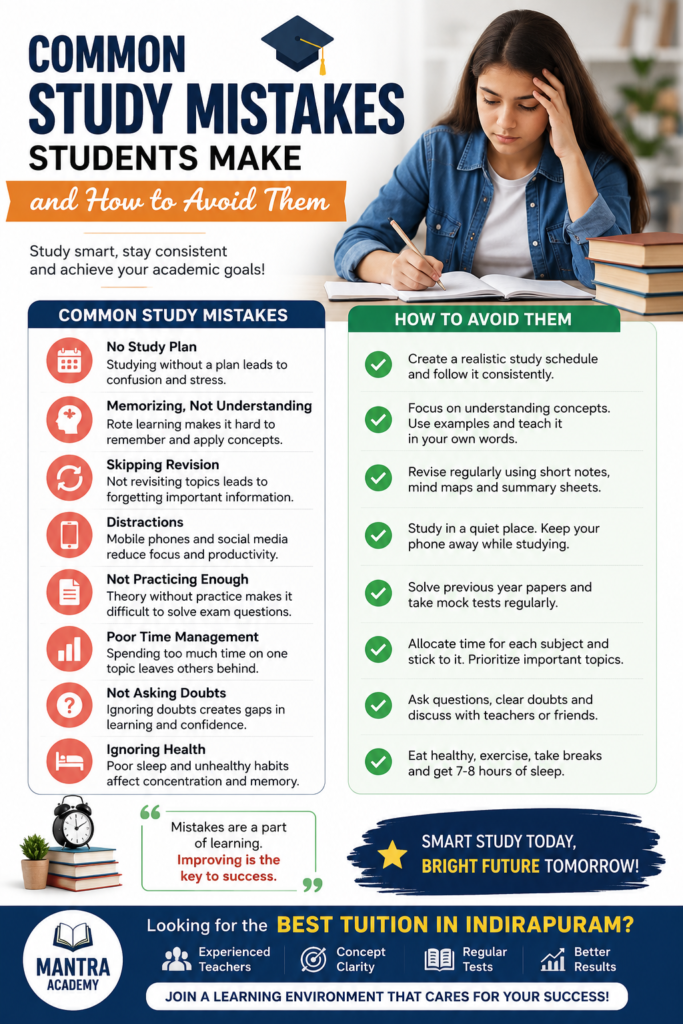

Many students spend hours with their books open, yet their exam results don’t reflect their efforts. The problem isn’t always a lack of hard work—it’s often the way they study. Small mistakes like memorizing without understanding, skipping revision, or studying without a plan can significantly affect academic performance.
Whether you’re preparing for school exams or competitive tests, avoiding these common study mistakes can help you learn faster, remember longer, and score better. If you’re looking for the best tuition in Indirapuram, understanding these mistakes is the first step toward achieving academic success.
Why Do Students Make Study Mistakes?
Every student learns differently. Some struggle with time management, while others become distracted by mobile phones or social media. Many students are never taught effective study techniques, so they continue using methods that don’t deliver results.
The good news is that these habits can be changed with proper guidance, discipline, and consistent practice.
1. Studying Without a Proper Schedule
One of the biggest mistakes students make is studying only when exams are close. Last-minute preparation creates stress and leaves little time to understand concepts.
How to Avoid It
- Create a realistic weekly study timetable.
- Study difficult subjects during your most productive hours.
- Divide large chapters into smaller daily goals.
- Keep time for revision every week.
A consistent routine helps reduce anxiety and improves long-term memory.
2. Memorizing Instead of Understanding
Many students focus only on memorizing answers. While this may help in the short term, it becomes difficult to solve application-based questions or answer differently worded exam questions.
How to Avoid It
- Understand the concept before learning the answer.
- Ask “Why?” and “How?” while studying.
- Use diagrams, examples, and real-life situations.
- Teach the topic to someone else to check your understanding.
Conceptual learning builds confidence and improves problem-solving skills.
3. Ignoring Revision
Students often believe reading a chapter once is enough. Unfortunately, our brain naturally forgets information if it isn’t revised.
How to Avoid It
Follow a simple revision cycle:
- Revise within 24 hours.
- Revise again after one week.
- Review once more before exams.
Regular revision strengthens memory and reduces last-minute pressure.
4. Studying with Constant Distractions
Mobile phones, television, notifications, and social media can reduce concentration without students even realizing it.
How to Avoid It
- Keep your phone away while studying.
- Turn off unnecessary notifications.
- Study in a quiet environment.
- Use focused study sessions with short breaks.
Even one hour of distraction-free study is often more productive than three hours of interrupted learning.
5. Not Practicing Enough Questions
Reading textbooks alone isn’t enough. Exams test your ability to apply concepts, not just recognize them.
How to Avoid It
- Solve previous years’ question papers.
- Practice sample papers regularly.
- Attempt mock tests with time limits.
- Review mistakes after every practice session.
Practice improves speed, accuracy, and confidence.
6. Avoiding Difficult Subjects
Students naturally spend more time on subjects they enjoy and ignore the ones they find difficult.
This creates bigger learning gaps over time.
How to Avoid It
- Start your study session with difficult subjects.
- Break challenging topics into smaller sections.
- Seek help immediately when concepts aren’t clear.
- Practice regularly instead of postponing.
With consistency, difficult subjects often become easier than expected.
7. Poor Time Management During Exams
Many students know the answers but fail to complete the paper because they spend too much time on a few questions.
How to Avoid It
- Practice writing answers within time limits.
- Learn to prioritize easier questions first.
- Keep the last few minutes for revision.
- Avoid spending excessive time on one question.
Time management can improve overall exam scores significantly.
8. Not Asking Questions
Some students hesitate to ask doubts because they fear being judged. As a result, confusion continues to grow.
How to Avoid It
Remember that every successful student asks questions.
- Clarify doubts immediately.
- Participate in classroom discussions.
- Ask teachers for additional examples.
- Never leave a topic partially understood.
Learning becomes much easier when doubts are cleared on time.
9. Depending Only on Notes
Notes are helpful, but relying only on summarized material can limit understanding.
How to Avoid It
Use multiple learning resources:
- School textbooks
- Reference books
- Practice worksheets
- Educational videos
- Teacher explanations
A balanced approach improves both knowledge and confidence.
10. Ignoring Physical and Mental Health
Many students sacrifice sleep before exams, believing extra study hours will improve performance.
In reality, lack of sleep reduces concentration, memory, and decision-making ability.
How to Avoid It
- Sleep for 7–8 hours daily.
- Eat balanced meals.
- Stay physically active.
- Take short breaks while studying.
- Drink enough water.
A healthy body supports a healthy mind.
How Parents Can Help Students Study Better
Parents play an equally important role in academic success.
Here are a few simple ways parents can support learning:
- Create a distraction-free study environment.
- Encourage consistency rather than pressure.
- Appreciate effort, not just marks.
- Communicate regularly with teachers.
- Help students maintain a balanced routine.
Positive encouragement builds confidence and motivation.
When Should You Consider Professional Academic Guidance?
Sometimes students work hard but still struggle because they need personalized support.
Joining a reputed coaching institute in Indirapuram can provide structured learning, regular assessments, experienced teachers, and personalized attention that helps students overcome weak areas more effectively.
For students who require individual attention or flexible schedules, experienced home tutors in Indirapuram Ghaziabad can also provide customized learning support based on the student’s pace and academic needs.
Final Thoughts
Success in academics isn’t about studying longer—it’s about studying smarter. By avoiding common mistakes like poor planning, memorization without understanding, skipping revision, and avoiding practice, students can improve both their confidence and their results.
Parents and students should remember that good study habits develop gradually through consistency, discipline, and the right guidance. If you’re searching for the best tuition in Indirapuram, choose a learning environment that focuses on concept clarity, regular practice, personalized attention, and continuous improvement. The right support system can transform study habits and help students achieve their full academic potential.