
Open source application development has moved from a niche engineering preference to a mainstream business strategy. Across the United States, companies of every size, from early stage startups, are building their core software on open source foundations. The reasons go far beyond saving money on licenses. Open source gives companies control, speed, and access to a global pool of innovation that proprietary software simply cannot match.
In this guide, we will walk through why open source application development has become the default choice for so many US businesses, what real benefits it delivers, where it works best, and how to adopt it without running into common pitfalls. Whether you are a CTO evaluating your next tech stack or a founder trying to move fast without burning through your budget, this article will give you a clear, practical picture.
What Is Open Source Application Development
Open source application development is the process of building software using source code that is publicly available for anyone to view, modify, and distribute. Instead of relying on closed, vendor-owned codebases, development teams use frameworks, libraries, and tools maintained by open communities such as Linux, React, PostgreSQL, Kubernetes, and thousands of others.
This approach is not just about using free tools. It is a philosophy built around transparency, collaboration, and shared improvement. When a company chooses open source software development, it gains access to code that has been tested, reviewed, and improved by developers around the world, often for years before that company ever uses it.
For US companies operating in competitive, fast moving markets, this translates into a real strategic advantage: you are not starting from zero, and you are not locked into a single vendor’s roadmap.
Why USA Companies Are Choosing Open Source
The shift toward open source software solutions in the United States is not a trend, it is a structural change in how software gets built. A few forces are driving this shift:
- Rising software costs. Licensing fees for proprietary enterprise software have climbed steadily, pushing IT budgets to their limits.
- Talent availability. Most computer science graduates and experienced developers in the US learn and work with open source technologies like JavaScript frameworks, Python, and container tools, making hiring and onboarding easier.
- Cloud native growth. Open source is the backbone of cloud computing, from Kubernetes orchestrating containers to Terraform managing infrastructure.
- Demand for faster innovation. Businesses need to ship features quickly, and open source ecosystems remove the friction of waiting on a vendor’s release cycle.
Put simply, open source application development lets American companies build faster, spend smarter, and stay in control of their own technology decisions.
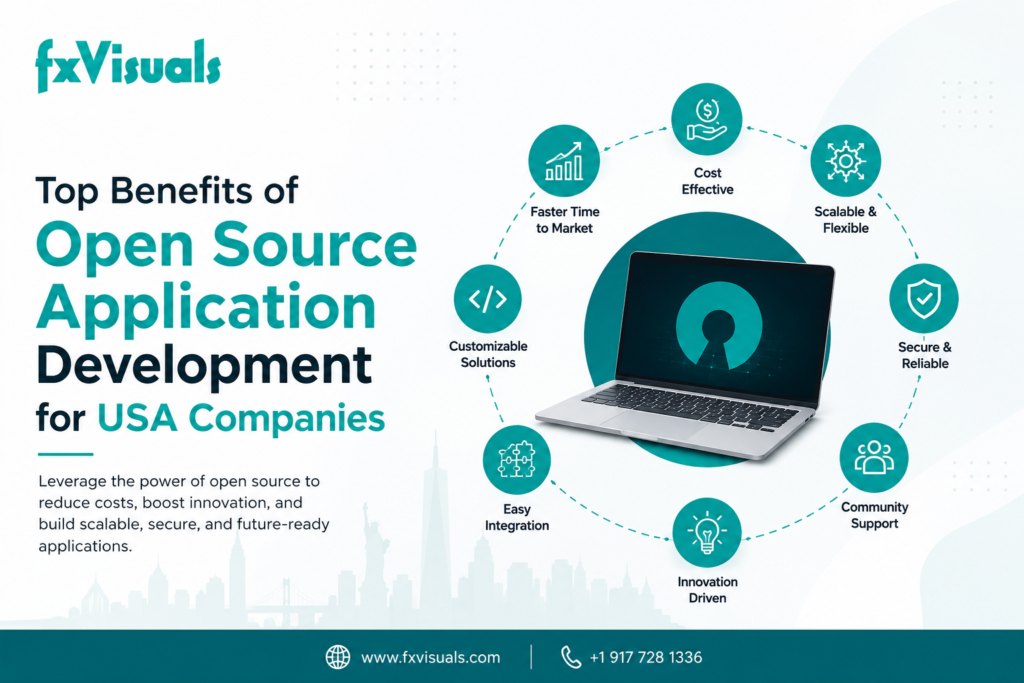
Top Benefits of Open Source Application Development
1. Lower Total Cost of Ownership
The most obvious advantage is cost. Open source software eliminates licensing fees, which can run into hundreds of thousands of dollars annually for enterprise-grade proprietary systems. While there are still costs involved, such as development, hosting, and maintenance, companies typically see a significantly lower total cost of ownership over the life of an application.
2. Full Customization and Flexibility
With open source, you are not limited to whatever features a vendor decides to build. Development teams can modify the source code directly to fit exact business requirements. This level of custom application development flexibility is nearly impossible to achieve with closed, proprietary platforms.
3. Stronger Security Through Transparency
A common misconception is that open source software is less secure because the code is public. In practice, the opposite tends to be true. Open codebases are reviewed by thousands of independent developers and security researchers, which means vulnerabilities are often identified and patched faster than in closed systems where only a small internal team has visibility.
4. No Vendor Lock-In
Proprietary software often comes with hidden costs down the road: forced upgrades, unpredictable price increases, and limited ability to switch providers. Open source application development gives companies full ownership of their technology stack, so decisions about scaling, hosting, or switching tools remain entirely in-house.
5. Faster Time to Market
Because open source frameworks and libraries already solve common technical problems, development teams do not need to reinvent core functionality. This lets teams focus on building the features that actually differentiate their product, cutting weeks or months off the development timeline.
6. Access to a Global Developer Community
Open source projects are backed by active communities that contribute plugins, documentation, bug fixes, and improvements. This collective knowledge base acts like an extended engineering team, available at no additional cost.
7. Built-In Scalability
Technologies like Kubernetes, Docker, and PostgreSQL were built to handle massive scale from the ground up, because they power some of the largest platforms in the world. Companies adopting these tools inherit that scalability without having to build it themselves.
8. Continuous Innovation
Open source ecosystems evolve quickly because improvements come from a wide, diverse pool of contributors rather than a single company’s product team. This constant iteration means businesses get access to cutting-edge features, often before proprietary competitors catch up.
Open Source vs Proprietary Software: A Quick Comparison
| Factor | Open Source Software | Proprietary Software |
| Cost | Low to no licensing fees | High licensing and subscription costs |
| Customization | Fully customizable source code | Limited to vendor-approved features |
| Vendor Lock-In | None, full ownership | High, dependent on vendor roadmap |
| Security | Transparent, community-reviewed | Closed, dependent on vendor patches |
| Support | Community plus optional paid support | Vendor-provided support included |
| Time to Market | Faster, reusable components | Slower, dependent on vendor release cycles |
| Scalability | Built for scale by design | Varies by vendor architecture |
| Innovation Pace | Rapid, community-driven | Slower, controlled by vendor priorities |
Real World Use Cases
Fintech and Banking
Financial companies use open source frameworks to build secure, compliant applications while maintaining full control over data handling and audit trails, something that is critical for meeting US regulatory requirements like SOC 2 and PCI DSS.
Healthcare Technology
Healthcare platforms rely on open source databases and backend frameworks to manage patient data securely while customizing workflows to match HIPAA compliance needs, without depending on a single vendor for critical infrastructure.
E-commerce Platforms
Retailers use open source content management systems and headless commerce frameworks to build fast, SEO-friendly storefronts that can be customized freely as the business grows, avoiding the rigid limitations of proprietary e-commerce platforms.
SaaS Startups
Startups building SaaS products lean heavily on open source application development to move fast without burning capital on licensing. Frameworks like Node.js, React, and open source databases let small teams build production-grade products quickly.
Best Practices for Open Source Application Development
- Choose actively maintained projects. Check commit history, contributor activity, and issue response times before adopting any open source tool.
- Understand the license terms. Licenses like MIT, Apache 2.0, and GPL have different obligations. Know what you can and cannot do commercially before building on top of them.
- Invest in security scanning. Use tools that continuously scan dependencies for known vulnerabilities, since open source projects are frequently targeted by supply chain attacks.
- Contribute back when possible. Fixing bugs upstream and contributing improvements strengthens the ecosystem and often earns goodwill with maintainers who can help troubleshoot issues faster.
- Document your customizations. Since open source code can be modified freely, clear internal documentation prevents knowledge loss when developers move on.
- Plan for long-term maintenance. Open source is not “set and forget.” Budget time and resources for updates, patches, and dependency management.
- Work with experienced partners. Partnering with a development team that has real experience in open source software development reduces the risk of costly architectural mistakes.
Common Mistakes to Avoid
- Ignoring license compliance. Using GPL-licensed code in a proprietary commercial product without understanding the obligations can create serious legal risk.
- Choosing inactive or abandoned projects. A library with no updates in years is a liability, not an asset.
- Underestimating maintenance costs. Free to use does not mean free to maintain. Ongoing updates, security patches, and compatibility checks require real resources.
- Skipping security audits. Public code does not mean automatically secure code. Every dependency needs to be vetted.
- Failing to document customizations. Undocumented changes to open source code create technical debt that slows down future development.
- Treating community support as a replacement for expertise. Community forums are helpful, but complex, mission-critical applications still need experienced engineers who understand the underlying architecture.
How fxVisuals Helps Companies Build with Open Source
At fxVisuals, we work with US companies to design, build, and scale applications using proven open source technologies. Our team helps businesses avoid the common pitfalls of open source adoption, from choosing the right frameworks to managing long-term maintenance, so they get the cost savings and flexibility of open source without the operational risk.
Whether you are modernizing legacy software or building a new product from scratch, fxVisuals can help you put together an open source strategy that fits your business goals and budget. Many of the companies we work with come to fxVisuals specifically because they want a development partner who understands both the technical and business sides of open source adoption.
Frequently Asked Questions
Is open source application development secure for business use?
Yes. Open source security often benefits from broad community review, which tends to catch vulnerabilities faster than closed systems reviewed by smaller internal teams. Security still depends on proper implementation, regular updates, and dependency monitoring.
Is open source software really free?
The source code itself is typically free to use, but businesses still need to budget for development, hosting, maintenance, and sometimes paid support or enterprise add-ons.
What is the difference between open source and free software?
Open source refers to software with publicly available source code that can be modified and redistributed under specific license terms. Free software may simply mean no cost, without the same transparency or modification rights.
Can open source applications scale for large enterprises?
Yes. Technologies like Kubernetes, PostgreSQL, and Linux already power some of the largest platforms in the world, so scalability is built into many open source tools from the start.
How do companies choose the right open source technology stack?
The right stack depends on business goals, technical requirements, team expertise, and long-term maintenance plans. Working with an experienced development partner helps avoid costly missteps early on.
Does using open source software create legal risk?
It can, if license terms are not followed correctly. Different licenses (MIT, Apache, GPL, and others) carry different obligations, so understanding the terms before building a commercial product is essential.
Conclusion
Open source application development gives US companies a rare combination of cost savings, flexibility, security, and speed, without the constraints that come with proprietary software. From startups trying to move fast on a limited budget to enterprises looking to modernize legacy systems, open source has proven itself as a reliable foundation for building software that scales with the business rather than against it.
The key to success is not just choosing open source, but choosing it strategically: picking actively maintained projects, understanding license terms, planning for long-term maintenance, and working with a team that knows how to avoid the common pitfalls.
If your company is considering a move toward open source application development, fxVisuals can help you build a strategy tailored to your goals. Reach out to fxVisuals today to discuss how open source technology can help your business build faster, spend smarter, and scale with confidence.