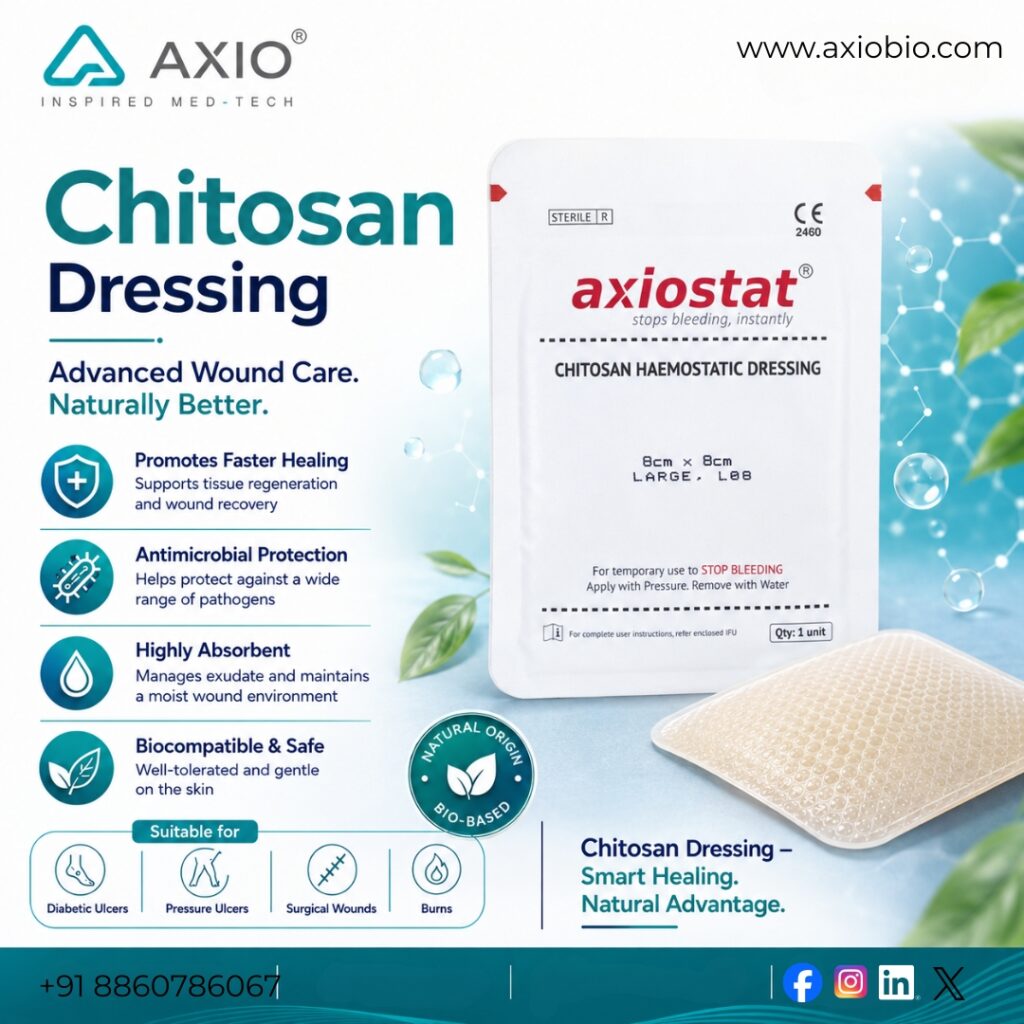

Ahmedabad’s healthcare landscape has changed dramatically over the past decade. Trauma centers handle higher patient loads, ambulance response times have improved, and hospitals across Gujarat are adopting more advanced first-response protocols. Yet one of the biggest shifts hasn’t come from better infrastructure alone. It has come from the material used in the first few minutes after an injury occurs.
That material is chitosan.
For emergency physicians, paramedics, and even home first-aid kits, chitosan technology has quietly become one of the most talked-about developments in bleeding control. It is not a new discovery in the scientific sense, but its application in modern wound care and trauma response has matured significantly, especially in India’s fast-growing medical device sector.
This article breaks down what chitosan technology actually is, why it matters for trauma care in Ahmedabad specifically, and what clinicians and caregivers should know before choosing a hemostatic solution.
What Is Chitosan Technology, Exactly?
Chitosan is a natural biopolymer derived from chitin, a substance found in the shells of crustaceans like shrimp and crab. Once processed into a medical-grade form, chitosan carries a positive ionic charge. This is the detail that matters most in trauma care.
Blood cells carry a negative charge. When chitosan comes into contact with a bleeding wound, the opposite charges attract each other almost instantly. Red blood cells and platelets bind to the chitosan surface, forming a dense, gel-like clot that seals the wound mechanically. This happens independent of the body’s normal clotting cascade, which is why chitosan wound dressing products work even in patients with clotting disorders or those on blood thinners.
This mechanism is the foundation of most modern chitosan gauze formats used across surgical and trauma settings today.
A few things set this technology apart from older gauze-based approaches:
- It does not rely on the patient’s own clotting factors, making it effective for arterial and venous bleeding alike
- It forms a flexible seal that conforms to irregular wound shapes, unlike rigid dressings
- It is biodegradable and biocompatible, reducing tissue irritation during removal
- It performs consistently in field conditions, not just controlled hospital environments
Why Ahmedabad’s Trauma Care Sector Is Paying Attention
Ahmedabad sits at the center of Gujarat’s medical and industrial activity. With a dense mix of manufacturing units, highway traffic corridors, and a growing private hospital network, the city sees a steady volume of trauma cases every year, ranging from industrial accidents to road traffic injuries.
In these situations, the first few minutes determine outcomes far more than what happens once a patient reaches a fully equipped operating theatre. Ambulance crews, factory first-aid stations, and even home users increasingly need a bleeding control dressing that works reliably without requiring advanced medical training.
This is where chitosan technology has found real traction. Unlike older cotton-based trauma dressing methods that rely on pressure and time, chitosan-based products actively participate in clot formation. For a city like Ahmedabad, where response time can vary depending on traffic and distance to the nearest trauma center, that difference can be meaningful.
Local hospitals, occupational health units in industrial zones, and even sports medicine clinics have started incorporating chitosan gauze into their standard first-response kits for exactly this reason.
How Chitosan Dressings Compare to Traditional Methods
It helps to understand what came before. Traditional gauze dressings work primarily through absorption and pressure. They soak up blood and rely on the body’s own clotting mechanism to eventually stop bleeding. This works fine for minor cuts, but it is far less effective for:
- Deep lacerations
- Arterial bleeds
- Wounds in patients on anticoagulant medication
- Field situations where sustained manual pressure isn’t practical
Chitosan dressing technology addresses these gaps directly. Because the clotting action is chemical rather than purely mechanical, it works faster and more predictably across a wider range of injury types. Several independent clinical evaluations, along with data available on our comparative evidence page, illustrate how hemostatic gauze performs against conventional alternatives in real-world trauma scenarios.
This isn’t about dismissing traditional dressings entirely. Cotton gauze still has its place for minor wound management. But when the goal is genuine bleeding control in higher-risk situations, chitosan-based solutions offer a more dependable option, and that is increasingly reflected in hospital procurement decisions across Ahmedabad and the wider Gujarat region.
What Makes a Chitosan Product Reliable
Not all chitosan-based dressings are built the same way. The purity of the chitosan, the manufacturing process, and the final product format all affect real-world performance. When evaluating a best hemostatic gauze option, a few factors are worth checking:
- Molecular weight and deacetylation level of the chitosan used, which directly affects clotting speed
- Sterility standards during manufacturing, since trauma dressings are often used in non-sterile field environments
- Flexibility and conformability of the dressing material for irregular wound shapes
- Shelf stability, particularly important for ambulance kits and industrial first-aid stations that may not see frequent turnover
- Clinical validation, meaning the product has documented performance data rather than marketing claims alone
These are the same criteria hospital procurement teams and paramedic training programs use when selecting a bleeding control dressing for standard-issue kits. Products developed with rigorous manufacturing oversight tend to perform more consistently across varied trauma scenarios, which is why clinical documentation matters as much as the underlying chemistry.
The Broader Shift Toward Chitosan in Indian Healthcare
India’s medical device sector has grown considerably more sophisticated over the past several years, and wound care is one of the categories where domestic innovation has genuinely kept pace with international standards. Chitosan-based hemostatic technology, once seen mainly in defense and battlefield medicine contexts, has moved into mainstream civilian trauma care, sports medicine, surgical settings, and even home emergency kits.
This shift reflects a few converging factors:
- Rising awareness among clinicians about the limitations of traditional gauze in high-bleed scenarios
- Greater domestic manufacturing capability, reducing dependence on imported hemostatic products
- Growing hospital investment in evidence-based procurement rather than legacy habits
- Increased public and institutional interest in faster, science-backed trauma response tools
For a city like Ahmedabad, with its blend of industrial activity, dense road networks, and expanding private healthcare infrastructure, this shift has practical implications. Faster, more reliable bleeding control at the point of injury reduces complications and can meaningfully affect patient outcomes before they even reach a hospital setting.
You can explore the full range of chitosan technology formulations for a more detailed technical breakdown.
Practical Considerations for Hospitals and First Responders
For institutions considering a transition to chitosan-based trauma dressings, a few practical points are worth keeping in mind:
- Staff training matters. Even though chitosan dressings are easier to use correctly than some legacy methods, proper application technique still affects outcomes
- Storage conditions should follow manufacturer guidance, particularly for ambulance and field kits exposed to temperature variation
- Procurement decisions should be based on documented clinical performance, not price alone
- Integration into existing trauma protocols should be gradual, with clear guidelines on when chitosan-based products are indicated versus standard gauze
Hospitals and industrial safety units in Ahmedabad that have already integrated chitosan technology into their first-response kits report smoother handling during high-bleed emergencies, along with fewer complications tied to delayed clot formation.
Industry Perspective
The direction of trauma care in India is increasingly shaped by evidence rather than legacy habit. Chitosan technology represents one of the clearer examples of this shift, a scientifically grounded approach that has moved from specialized use cases into everyday clinical and field practice.
For Ahmedabad specifically, where trauma response speed genuinely affects patient outcomes given the city’s industrial density and traffic patterns, this technology offers a meaningful upgrade over conventional wound care methods. As more hospitals, occupational health units, and emergency services adopt chitosan-based dressings, the standard for what counts as adequate first-response bleeding control is likely to keep rising.
To learn more about how these solutions are developed and validated, reach out through our contact page. You can also read more about our background and clinical focus on the about us page.
People also ask
What is chitosan technology used for in wound care?
Chitosan technology is primarily used to control bleeding in trauma, surgical, and emergency settings. Its positively charged surface binds with blood cells to form a clot quickly, making it effective for wounds where standard gauze may not work fast enough.
Is chitosan-based hemostatic gauze safe for patients on blood thinners?
Yes. Because chitosan works through a physical charge-based clotting mechanism rather than relying on the body’s natural clotting cascade, it remains effective for patients on anticoagulant medication.
How is chitosan gauze different from regular gauze?
Regular gauze relies on absorption and pressure, depending on the body’s own clotting process. Chitosan gauze actively participates in clot formation through its ionic charge, making it more effective for significant or arterial bleeding.
Can chitosan dressings be used outside hospital settings?
Yes. Chitosan-based trauma dressings are commonly used in ambulances, industrial first-aid kits, sports medicine settings, and even home emergency kits due to their ease of use and reliability in non-clinical environments.
Why is chitosan technology gaining popularity in India?
Growing clinical evidence, improved domestic manufacturing capability, and rising awareness among hospitals about the limitations of traditional gauze have all contributed to wider adoption of chitosan-based hemostatic products across Indian healthcare.
Contact Information
Website: https://axiobio.com
Email: info@axiobio.com
Phone no: +91 8860786067
Follow Axiobio on Social Media
LinkedIn | Facebook | Instagram | YouTube
Stay connected with Axiobio for the latest updates on hemostatic innovations, wound care advancements, clinical insights, healthcare education, and new product developments.