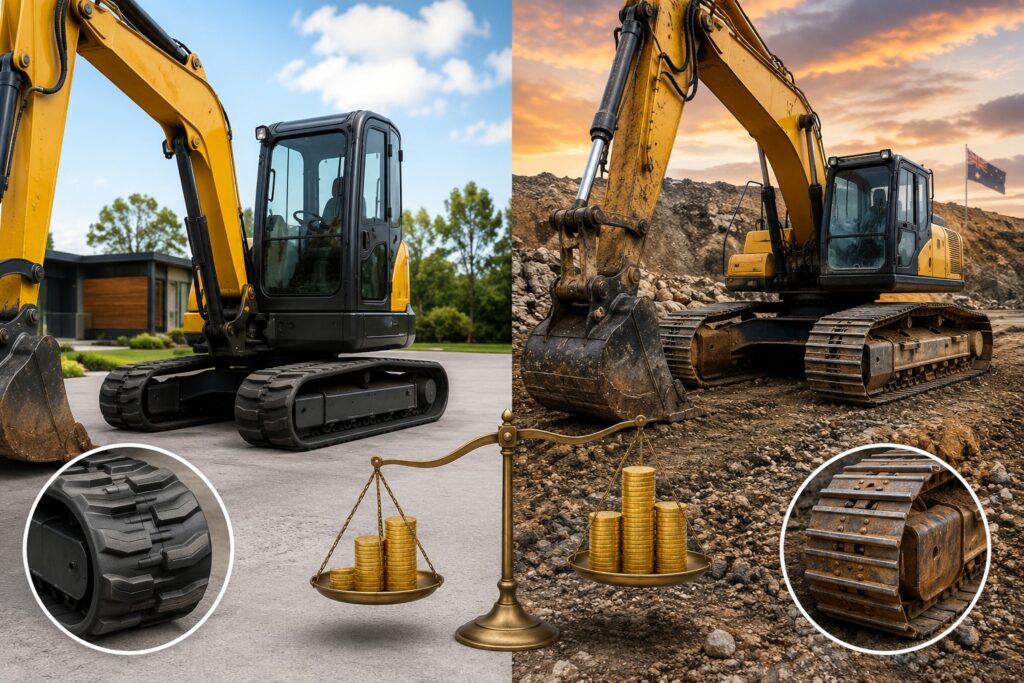

The choice between rubber tracks and steel tracks is not simply about upfront price. It is about total cost across the life of the tracks purchase price, wear rate, surface damage risk, fuel consumption, operator comfort, and the cost of downtime when something goes wrong.
Australian operators work across a wide range of conditions: soft agricultural ground, hard compacted construction sites, rocky mine site access roads, and everything in between. The right track type depends heavily on where and how the machine is used. Getting this decision wrong costs money every day the machine is running.
This article breaks down both track types honestly so you can make the right call for your operation.
What the Upfront Cost Actually Tells You
Steel tracks cost more to purchase than rubber tracks for the same machine class. That is a straightforward fact. On a mid-size mini excavator, a set of steel tracks will typically sit notably higher in price than a comparable rubber set.
But upfront price is the least useful number in this comparison. A rubber track that wears out in 800 hours on a hard rocky surface costs more over two years than a steel track that runs 3,000 hours on the same ground. The purchase price is just the starting point.
The more useful question is: what is the cost per operating hour across the expected service life in your specific conditions?
Where Rubber Tracks Win
Soft and Sensitive Ground
Rubber tracks are wider in contact area relative to their weight and cause significantly less surface damage than steel. On agricultural land, landscaped areas, golf courses, paved surfaces, or anywhere the ground condition matters, rubber is the correct choice.
Steel tracks on soft ground cause ruts, surface damage, and compaction that can create costly remediation work. On a paved surface, steel tracks cause damage from the first metre of travel.
Fuel Consumption and Machine Efficiency
Rubber tracks are lighter than steel. Less rotating mass means less energy required to drive the undercarriage, which translates directly to lower fuel consumption over time. On a machine running eight hours a day, five days a week, the fuel saving across a year of operation is measurable.
Operator Comfort and Machine Vibration
Steel tracks transmit significantly more vibration to the operator than rubber. On long operating days this affects operator fatigue and productivity. It also affects the machine prolonged vibration accelerates wear on pins, bushings, and structural components beyond the undercarriage itself.
Travel Speed
Rubber-tracked machines travel faster between work areas than steel-tracked machines. On sites where the machine moves frequently suburban construction, landscaping, utility work this adds up to genuine time saving over a working week.
Urban and Residential Sites
On urban job sites, rubber tracks are often the only practical option. Steel tracks on concrete or pavers cause surface damage that the contractor is liable for. Many site conditions in Australian urban construction specify rubber-tracked machines as a requirement.
Where Steel Tracks Win
Rocky and Abrasive Ground Conditions
Hard, sharp, rocky ground destroys rubber tracks. The abrasion from rock edges cuts into the rubber compound, accelerates lug wear, and can expose the steel cord reinforcement well before the track reaches its expected service life.
Steel tracks are designed for this environment. The steel pads withstand abrasion and impact that would destroy a rubber track in a fraction of the time. On mine site access roads, quarry floors, or rocky hillside work, steel tracks last significantly longer.
High-Load and Heavy-Duty Applications
For demolition, heavy earthmoving, and applications where the machine is under constant high load, steel tracks handle the stress better. The structural capacity of steel undercarriage systems suits machines working at or near their rated capacity for extended periods.
Extreme Heat Conditions
Prolonged operation on very hot surfaces compacted gravel in direct sun, hot asphalt, or similar surfaces in Australian summer conditions accelerates rubber degradation. Steel tracks are unaffected by surface temperature in a way that rubber is not.
Long Service Life in the Right Conditions
In the conditions they are designed for, steel tracks last longer than rubber tracks. For operations where the machine works predominantly in hard, abrasive conditions, the longer service interval of steel reduces the frequency and cost of track replacement.
The Hidden Costs That Change the Calculation
Surface Damage Liability
Steel tracks on the wrong surface create liability. If a steel-tracked machine damages a paved access road, a client’s driveway, or a landscaped area, the cost of repair falls on the operator or contractor. In some cases this cost exceeds the value of the tracks themselves.
Rubber tracks eliminate this risk on appropriate surfaces.
Undercarriage Wear Rate
The track type affects the wear rate of the entire undercarriage system — rollers, idlers, sprockets, and carrier rollers. Steel tracks on hard ground generate higher impact loads through the undercarriage components than rubber tracks on the same ground.
If your undercarriage is wearing faster than expected, the track type and ground conditions combination is worth reviewing before the next set of components is due.
Productivity Loss from the Wrong Choice
A rubber-tracked machine running on rocky ground will de-track, wear rapidly, and require more frequent replacement. Each track replacement means downtime. Downtime on a productive machine has a cost that does not appear in the track purchase price but is very real.
Fitting the correct track type for the application is a direct productivity decision, not just a maintenance decision.
A Practical Decision Framework for Australian Operators
The conditions your machine works in most of the time should drive the decision:
Choose rubber tracks when the machine works primarily on:
- Agricultural land, turf, or soft ground
- Paved or sealed surfaces
- Urban construction and residential sites
- Mixed conditions with frequent road travel
- Any surface where ground damage is a liability
Choose steel tracks when the machine works primarily on:
- Rocky, abrasive ground
- Quarry or mine site environments
- Heavy demolition
- Remote sites with no sealed surface exposure
- Applications where maximum track life in hard conditions is the priority
If the machine works across both conditions regularly, rubber tracks with bolt-on steel pads offer a practical middle ground. The rubber track provides the base performance on soft or sealed surfaces, and the bolt-on pads add protection and traction on harder ground without fully committing to steel.
What Australian Operators Often Get Wrong
The most common mistake is buying rubber tracks because they are cheaper upfront and then running them on ground conditions that destroy rubber quickly. The second most common mistake is the reverse running steel tracks on urban sites and paying for surface damage that outweighs any saving on the track itself.
Neither track type is universally better. The one that saves you more money is the one matched to your actual operating conditions.
If your conditions change seasonally agricultural work in winter and construction work in summer, for example it is worth having both track types available and swapping based on the work at hand. The cost of carrying a second set of tracks is often less than the cost of running the wrong type year-round.
Getting the Right Recommendation for Your Machine
Track selection for your specific machine and application is something a specialist can confirm quickly. The machine model, the ground conditions, and the expected operating hours per year are enough information to give a clear recommendation.
For Australian operators looking at mini excavator tracks or compact track loader tracks across a range of conditions, Tradefaire International carries rubber tracks, steel tracks, and bolt-on rubber pads and can confirm the correct specification and track type before you order.
Call 1300 915 078 or use the online quote form to get a recommendation based on your machine and working conditions.
FAQ
Are rubber tracks cheaper than steel tracks overall?
Rubber tracks have a lower purchase price in most machine classes, but total cost depends on operating conditions. Rubber tracks in the right conditions can outlast steel tracks in the wrong conditions by a significant margin. The cost per operating hour in your specific environment is the number that matters.
Can steel tracks damage concrete or sealed surfaces?
Yes. Steel tracks cause surface damage on concrete, pavers, asphalt, and any sealed surface from the first pass. On urban job sites or anywhere surface condition matters, rubber tracks are the correct choice.
What are bolt-on rubber track pads?
Bolt-on rubber pads attach to steel track shoes, adding rubber contact on the underside of each pad. They allow a steel-tracked machine to operate on sealed surfaces without causing damage. They are a practical option when a machine needs to work on both hard ground and sealed surfaces regularly.
How long do rubber tracks last on a mini excavator?
Service life varies significantly based on ground conditions, operating hours, and maintenance. Rubber tracks in suitable conditions typically run between 1,200 and 2,000 hours. Rocky or abrasive ground reduces this considerably. Regular inspection and correct tensioning extend track life.
Does track type affect fuel consumption?
Yes. Rubber tracks are lighter than steel, which reduces the energy required to drive the undercarriage. The fuel saving per hour is small, but across a full year of operation it becomes a measurable figure.
Can I switch between rubber and steel tracks on the same machine?
On most mini excavators and compact track loaders, yes provided the replacement tracks match the correct W × P × L specification for the machine. Swapping track types seasonally based on ground conditions is a practical approach for machines that work across varied environments.