
Medical imaging has become one of the most transformative technologies in modern healthcare. From X-rays and CT scans to MRI and ultrasound images, healthcare professionals rely on medical imaging to diagnose diseases, monitor patient conditions, and guide treatment decisions. As Artificial Intelligence (AI) continues to revolutionize healthcare, the quality of training data has emerged as a critical factor in developing reliable diagnostic systems.
Among various annotation techniques, polygon annotation has become an essential method for creating highly accurate medical imaging datasets. By precisely outlining anatomical structures, tumors, lesions, organs, and abnormalities, polygon annotation enables AI models to learn detailed visual patterns that are crucial for medical diagnosis.
At Annotera, we provide specialized polygon annotation services that help healthcare organizations, AI developers, and research institutions build robust medical imaging datasets. As a trusted data annotation company, we understand the importance of precision, consistency, and quality in healthcare AI applications.
Understanding Polygon Annotation in Medical Imaging
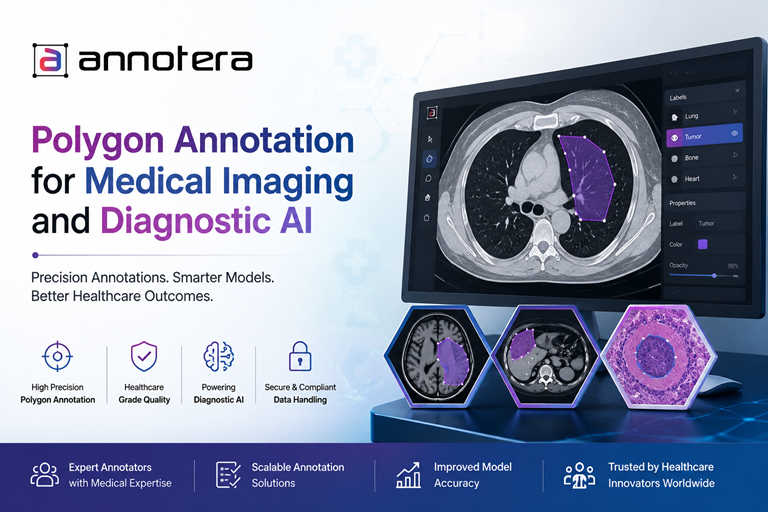
Polygon annotation is a data labeling technique where annotators draw multiple connected points around an object’s exact boundaries. Unlike bounding boxes that simply enclose an object within a rectangular frame, polygon annotation captures the true shape and contours of medical structures.
In medical imaging, many anatomical features have irregular shapes and complex boundaries. Tumors, organs, blood vessels, and lesions often cannot be accurately represented using simple rectangular annotations. Polygon labeling allows annotators to define these structures with exceptional precision.
For example, when annotating a lung nodule in a CT scan, polygon annotation can accurately trace the nodule’s edges, providing AI systems with detailed information about its size, shape, and location.
This level of precision is critical for developing diagnostic AI systems that support clinicians in identifying diseases and abnormalities.
Why Accuracy Matters in Diagnostic AI
Healthcare AI systems operate in high-stakes environments where inaccurate predictions can have significant consequences. A small labeling error in a training dataset may impact model performance and potentially affect diagnostic outcomes.
Diagnostic AI applications require detailed image understanding for tasks such as:
- Cancer detection
- Tumor segmentation
- Organ identification
- Lesion localization
- Disease progression monitoring
- Surgical planning
- Radiology workflow automation
Polygon annotation provides the pixel-level accuracy necessary for these applications. By creating detailed object boundaries, it helps machine learning models distinguish between healthy and abnormal tissues more effectively.
As a result, AI systems trained with accurately annotated datasets often achieve improved detection accuracy, segmentation quality, and diagnostic reliability.
Applications of Polygon Annotation in Medical Imaging
Tumor Detection and Segmentation
Cancer diagnosis is one of the most prominent applications of AI in healthcare. Tumors frequently have irregular shapes and varying sizes, making accurate annotation essential.
Polygon annotation enables precise delineation of tumor boundaries in:
- MRI scans
- CT scans
- Mammography images
- Histopathology slides
- PET scans
These annotations help AI models learn subtle visual characteristics that differentiate tumors from surrounding tissues.
Organ Segmentation
Medical imaging AI often requires accurate identification of organs for treatment planning and disease analysis.
Polygon annotation supports segmentation of:
- Liver
- Kidneys
- Heart
- Lungs
- Brain structures
- Pancreas
Precise organ segmentation allows AI systems to measure organ size, detect abnormalities, and assist physicians in evaluating patient health.
Lesion and Abnormality Detection
Many diseases manifest as small lesions or abnormalities that can be difficult to identify.
Polygon annotation helps define:
- Skin lesions
- Brain lesions
- Liver lesions
- Retinal abnormalities
- Pulmonary nodules
The detailed boundaries provided through polygon labeling improve model sensitivity and detection performance.
Histopathology Image Analysis
Digital pathology is becoming increasingly important in disease diagnosis.
Histopathology images contain complex cellular structures that require highly detailed annotations. Polygon annotation enables accurate labeling of:
- Cancerous cells
- Tissue regions
- Cell nuclei
- Biomarkers
These datasets support AI systems designed to assist pathologists in disease identification and classification.
Benefits of Polygon Annotation for Medical AI Development
Enhanced Segmentation Accuracy
Semantic and instance segmentation models require precise boundary information.
Polygon annotation provides detailed object contours that improve segmentation performance and help AI systems understand anatomical structures more accurately.
Better Clinical Relevance
Medical professionals often need measurements based on exact anatomical boundaries.
Because polygon annotations closely match real-world structures, AI outputs become more clinically meaningful and useful in healthcare workflows.
Improved Model Performance
High-quality annotations directly influence machine learning outcomes.
Accurate polygon labels reduce noise in training datasets, enabling models to learn more effectively and generalize better across diverse patient populations.
Support for Regulatory Compliance
Healthcare AI solutions must often meet strict validation and regulatory standards.
Detailed annotation methodologies contribute to dataset transparency and documentation, supporting compliance efforts during model development and evaluation.
Challenges in Medical Polygon Annotation
Although polygon annotation offers substantial benefits, medical imaging projects present unique challenges.
Complex Anatomical Structures
Human anatomy contains intricate structures that may overlap or appear similar in imaging data.
Annotators must possess domain-specific knowledge to correctly identify and outline these structures.
Large Annotation Volumes
Medical AI projects frequently involve thousands of images collected from multiple healthcare facilities.
Managing large-scale annotation efforts while maintaining consistency can be difficult without experienced annotation teams and quality assurance processes.
High Precision Requirements
Even minor annotation inconsistencies may affect model accuracy.
Healthcare datasets require rigorous quality control procedures to ensure reliable training data.
Data Privacy and Security
Medical imaging datasets often contain sensitive patient information.
Organizations must follow strict privacy regulations and implement secure annotation workflows to protect healthcare data.
The Role of Expert Annotation Teams
Medical imaging annotation requires more than technical labeling skills. It often demands collaboration between annotation specialists, quality reviewers, and subject matter experts.
At Annotera, our annotation workflows are designed to maintain consistency, precision, and scalability across healthcare projects. We combine advanced quality control measures with experienced annotation professionals to produce reliable datasets for medical AI development.
As a leading data annotation company, we understand that healthcare applications require a higher level of accuracy than many other AI domains. Our structured review processes help ensure that every polygon annotation meets project-specific requirements.
Polygon Annotation and Video-Based Medical Analysis
While medical imaging often focuses on static images, healthcare increasingly relies on dynamic imaging technologies such as ultrasound videos, endoscopy recordings, and surgical footage.
In these scenarios, polygon annotation can be extended across video frames to track anatomical structures and abnormalities over time.
Organizations seeking specialized support frequently partner with a video annotation company capable of handling complex medical video datasets. High-quality video annotation outsourcing services enable healthcare AI developers to scale projects efficiently while maintaining annotation consistency.
Similarly, data annotation outsourcing allows healthcare organizations to access skilled annotation resources without building large in-house teams, reducing costs and accelerating development timelines.
Why Choose Annotera for Medical Imaging Annotation
Developing successful healthcare AI solutions begins with accurate training data. Annotera delivers precise polygon annotation services tailored to the demanding requirements of medical imaging and diagnostic AI applications.
Our capabilities include:
- Medical image annotation
- Polygon segmentation
- Organ and tumor labeling
- Video annotation services
- Quality assurance workflows
- Scalable dataset management
- Secure data handling practices
Whether you are building cancer detection systems, radiology AI platforms, pathology analysis tools, or next-generation diagnostic solutions, our team provides the annotation expertise needed to support reliable model development.
Conclusion
Polygon annotation has become a foundational component of medical imaging and diagnostic AI. Its ability to accurately capture complex anatomical structures makes it indispensable for applications such as tumor detection, organ segmentation, lesion identification, and pathology analysis.
As healthcare organizations continue investing in AI-driven diagnostics, the demand for precise, high-quality training data will only increase. Partnering with an experienced data annotation company ensures that medical AI models are trained on datasets that meet the highest standards of accuracy and consistency.
At Annotera, we help healthcare innovators accelerate AI development through expert polygon annotation, data annotation outsourcing, medical imaging labeling, and advanced video annotation outsourcing solutions that support the future of intelligent healthcare.