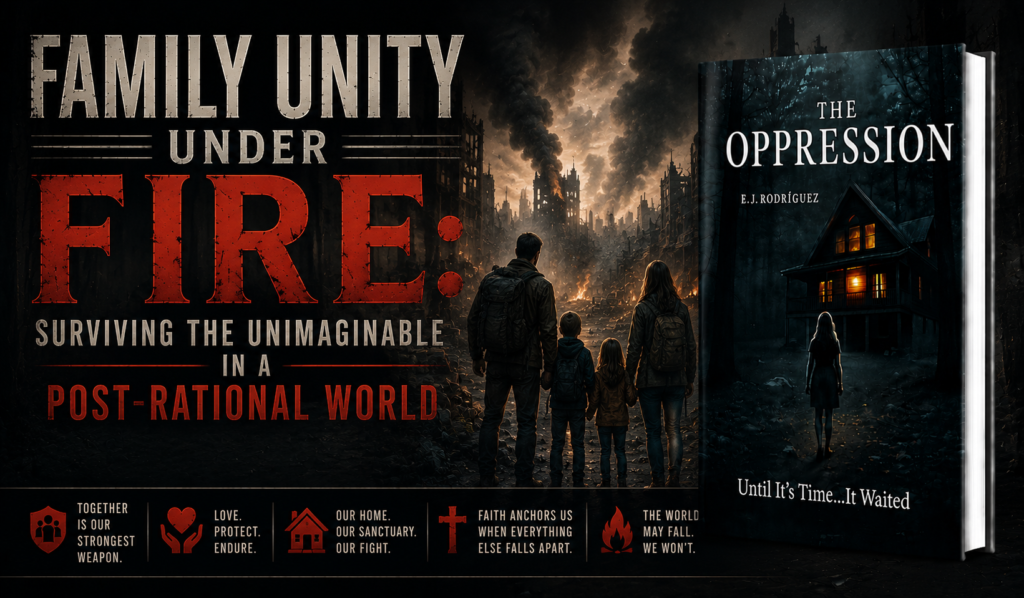

Every modern family is intimately familiar with stress. We navigate the relentless pressures of careers, mortgages, raising children, and maintaining a marriage in an increasingly chaotic world. We develop coping mechanisms to handle these natural, everyday frictions. But what happens when the pressure applied to a family’s fault lines is not natural at all? What happens when a predatory, unseen intelligence actively attempts to dismantle a home from the inside out?
In the cinematic, supernatural thriller The Oppression, author E.J. Rodriguez subverts the traditional haunted house narrative by transforming it into a high-stakes psychological family drama. When retired Air Force veteran Gabe Aldana unwittingly brings a demonic attachment home from a cursed cabin in the Smoky Mountains, the entity doesn’t just bump in the night. It launches a calculated, strategic assault on the very foundation of the Aldana family.
By portraying family unity not merely as a heartwarming theme, but as a critical tactical weapon, Rodriguez delivers a story that resonates on a deeply primal level. The Oppression asks a terrifying question: When the unimaginable invades your safe haven, is your bond strong enough to withstand the siege?
The Strategy of Isolation
In traditional horror cinema, the demonic entity’s playbook is often blunt and theatrical. In Rodriguez’s grounded, terrifying reality, the enemy’s tactics are far more insidious. The entity in The Oppression understands that to conquer a fortified target, it must first divide its defenses. It aims to isolate Gabe, the family’s natural protector, by breeding shame, anger, and paranoia.
The psychological warfare is brilliantly executed. Gabe begins experiencing highly personalized, invasive nightmares featuring a demonic woman—a succubus—who manipulates his thoughts and desires. The purpose of these attacks is not simply to frighten him, but to fundamentally compromise his moral compass and marital fidelity. The demon wants Gabe to feel a profound, secret shame, knowing that secrets are the wedge that splits a marriage apart.
Furthermore, the entity targets the most vulnerable member of the household: eleven-year-old Ryan. When Gabe discovers burning, raised scratches and bite marks on his son’s skin, his identity as a protector is shattered. The demon is sending a clear message: You cannot keep them safe.
As the attacks escalate, we see the psychological toll manifest in Gabe’s behavior. The disciplined, stoic veteran begins to unravel. He turns to late-night bourbon to numb his racing mind. In one of the novel’s most harrowing and vulnerable scenes, a terrified, sleep-deprived Gabe actually soils himself in his living room, subsequently snapping at his wife to get away from him. He attempts to build a wall around his trauma, falling back on his military instinct to internalize the horror. But in the realm of spiritual warfare, isolation is a death sentence.
The Spiritual Anchor: Refusing to Break
If Gabe represents the physical, tactical defense of the family, his wife, Janet, represents its spiritual anchor. Rodriguez crafts Janet not as a hysterical victim, but as a formidable, intuitive warrior who recognizes the true nature of the battlefield long before her husband does.
Raised in a devout Evangelical family in the Dominican Republic, Janet possesses a cultural and spiritual literacy that strips away the modern, Western skepticism Gabe clings to. “Where I come from, we’re simple enough to know the difference between the natural and supernatural,” she tells him during a heated confrontation.
Janet refuses to let the entity dictate the terms of their reality. When Gabe withdraws into anger and silence, Janet forcefully pulls him back. She recognizes that his sudden hostility and uncharacteristic cruelty are symptoms of the oppression, not reflections of his true character. She demands communication, refusing to let the unspoken horrors fester in the dark.
More importantly, Janet weaponizes their faith. She doesn’t wait for a priest to arrive to begin fighting back; she immediately establishes a spiritual perimeter. She gathers Gabe and Ryan in their bedroom, pulling them into a unified circle to recite the St. Michael prayer. Even as the entity hurls objects in the kitchen and bangs violently against the walls to break their concentration, Janet’s resolve holds the family together. She intuitively understands the novel’s central thesis: the demon feeds on their fear and division, but it starves in the face of their unified faith.
Love as a Tactical Countermeasure
The thematic brilliance of The Oppression is fully articulated when the family finally seeks the help of Father Marco, a seasoned Catholic exorcist. When Gabe, still reeling from the guilt of bringing this nightmare upon his family, asks the priest why they are being targeted, Father Marco’s diagnosis is profound.
The demon isn’t attacking them because they are weak; it is attacking them because their love is a threat.
“The Catholic Church does not have a monopoly on exorcism, and so long as you’re a disciple of Christ, everything will be okay,” Father Marco explains to the blended, Protestant-Catholic family. He looks at the couple, noting their fierce dedication to one another despite the harrowing crucible they are enduring. “I feel that your love for each other, this real thing you have between you, is what matters the most.”
Father Marco reveals that the entity’s ultimate goal is the destruction of the family unit. It wants to entice Gabe into sin, break his marriage, and ruin the home. The supernatural manifestations—the moving objects, the foul odors, the terrifying apparitions—are all just smoke and mirrors designed to achieve that singular, destructive goal. Therefore, staying married, communicating openly, and loving one another fiercely are not just romantic ideals; they are active, tactical countermeasures against a demonic siege.
Forged in the Crucible
The Oppression elevates the supernatural thriller genre by grounding its horror in deeply relatable domestic stakes. The true suspense does not rely solely on what is hiding in the shadows, but on whether Gabe and Janet’s marriage can bear the weight of the darkness pressing against it.
For potential film producers and readers seeking a story with authentic emotional depth, Rodriguez delivers a narrative that is as moving as it is terrifying. The Aldana family is not a collection of horror movie tropes waiting to be picked off one by one. They are a real, flawed, fiercely loving family forced to navigate a post-rational world.
In the end, The Oppression proves that while the enemy may predate time and operate with chilling, supernatural efficiency, it has a fatal blind spot. It fundamentally underestimates the resilience of human connection. When the unimaginable invades, and physical weapons fail, a family standing shoulder-to-shoulder in the dark is the most formidable fortress in the world.