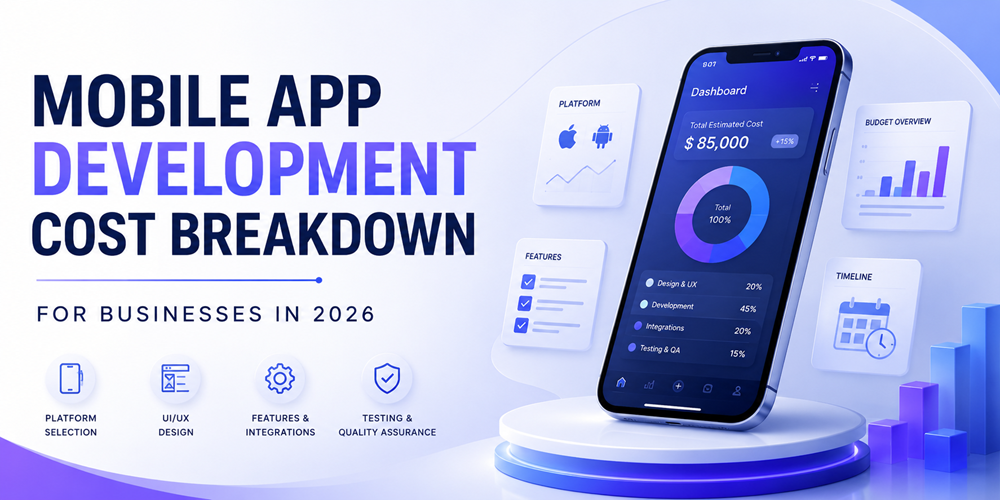

Mobile applications have been a critical element for any company’s strategy nowadays. Regardless of whether the aim is to boost customer engagement, enhance business processes, or generate additional profit, the implementation of the right mobile app can be of great help. The app can bring benefits to your company; however, in order to reach success or to reach the peak, there is always one question that arises from many people or companies: what will be the mobile app development cost?
In 2026, the mobile app development cost will be influenced by the development of advanced technologies, thus raising users’ demands and requirements. Therefore, the app development cost may depend on several aspects.
Design and the User Experience Cost
The user experience is crucial for the mobile application, as users demand intuitiveness, aesthetic designs, and interaction throughout all screens. The better design or layouts take a considerable amount, which is included in the custom mobile app development pricing. The experts concentrate on developing layouts that look attractive and are also user-friendly.
Without doubt, extra features play an important role in determining its cost. Designs that utilize animations and special visual effects will entail much more effort, hence increased costs. Eventually, many companies choose a simple design because it automatically reduces the development cost.
What is the average cost of building an app in 2026?
The mobile app development cost in 2026 is not particularly fixed; in fact, it depends on the projects, agencies, or the type of app development you want. Essentially, it is the total budget that is needed to design, develop, test, and launch your mobile app. Let’s take an example, for most of the businesses, the average cost of the mobile app development falls between $15,000 to $300,000+. Smaller mobile apps stay on the lower end, while complex and multiple-feature apps require more investment.
On the other hand, when people ask, ” Why is app development so expensive?, mainly, most of them only know about the coding, but the real app development cost breakdown includes:
- Planning and research
- UI&UX design
- Third-party integrations
- Testing and bug fixing
Selecting a Platform: Android, iOS, or Both
The choice of platform is one of the most crucial factors when considering the mobile app development cost. Companies can decide to create apps on the Android or iOS operating system or both. Developing individual apps that are specific to each operating system guarantees optimal efficiency but may come at an increased cost of development owing to more coding and testing.
Alternatively, cross-platform app development frameworks are now more prevalent, enabling software engineers to develop apps that work in different environments with minimal development costs through a common codebase.
The Testing and the Quality Assurance
Quality assurance is a very important stage which can never be missed. Proper testing will guarantee the smooth functioning of the software on different gadgets and platforms. A portion of the custom mobile app development pricing is dedicated to discovering and fixing the existing problems during testing. Testing allows for the finding of all sorts of possible errors and malfunctions in order to fix them before the launch.
Modern mobile applications need to function properly on various gadgets and platforms. Quality assurance can help provide users with a decent experience. Applications that have been tested and verified through quality assurance are likely to bring more customer satisfaction.
Final Thoughts:
Mobile apps can carry multiple features if it is invested in a proper manner. However, the mobile app development cost is less about a fixed number and more about how intentionally each stage is handled. A strong app is not defined by how much was spent; in fact, it defines how well the spending contributed to each section.
Businesses that approach app development strategically are better positioned to manage the costs while creating valuable digital solutions that support the growth and customer engagement.