
Artificial intelligence is transforming enterprise operations at an unprecedented pace. From automation and analytics to customer engagement and productivity, organizations are rapidly embracing AI-driven technologies to stay competitive in a digital-first economy. But while enterprises are exploring the positive potential of AI, cybercriminals are weaponizing the same technology at an alarming speed.
Deepfake fraud, AI-powered phishing, synthetic voice impersonation, and next-generation Business Email Compromise (BEC) attacks are no longer future threats. They are active, operational, and already costing organizations billions of dollars globally. Traditional cybersecurity strategies that once focused on malware, ransomware, or phishing detection are no longer sufficient against attacks that mimic trusted executives, replicate employee voices, and manipulate human decision-making with near-perfect accuracy.
This is exactly why modern CISOs, security leaders, risk officers, and enterprise decision-makers need a completely new operational playbook.
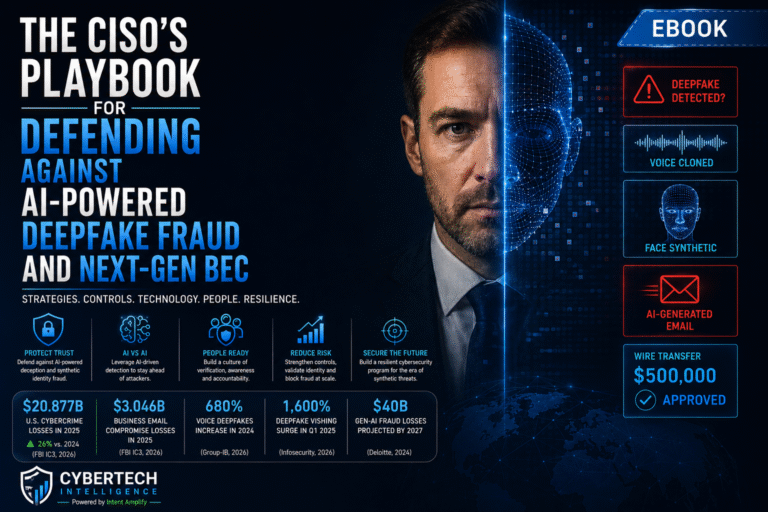
The CISO’s Playbook for Defending Against AI-Powered Deepfake Fraud and Next-Gen BEC provides a comprehensive breakdown of how AI-driven cybercrime is reshaping enterprise risk and what organizations must do immediately to defend themselves. The ebook is designed for security leaders who need actionable intelligence, strategic frameworks, and practical implementation guidance to secure their organizations against the next generation of cyber-enabled fraud.
Read More: https://tinyurl.com/t7jek8k5
The report explores how generative AI has become a force multiplier for cybercriminals. Attackers can now automate social engineering campaigns, generate highly convincing phishing emails, create synthetic executive voices with only seconds of audio, and launch sophisticated impersonation attacks that bypass traditional verification processes. The ebook highlights how these attacks are impacting enterprises globally and why organizations are struggling to keep pace with the rapidly evolving threat landscape.
One of the most important themes covered in the ebook is the collapse of trust-based communication models. In the past, employees could identify suspicious requests through poor grammar, unusual phrasing, or obvious red flags. AI has changed that completely. Today’s attacks are polished, contextual, personalized, and engineered to exploit urgency and authority at the exact moment of decision-making.
The ebook also provides deep insight into the growing financial impact of AI-powered fraud. From multimillion-dollar deepfake wire transfer scams to rapidly escalating BEC losses, the report demonstrates how attackers are leveraging synthetic media technologies to exploit enterprise workflows. It explains why finance teams, executive assistants, HR departments, and IT service desks are becoming primary targets for AI-enhanced social engineering campaigns.
Beyond the threat analysis, the playbook focuses heavily on practical defense strategies. Security leaders will learn why process resilience has become more important than relying solely on technical detection tools. The ebook explains how organizations must redesign critical workflows to assume that communications themselves may already be compromised.
Readers will discover the five critical pillars every enterprise security program should implement in 2026 and beyond:
- Process resilience and deception-resistant workflows
- Layered deepfake defense architectures
- AI-powered detection and behavioral analytics
- Modernized security awareness training for synthetic media threats
- Governance, compliance, and intelligence-sharing frameworks
The ebook also highlights why traditional employee awareness programs are no longer enough. Training employees to spot spelling errors or suspicious attachments does little against AI-generated voice cloning or hyper-personalized phishing attacks. Instead, enterprises must build procedural verification habits that make fraudulent communications ineffective regardless of how convincing they appear.
Another key focus of the playbook is the growing AI-versus-AI cybersecurity arms race. As attackers increasingly use generative AI to scale operations, defenders must adopt AI-powered threat hunting, behavioral anomaly detection, voice biometric validation, and real-time deepfake detection technologies to maintain defensive parity.
For CISOs preparing board-level investment discussions, the ebook provides strong financial justification for modern deepfake defense programs. It demonstrates how the cost of prevention is dramatically lower than the potential financial and reputational impact of a successful AI-driven fraud incident. This makes the report especially valuable for security leaders building cybersecurity investment cases for executive stakeholders and board members.
The ebook also delivers a practical 90-day implementation roadmap designed specifically for enterprise environments. Rather than presenting theoretical concepts alone, it outlines immediate actions organizations can take to assess vulnerabilities, harden workflows, modernize verification controls, and conduct realistic deepfake simulation exercises across finance and executive operations.
What makes this playbook particularly relevant is its strategic focus on trust itself as a cybersecurity challenge. In the AI era, organizations can no longer assume that a voice, face, or email identity is authentic simply because it appears legitimate. This shift fundamentally changes how enterprises must approach communication security, identity verification, and operational risk management.
For cybersecurity professionals, technology executives, fraud prevention teams, compliance leaders, and enterprise boards, this ebook provides timely intelligence into one of the fastest-growing cyber risk categories affecting modern business operations.
As organizations accelerate digital transformation initiatives, attackers are evolving even faster. Enterprises that fail to modernize their security frameworks may soon find themselves defending against threats designed specifically to exploit human trust at scale. This ebook provides the strategic guidance security leaders need to prepare for that reality.
Whether your organization is already experiencing advanced phishing campaigns, executive impersonation attempts, suspicious financial authorization requests, or synthetic identity fraud concerns, this playbook delivers practical, research-backed recommendations for strengthening enterprise resilience against AI-enabled cyber threats.
The future of cybersecurity is no longer just about protecting systems. It is about protecting decision-making, operational trust, and business integrity in an era where synthetic deception is becoming indistinguishable from reality.
Read More: https://tinyurl.com/t7jek8k5