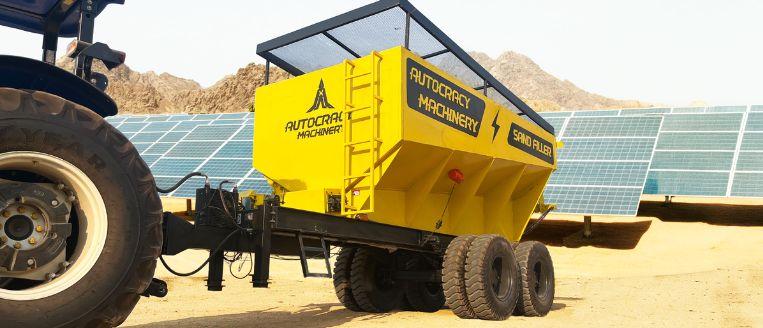

Solar power plants rely on extensive underground cable networks that must be properly protected after installation. One of the most critical steps in this process is sand padding, which creates a cushioning layer around the cables. However, when done manually, this task is often slow and inconsistent—especially across large, uneven project sites. To overcome these challenges, modern sand padding machines are transforming how solar companies manage backfilling. These machines ensure that both DC and AC cables are covered with a uniform, stable layer of sand, improving overall system reliability.
As solar projects expand over vast areas, manual backfilling becomes increasingly difficult to control. Workers may struggle to maintain consistent speed and accuracy over long trench routes, leading to uneven sand distribution and a higher risk of cable damage. Mechanised solutions bring much-needed consistency, enabling smooth and even padding throughout the trench. This not only enhances quality but also reduces the likelihood of future maintenance problems.
Faster and More Reliable Backfilling
Today’s solar plants require thousands of metres of underground cabling. Manual backfilling slows down project timelines and often leads to inconsistent results. Sand padding machines address these issues by evenly distributing sand along the cable path. This reduces human error, minimises rework, and ensures safer cable installation across large solar farms.
With the growing scale of solar developments, depending solely on large labour teams is no longer efficient. Mechanised equipment allows for faster execution while maintaining consistent quality. Proper sand placement acts as a protective barrier, helping cables remain secure and functional over time, while also reducing the chances of breakdowns and energy losses.
Designed for Long Cable Routes
Solar cable trenches often extend across long, straight stretches that require continuous and uniform sand placement. Sand backfilling machines are built to maintain a steady flow and consistent output, allowing these long sections to be completed quickly and efficiently. This uniformity improves cable durability and reduces the risk of insulation damage.
As trench lengths increase, maintaining consistent sand thickness manually becomes difficult. Machines eliminate this inconsistency by ensuring every section of the trench receives equal attention. The result is higher-quality work completed in less time.
Safe and Controlled Trench Backfilling
After cables are laid, they must be carefully covered with clean sand to prevent damage. Trench-filling machines distribute sand evenly without disturbing cable alignment. This is essential for solar installations, where long-term performance depends on stable cable positioning.
Uneven sand placement can lead to cable stress, bending, or exposure to sharp objects in the soil. Machine-based backfilling prevents these issues by ensuring controlled and uniform coverage. This makes the process more reliable and well-suited for large EPC (engineering, procurement, and construction) projects.
Protecting Solar DC Cables
DC cables in solar plants carry significant electrical loads and require proper protection at all times. Uniform sand cushioning helps extend their lifespan and maintain efficiency, making backfilling a crucial step in solar installation.
Improper backfilling can cause overheating, insulation damage, or cable failure. By ensuring even sand coverage, solar developers can avoid costly repairs and downtime. This leads to a more stable and efficient energy system across the entire plant.
Efficient Performance on Challenging Terrain
Many solar projects are located on uneven or semi-rocky land, where manual work becomes slow and prone to errors. Sand filler machines are designed to operate efficiently in such conditions, ensuring consistent sand placement regardless of terrain.
With a steady working pace, these machines help teams complete long trench routes faster. This improves planning, increases daily productivity, and keeps projects on schedule. It also reduces worker fatigue and minimises the risk of human error.
Enhancing Productivity for Solar EPC Teams
Solar EPC contractors often work under tight deadlines, especially in large-scale installations. Mechanised backfilling reduces labour requirements while significantly boosting productivity. By using sand filler equipment, teams can complete padding tasks more quickly and focus on other essential activities.
This approach also reduces dependence on large labour forces, which can be difficult to manage across wide project sites. Machines provide consistent output and predictable performance, helping teams maintain steady progress and complete projects safely and on time.
Built for Modern Solar Project Requirements
Modern solar projects demand speed, precision, and long-term reliability. Sand padding machines are designed to meet these needs by delivering controlled, uniform sand placement throughout cable trenches. This reduces the risk of cable faults and soil-related issues, ensuring dependable performance over the life of the solar plant.
Adopting advanced sand padding technology is not just about improving efficiency—it is about building stronger, safer, and more reliable solar infrastructure for the future.