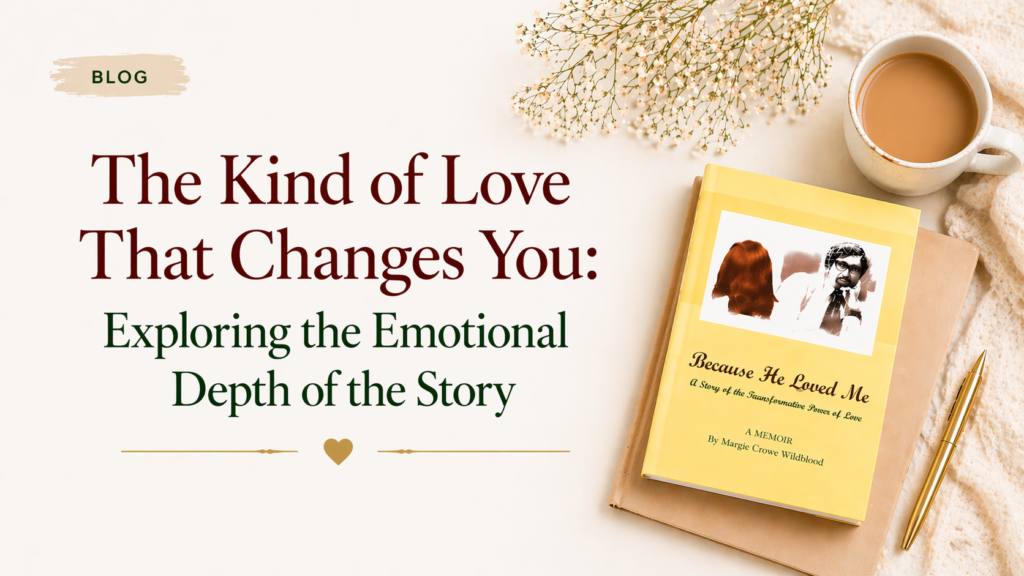

There are many kinds of love we recognize easily—family love, romantic love, friendship. They come with names, expectations, and familiar patterns. But every so often, there is a connection that doesn’t fit neatly into any of those categories. It’s harder to define, harder to explain, and yet it leaves a deeper impression than most.
Because He Loved Me is, in many ways, a story about that kind of love.
Not the kind built on grand gestures or clear declarations, but the kind that forms quietly, through attention, through listening, through the simple act of one person taking another seriously. It’s a love that doesn’t demand anything, doesn’t try to possess, but still manages to change everything.
At the beginning of the story, Margie isn’t looking for love.
What she is looking for—though she may not fully realize it—is a sense of being valued. She moves through her college life carrying a quiet belief that she is not quite enough. Not enough to stand out, not enough to be chosen, not enough to fully belong. These thoughts are not dramatic or overwhelming, but they are constant.
And because they are constant, they shape how she experiences everything else.
When she enters into conversations with her professor, she does so cautiously. At first, it’s simply curiosity—why would someone invite students to talk about anything? What is expected of her in that space? But as those conversations continue, something begins to shift.
She is listened to.
Not casually, not distractedly, but with full attention. Her thoughts are not dismissed or corrected. They are explored. She is asked questions that go deeper than surface-level responses. She is encouraged to reflect, to consider, to articulate.
And in that process, she experiences something unfamiliar.
She feels seen.
That feeling—being truly seen—is at the heart of the emotional depth in this book. It’s easy to underestimate how powerful it can be, especially for someone who has spent so much time feeling overlooked or uncertain. But once it happens, it changes something fundamental.
Margie begins to open up.
She shares more of herself—her background, her insecurities, her questions about her beliefs and her experiences. These are not things she would easily share with just anyone. They require trust, and that trust builds slowly, through consistency and care.
What makes this connection so compelling is that it doesn’t follow a predictable path.
There are no clear labels placed on it. It isn’t defined in a way that allows it to be easily categorized. And yet, its impact is undeniable. It becomes one of the most important parts of Margie’s experience during this time in her life.
She begins to feel a sense of closeness that she doesn’t fully understand.
There is admiration, certainly. There is gratitude. But there is also something deeper—something tied to the way she feels in those conversations, the way she begins to see herself differently because of them.
This is where the idea of transformative love comes into play.
Not love as something that completes you or fixes you, but love as something that reveals you to yourself. Through this connection, Margie starts to recognize parts of herself she hasn’t fully acknowledged before. Her thoughts, her emotions, her perspective—they all begin to feel more real, more valid.
And that changes how she moves through the world.
She doesn’t become suddenly confident or completely certain. But she becomes more aware. More willing to question the negative beliefs she has held about herself. More open to the possibility that she might be more than she has allowed herself to believe.
That shift is subtle, but it is powerful.
It’s also what makes this story resonate on a deeper level. Because while not everyone will experience the exact same kind of relationship Margie does, many will recognize the feeling of being changed by someone who saw them clearly.
Someone who listened.
Someone who made them feel like they mattered.
That kind of experience stays with you.
Another important aspect of this emotional depth is how the story handles complexity. The connection Margie experiences is not presented as perfect or uncomplicated. There are questions, uncertainties, and moments of internal conflict. She doesn’t always understand what she is feeling or what it means.
And that’s what makes it feel real.
Love, in its most meaningful forms, is rarely simple. It can be layered, confusing, and difficult to define. Because He Loved Me doesn’t try to simplify it. Instead, it allows that complexity to exist, trusting the reader to sit with it.
Margie’s writing adds another layer to this exploration.
Through her reflections and poetry, she processes these emotions in a way that feels honest and unfiltered. Writing becomes a space where she can examine what she’s experiencing without needing to resolve it immediately. It allows her to hold multiple feelings at once—gratitude, confusion, curiosity, and something that feels like affection but isn’t easily named.
That openness is part of what makes the book so engaging.
It doesn’t tell you exactly what to think or how to interpret every moment. Instead, it invites you to experience it alongside her, to feel the uncertainty, to recognize the significance without needing a clear label.
By the time you step back from the story, what stands out is not a single moment or a single definition of love, but the overall impact of the connection.
Margie is not the same person she was at the beginning.
Not because someone changed her directly, but because someone gave her the space to see herself differently.
That is the kind of love this book explores.
The kind that doesn’t demand attention, but gives it.
The kind that doesn’t define you, but helps you define yourself.
And once you’ve experienced that, even briefly, it becomes something you carry with you—long after the moment has passed.
Because He Loved Me captures that experience with honesty and depth, offering a story that feels both deeply personal and widely relatable.
It reminds us that sometimes, the most important connections in our lives are the ones that quietly change how we see ourselves.