
Most engine problems don’t announce themselves all at once. They build gradually a sound that wasn’t there last month, a gauge that reads slightly off, a performance drop that’s easy to dismiss as a bad tank of fuel. Volkswagen diesel engines are well-engineered and generally durable, but they’re not immune to the wear patterns that affect any high-compression powerplant running real-world mileage. The drivers who catch problems early are the ones who know what to look for. Ignoring the signals costs significantly more than responding to them.
Here are five signs that your Volkswagen Diesel Engine is telling you something needs immediate attention.
1. Unusual Knocking or Rattling From the Engine Bay
A cold-start knock that disappears within a minute of warm-up is relatively common in diesel engines and usually harmless. A knock that persists after the engine reaches operating temperature is a different matter entirely. Persistent knocking in a VW diesel typically points to issues with injector timing, worn big-end bearings, or low oil pressure, none of which improve on their own.
Rattling from the front of the engine, particularly at startup, often indicates wear in the timing chain or timing belt tensioner. In Volkswagen engine timing systems, the relationship between the camshaft and the crankshaft must be exact. When timing components begin to fail, the rattle is often the first audible warning before a more serious mechanical event occurs. A stretched chain or a failing tensioner won’t tighten itself that noise is a countdown, not a quirk.
2. White or Blue Smoke From the Exhaust
Diesel engines produce some visible exhaust on a cold morning, and a small amount of white smoke during warm-up is normal. White smoke that continues once the engine is fully warmed up points to a coolant leak into the combustion chamber, typically a head gasket failure or a cracked cylinder head. Left unaddressed, this leads to overheating damage that can write off an engine entirely.
Blue smoke tells a different story. It means oil is being burned in the combustion chamber, usually due to worn piston rings, valve stem seals, or turbocharger seal failure. In a Volkswagen Diesel Engine, oil consumption of this nature isn’t just an emissions issue; it’s a sign of internal wear that will accelerate if the root cause isn’t found and fixed. Blue smoke on hard acceleration, specifically, often points to the turbo, which is worth inspecting early, given replacement costs.
3. Loss of Power or Poor Acceleration Response
Sluggish acceleration on a VW diesel isn’t always dramatic it creeps in. A car that once pulled cleanly through roundabouts starts hanging under load, taking longer to build revs, and feeling like it’s working harder than it should for the same result. A clogged diesel particulate filter is often the first place to look, though a failing EGR valve, restricted air filter, or worn injectors can produce near-identical symptoms. What makes diagnosis tricky is that none of these necessarily throw a warning light early on, the car just feels increasingly flat without giving you much to go on.
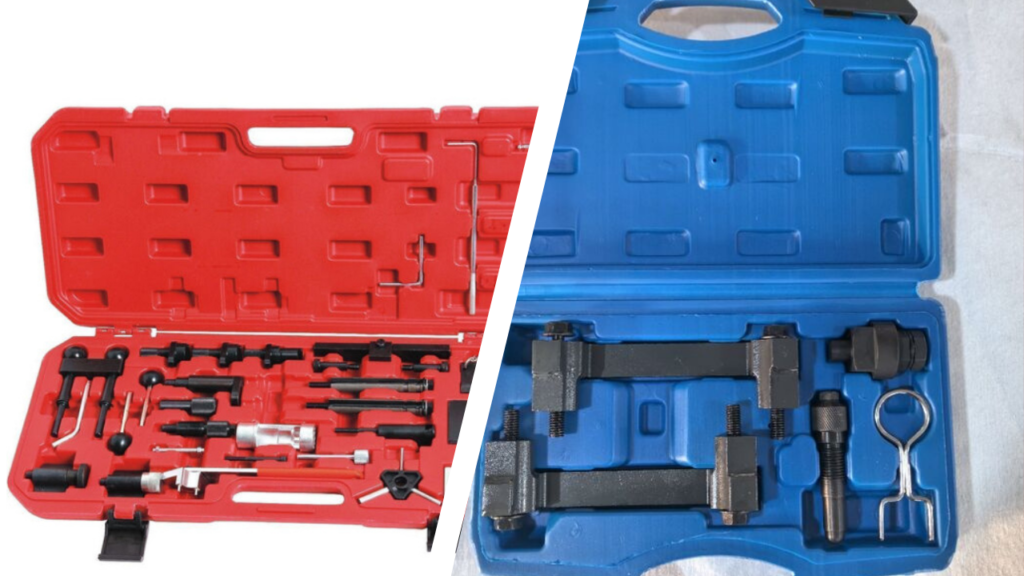
Timing-related power loss has a slightly different character. Rather than a specific point in the rev range where the engine drops off, there’s a general dullness throughout, like the engine never quite gets into its stride. Even minor deviation in Volkswagen engine timing pulls combustion efficiency down noticeably, because TDI common-rail engines are calibrated to tight tolerances where injection timing affects both output and emissions simultaneously. A technician working through this kind of fault needs to verify camshaft and crankshaft positions against factory data, not estimate them. That’s exactly what a Volkswagen timing tool kit is for it removes the margin for error that visual inspection alone can’t eliminate.
4. Dashboard Warning Lights That Won’t Clear
The engine management light on a VW diesel is worth taking seriously, regardless of how the car seems to be driving. Modern TDI engines run complex ECU mapping, and fault codes are stored for a reason; they flag conditions that the system has detected as outside normal operating parameters. Some codes are minor and historical; others indicate active faults in fuel delivery, emissions systems, or sensor circuits that are affecting engine operation right now.
Glow plug faults are particularly common in older VW diesels and are worth addressing promptly, especially heading into cooler months. A single failed glow plug makes cold starting harder and increases cranking time, which stresses the starter motor and battery. Multiple failed plugs can make the engine difficult to start altogether. An oil pressure warning light, if it appears while driving, requires stopping immediately; running a diesel engine with low oil pressure, even briefly, causes bearing damage that is expensive and sometimes irreversible.
5. Hard Starting or Extended Cranking Before Firing
Hard starting in an Audi Diesel Engine or VW diesel that has recently had timing belt service should prompt a timing check before anything else. An incorrectly set timing belt, even one tooth out on the camshaft sprocket, causes exactly this symptom and puts the engine at risk of serious internal damage if driven. Using a proper timing tool kit during belt replacement is the only reliable way to confirm timing positions are set to specification. A belt fitted by estimation rather than with the correct tooling is a liability waiting to surface, often at the worst possible moment.
Preventive Maintenance Tips to Avoid Major Engine Repairs
Most of what goes wrong in a VW diesel was preventable. It usually traces back to a skipped service, a stretched interval, or a repair done without the right parts. A few habits make a real difference:
- Oil changes on schedule, with the right grade; TDI engines don’t forgive late changes. The bearing clearances are tight, and degraded oil stops doing its job quietly before anything shows on a gauge.
- Timing belt at the manufacturer’s specified interval, not when it’s convenient. One snap on an interference engine and you’re looking at bent valves and a bill that dwarfs the cost of the belt replacement.
- The water pump goes in with the belt every time. The labour overlap makes it a no-brainer to do it separately later means paying for the same hours twice.
- Don’t reuse old tensioners. They’re inexpensive components that cause disproportionately expensive failures when they fail on a fresh belt.
- Fuel filter, EGR, and DPF maintenance on the Volkswagen schedule. A large portion of the power loss and warning light faults in this article don’t develop if these are kept on top of consistently.
When to Seek Professional Diagnosis
Not every symptom needs a workshop visit immediately, but some do, and waiting on those specific ones tends to turn a manageable repair into a much larger one.
- A knock or rattle that doesn’t clear after the engine warms up, don’t keep driving on it. Each mile adds wear to whatever is already failing underneath.
- Oil pressure warning while moving means pull over, engine off. Don’t limp to the nearest garage. Don’t check it when you get home.
- Smoke from the exhaust that’s still there once the engine is properly warm needs looking at before it gets worse, head gasket and turbo repairs both climb steeply the longer the underlying cause runs unchecked.
- Any timing belt service done without proper locking tools should be verified with a Volkswagen timing tool kit before the car covers serious mileage. One tooth out on the camshaft sprocket produces symptoms that aren’t always obvious until damage is already done.
- A fault code that keeps coming back after being cleared isn’t a sensor glitch, it’s the system flagging something real. A proper diagnostic session with VW-specific tooling resolves it faster and cheaper than guessing at it over several visits.
Conclusion
These problems don’t show up overnight. There’s usually a smaller, quieter version weeks before a faint knock, a slower start, a bit of smoke you talk yourself out of noticing. Catching it early almost always costs less than waiting. A worn tensioner is a simple fix. A snapped timing chain that’s wrecked a few valves on the way is not.
If your car is showing any of these signs, don’t wait around for it to get worse. A Volkswagen Diesel Engine can go from “running fine” to “real problem” faster than people expect once one of these issues actually shows up. Get it looked at sooner rather than later, and if the fix calls for precise timing work, make sure whoever’s doing it is using proper tools. YK Autotools makes the kind of timing tool kits built for exactly this job, so the work gets done right the first time. This website platform supplies precision-engineered timing tool kits for VW and Audi diesel engines, built to the tolerances that accurate timing work demands.