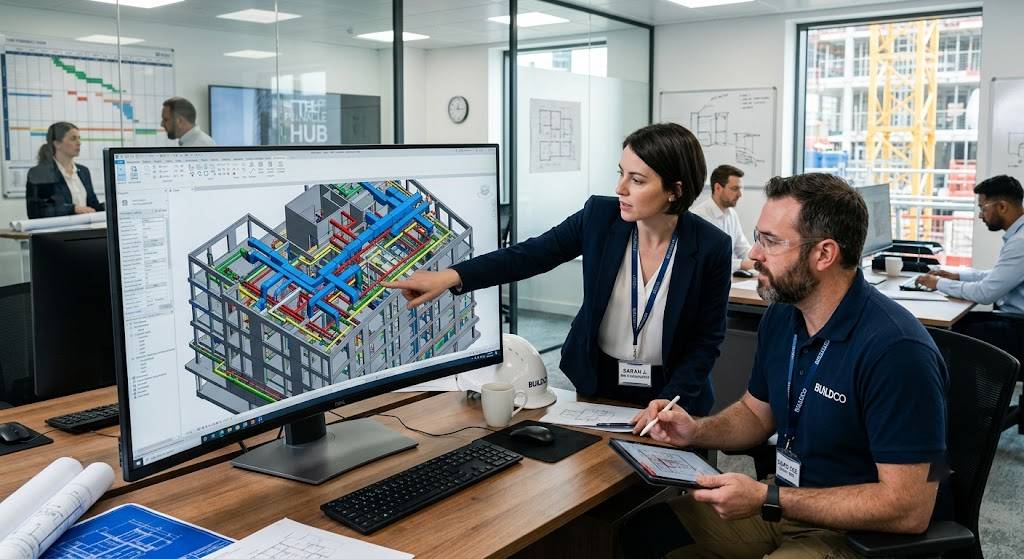

Construction delays rarely come from a single cause. More often, they build up from small coordination gaps that go unnoticed until equipment is already on site. A duct that does not fit, a beam that blocks a riser, or a sequence that puts two trades in the same space at the same time can each push a schedule back by days or weeks. This is the core reason BIM Clash Detection Services have become a standard part of preconstruction for general contractors, MEP trades, and design teams across the United States.
Below are ten specific ways a disciplined clash detection process protects project schedules, along with the techniques BIM managers and coordinators use to make it work in practice.
Why Project Delays Often Trace Back to Coordination Gaps?
Most commercial projects involve structural, architectural, mechanical, electrical, plumbing, and fire protection systems all occupying the same limited space. When these systems are modeled separately and never tested against each other, conflicts surface in the field rather than on screen. According to building information modeling practices documented by industry organizations, the earlier a conflict is identified relative to construction, the lower its cost and schedule impact tends to be.
10 Ways Clash Detection Keeps Projects on Schedule
1. Catching Physical Conflicts Before Construction Starts
Running clash tests on a combined 3D model identifies hard clashes, such as a pipe intersecting a structural beam, while the design can still be adjusted on screen. This avoids the cost and downtime of cutting, rerouting, or replacing materials that have already been installed.
2. Reducing Requests for Information During Construction
When clashes are resolved before issue for construction, field teams encounter fewer unexpected conflicts that require a formal request for information. Each RFI can add days to a schedule while waiting on a design response, so reducing their volume keeps work moving.
3. Supporting Accurate MEP Coordination
Mechanical, electrical, and plumbing systems generate the highest volume of spatial conflicts on most projects. Dedicated MEP Clash Detection Services verify duct routing, pipe sizing, and conduit paths against structural and architectural elements before fabrication begins, preventing rework that would otherwise stall installation crews.
4. Enabling Reliable Prefabrication
When MEP routing is verified clash free in the model, fabrication shops can build duct and pipe assemblies off site with confidence that they will fit as designed. This shifts labor away from the site, shortens on site installation time, and keeps the schedule less dependent on field conditions.
5. Identifying Sequencing Conflicts Through 4D BIM
Not every conflict is physical. Linking the model to the project schedule through 4D BIM reveals conflicts in timing, such as a crane path crossing planned scaffolding or a wall scheduled before the duct that needs to pass through it. Catching these issues early prevents crews from arriving on site only to find the area is not ready.
6. Minimizing Change Orders Tied to Field Conflicts
Unresolved clashes that surface during construction often require a change order to cover the cost of rework. Identifying and resolving these conflicts in the model, rather than in the field, reduces the volume of change orders directly tied to coordination issues, which keeps both cost and schedule more predictable.
7. Improving Communication Between Trades
A federated model gives every trade a shared reference point for how their work fits with everyone else’s. Instead of relying on separate two dimensional drawings that can be interpreted differently, clash detection reports give each subcontractor a clear, specific list of conflicts assigned to their scope.
8. Protecting Critical Path Activities
Some clashes affect activities sitting on the project’s critical path, where any delay pushes back the overall completion date. Prioritizing clash resolution based on schedule impact, not just physical severity, ensures that critical path work is not held up by conflicts that could have been resolved earlier.
9. Creating a Reliable Record for Subcontractors
A coordinated model that has passed clash detection becomes the reference document subcontractors build from. This reduces the ambiguity that often leads to field improvisation, rework, and the delays that come with both.
10. Supporting Faster Permit and Inspection Approval
Clash free models help demonstrate that mechanical, electrical, and structural systems meet required clearances and code separation distances before installation. This can shorten the back and forth often associated with inspection corrections, since systems are installed as designed rather than adjusted on the fly.
How General Contractors Put This Into Practice?
For general contractors managing multiple subcontractors on a tight schedule, BIM for General Contractors is now a practical necessity rather than an optional add on. A structured clash detection process gives GCs a single, reliable source of truth for resolving conflicts before they affect labor productivity in the field. Organizations such as the National Institute of Building Sciences continue to document how digital coordination practices support more predictable project delivery across the US construction industry.
Working with a firm that runs BIM clash detection and coordination services gives a general contractor the technical depth to manage multi trade coordination without pulling internal staff away from other preconstruction responsibilities. Many GCs also pair this with dedicated MEP coordination services, given how much of total project conflict volume originates with mechanical, electrical, and plumbing systems.
Conclusion
Construction delays are rarely the result of one major failure. They accumulate from coordination gaps that a structured clash detection process is specifically designed to catch. For BIM managers, coordinators, and general contractors working on US projects, treating clash detection as a continuous discipline rather than a one time check is what keeps schedules intact from design through closeout.
Teams looking to apply these techniques to their own projects can review BIM services built for general contractors to see how coordination support fits into standard preconstruction planning.