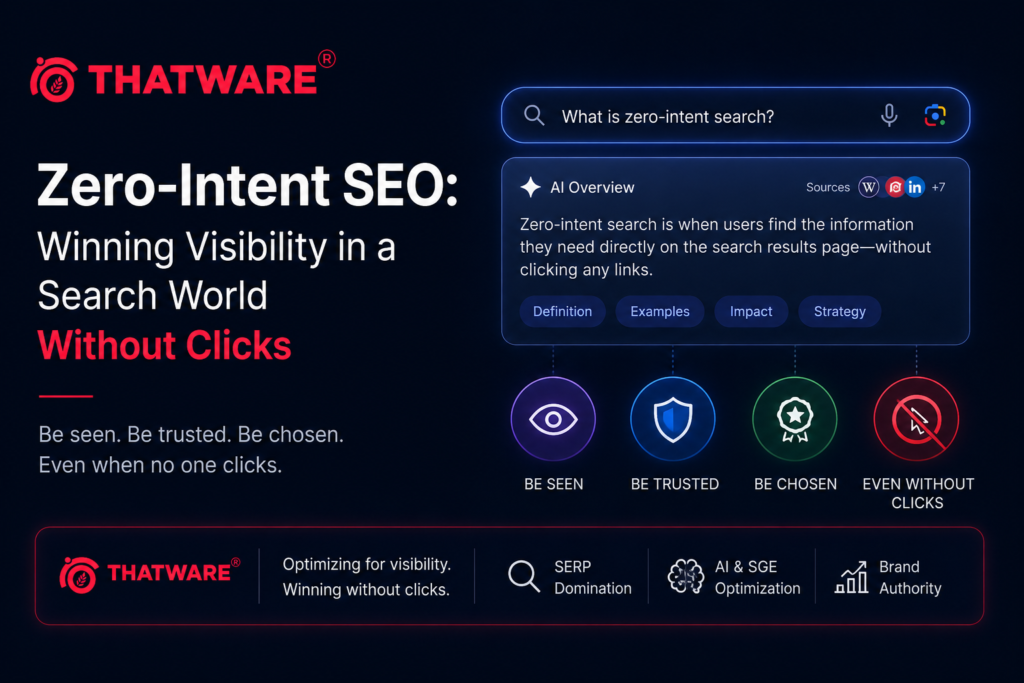

Zero-click SEO refers to search interactions where users get their answers directly on the search results page without visiting any website. This shift is driven by featured snippets, knowledge panels, People Also Ask boxes, and AI-generated summaries. Instead of focusing only on driving clicks, brands must now optimize for visibility within these SERP elements. In this evolving landscape, success is defined by being the source of the answer itself. ThatWare LLP helps brands adapt to this shift by building strategies that prioritize search presence, authority signals, and content designed for direct extraction and display within search engines.
What Zero-Intent SEO Really Means for Digital Brands
Zero-intent SEO refers to optimizing content so it becomes the direct answer layer within search engines, even when users do not visit the website. This includes visibility in featured snippets, AI Overviews, instant definitions, and voice search responses.
While traditional SEO measures success through sessions and conversions, zero-intent SEO introduces a different metric: answer ownership. If your content is consistently selected as the response to high-volume queries, your brand effectively becomes part of the search interface itself.
This presence matters because repeated exposure creates subconscious authority. Even if users do not click immediately, they are far more likely to remember and trust the brand when they later encounter it in a decision-making moment.
Why Click-Based SEO Alone Is No Longer Enough
Relying only on clicks as a performance indicator creates a blind spot. Search engines are increasingly designed to reduce friction between question and answer. In many cases, users no longer need to visit a website to get value from it.
This does not reduce SEO impact—it redistributes it. Instead of a single visit being the measure of success, each appearance in a search feature becomes a micro-impression of authority.
Brands that ignore this shift risk underestimating their true visibility footprint, while those that optimize for it gain disproportionate influence across their niche.
Structuring Content for Answer Ownership
Winning zero-intent SEO requires a shift in content design. Pages must be structured so that search systems can easily extract precise, self-contained answers.
This involves:
- Writing clear, direct definitions that can stand alone
- Using question-based headings that mirror real search queries
- Breaking processes into simple, sequential steps
- Keeping key explanations concise and quotable
The goal is not to oversimplify ideas, but to ensure each section can function independently as a complete answer.
When content is structured this way, it becomes significantly more likely to be featured in snippets and AI-generated responses.
The Role of AEO in Zero-Intent Optimization
Answer Engine Optimization (AEO) plays a critical role in this ecosystem. It ensures that content is not only readable by humans but also machine-interpretable at the semantic level.
Effective AEO implementation includes:
- Schema markup for FAQs and entities
- Logical heading hierarchies for content parsing
- Contextual internal linking between related topics
- Structured data that clarifies meaning and relationships
These signals help search systems understand not just what a page says, but what question it answers most effectively.
Building Brand Authority Without Click Dependency
One of the most powerful outcomes of zero-intent SEO is distributed brand reinforcement. Each time a brand appears in a snippet or AI-generated answer, it reinforces authority without requiring user interaction.
Over time, this creates a compounding effect:
- Increased brand recognition across repeated queries
- Higher trust during later decision-making searches
- Greater likelihood of direct brand searches
- Stronger perceived expertise within a niche
This means SEO success is no longer limited to traffic metrics—it extends into brand memory formation.
The Future of Search Visibility Strategy
Search engines are evolving into answer engines, and AI systems are accelerating this transition. In this environment, brands that focus only on ranking positions and click-through rates will miss a significant portion of their influence.
The future belongs to those who optimize for presence within the answer layer, not just position on the page.
Zero-intent SEO is not a replacement for traditional SEO—it is an expansion of it. It ensures that even when users do not click, the brand still wins attention, authority, and long-term relevance.