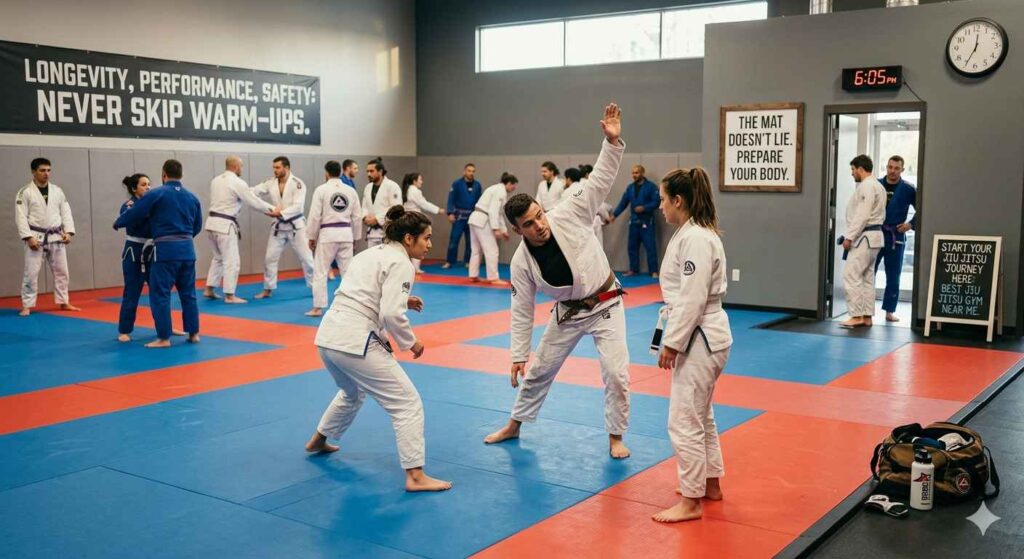

Introduction: The Two Minutes That Change Everything
Picture this: you walk into the gym, you are already running five minutes late, the instructor is about to call everyone to the mat, and you think to yourself, “I will just skip the warm-up and jump right in.” It feels harmless. You are not a beginner anymore. Your body feels fine. You have rolled a hundred times before.
But here is the reality: that decision, made in a rushed moment, is one of the most common reasons Brazilian Jiu-Jitsu practitioners end up sidelined with pulled muscles, strained ligaments, and injuries that take weeks or even months to heal. Skipping your warm-up before a BJJ session is not just a minor oversight; it is a genuine gamble with your long-term health and athletic development.
Brazilian Jiu-Jitsu is a physically demanding martial art. It involves explosive movements, deep ranges of motion, sudden changes in direction, and sustained muscular effort, all while someone is actively trying to submit you. Whether you are new to the sport or a seasoned competitor searching for bjj training near me to find the best gym in your area, the warm-up is not optional. It is the foundation of every productive, safe, and high-quality session on the mat.
This article breaks down exactly why warm-ups matter so much in BJJ, what happens to your body when you skip them, and how a consistent pre-training routine can elevate your performance, protect your longevity, and help you get far more out of every single class.
Section 1: What Happens to Your Body Without a Warm-Up
To understand why warm-ups are so critical, it helps to understand what is actually happening inside your body before and after you begin moving with intention.
When you are sitting at your desk, driving to the gym, or standing around chatting before class, your musculoskeletal system is in a relatively low-activity state. Your core body temperature is resting at around 98.6 degrees Fahrenheit. Blood flow is distributed across your organs and resting tissues. Your muscles are not primed for the kind of rapid, forceful contractions that BJJ demands.
When you go from that resting state directly into hard sparring or technical drilling, you are asking cold, stiff muscle fibers to perform at their absolute limit. The science here is straightforward: cold muscles are less elastic, less responsive, and far more susceptible to micro-tears and serious strains. The connective tissue surrounding your joints, including tendons and ligaments, is similarly vulnerable when it has not been gradually loaded and warmed.
Beyond the injury risk, there is a neuromuscular component that most people overlook. The nervous system needs time to establish efficient communication pathways between the brain and the muscles being used. A proper warm-up essentially “switches on” your motor patterns, improving your reaction time, coordination, and movement quality before the hard work begins. Without it, your first several minutes of rolling are spent in a sluggish, uncoordinated state, which also puts you at a mechanical disadvantage against training partners who arrived ready to move.
Research consistently supports this. According to recent coverage in Google News, sports scientists and physical therapists have highlighted that dynamic warm-up routines reduce injury incidence in grappling sports by a significant margin, particularly for the hip flexors, hamstrings, and shoulder girdle, all of which take enormous stress during a typical BJJ class.
The bottom line is simple: your body is not a machine that goes from zero to one hundred the moment you step on the mat. It needs a transition period, and the warm-up is that transition.
Section 2: Injury Prevention Is Not Just for Beginners
One of the most persistent myths in combat sports is that experienced practitioners are somehow immune to warm-up benefits. The logic goes something like: “I have been training for years, my body is used to this.” But this thinking is flawed in a very important way.
Experience on the mat builds skill, timing, and technique. It does not change the basic physiology of how muscle tissue responds to sudden mechanical load. A black belt’s hamstring is just as likely to tear under an explosive, cold takedown attempt as a white belt’s, arguably more so because experienced practitioners train harder, move faster, and take on higher-intensity sparring partners.
In fact, many of the most serious injuries in BJJ happen to long-term practitioners precisely because they become comfortable enough to skip the fundamentals of physical preparation. Overconfidence in one’s body is a real and well-documented risk factor.
Consider the most common BJJ injuries: knee ligament sprains, shoulder dislocations, neck strains, rib injuries, and hip flexor tears. Each of these occurs at a significantly higher rate when the body has not been properly prepared for movement. Warm-ups that include targeted mobility work for the hips and shoulders, dynamic stretching for the hamstrings and hip flexors, and gradual cardiovascular activation reduce the likelihood of all of these outcomes.
The financial and time cost of injury is another factor worth considering seriously. Forbes has noted that sports injuries cost athletes not just in medical bills, but in lost training time, diminished performance, and long-term wear on the body that compounds over years. For someone who trains BJJ as a lifestyle, a torn meniscus or a separated shoulder can mean months off the mat, potential surgery, and a lengthy rehabilitation process. All of that risk is meaningfully reduced by spending ten to fifteen minutes warming up properly before every session.
If longevity in the sport matters to you, and for most people it should, consistent warm-up habits are one of the most powerful tools available. The goal is not just to survive today’s class. It is to still be training ten, twenty, or thirty years from now.
Section 3: Performance Benefits You Are Leaving on the Table
Beyond injury prevention, there is a compelling performance argument for warm-ups that often goes underappreciated, especially among recreational practitioners who train for fun rather than competition.
A properly executed warm-up does not just protect you. It actively makes you better during the session that follows.
Here is how. As your core temperature rises during the warm-up, several performance-related physiological changes occur simultaneously. Hemoglobin in the blood releases oxygen more readily to working muscles, a process regulated by temperature. Enzyme activity in the muscle cells increases, meaning your energy systems become more efficient at producing the ATP needed for explosive effort. Nerve conduction velocity increases, which translates directly to faster reaction times and sharper technique execution.
In practical terms, this means a practitioner who has warmed up properly will move more fluidly, transition between positions more efficiently, and respond to their partner’s movements with greater speed and accuracy from the very first minute of drilling or sparring. Someone who jumped straight in from a cold state will spend the first chunk of the session feeling sluggish, getting caught in positions they would normally escape, and making technical errors that are not about skill but simply about physical unreadiness.
For anyone actively searching for bjj training near me with the intention of improving quickly, understanding this point can genuinely accelerate progress. Every warm class is a more productive class. Every properly prepared session compounds over time into better technique retention, higher-quality sparring, and faster development.
There is also a psychological dimension. The warm-up serves as a mental transition, a ritual that signals to your brain that training mode has begun. Practitioners who arrive early and invest in a deliberate warm-up consistently report feeling more focused, more present, and more engaged during the session. They are not thinking about work emails or the traffic on the way to the gym. They are mentally on the mat, ready to learn and compete.
This mental priming is not trivial. BJJ rewards presence and awareness above almost everything else. The practitioner who is fully engaged mentally will pick up on openings, recognize patterns, and respond to their opponent’s reactions faster than someone whose mind is still catching up to their body.
Section 4: Building an Effective BJJ Warm-Up Routine
Understanding why warm-ups matter is only half the equation. The other half is knowing what an effective pre-class warm-up actually looks like for a BJJ practitioner.
A good BJJ warm-up has three phases: general cardiovascular activation, dynamic mobility work, and BJJ-specific movement preparation.
Phase One: Cardiovascular Activation (3 to 5 minutes)
This phase is about raising your heart rate and increasing blood flow to the working muscles. Light jogging, jumping jacks, skipping, or even brisk shrimping and rolling drills across the mat accomplish this effectively. The goal is not to exhaust yourself; it is to transition your cardiovascular system from rest to readiness. By the end of this phase, you should feel warm, and there should be a light sweat forming.
Phase Two: Dynamic Mobility Work (5 to 7 minutes)
This is the most important phase for injury prevention. Dynamic stretching, which involves controlled movement through a full range of motion, is far superior to static stretching before training. Static stretching (holding a stretch) before intense activity has actually been shown in multiple studies to temporarily reduce power output and increase injury risk in cold tissue.
Dynamic mobility work for BJJ should target the hips, with exercises like leg swings, hip circles, and deep squat pulses; the shoulders, with arm circles, band pull-aparts, and thoracic rotations; and the spine, with cat-cow movements, bridges, and active twisting drills. The knees and ankles also benefit from controlled rotation and load-bearing movements that prepare them for the demands of guard work and takedowns.
Phase Three: BJJ-Specific Drills (3 to 5 minutes)
The final phase bridges the gap between general physical preparation and the demands of actual grappling. This includes movement drills that are native to BJJ itself: shrimping and reverse shrimping, forward and backward rolls, sit-outs, granby rolls, and wrestling-specific level changes. These movements rehearse the exact motor patterns your body will use during drilling and sparring, creating a seamless transition into full-intensity practice.
Many of the best gyms, particularly those that show up when you search for bjj training near me, build structured warm-ups directly into their class format. This is a hallmark of a well-run program with coaches who understand athlete development and take long-term practitioner health seriously. If your gym does not do this, it is well worth arriving ten minutes early to run through your own routine.
One additional note: cool-downs and post-class stretching are equally important for recovery and flexibility development, and they pair naturally with a proper pre-class warm-up to create a complete physical care routine around your training sessions.
Conclusion: Protecting Your Most Important Investment
There are no shortcuts in Brazilian Jiu-Jitsu. The sport demands time, consistency, technical study, physical conditioning, and mental resilience. Every practitioner knows that real progress comes slowly, through hundreds of hours on the mat, and through a relentless willingness to keep showing up.
That is exactly why protecting your ability to show up should be your first priority. Injuries are the single biggest disruptor of progress in BJJ. They steal training time, erode conditioning, and create mental setbacks that can be just as challenging to overcome as the physical ones. Warm-ups are your most accessible, most effective defense against all of that.
The evidence is clear. Physically, a proper warm-up elevates muscle temperature, improves joint lubrication, activates the nervous system, and prepares your cardiovascular system for effort. Physiologically, it reduces injury risk across every major body part stressed in grappling. Psychologically, it creates the mental focus and intentionality that separates a productive training session from a distracted one. And over the long term, it is one of the most significant habits separating practitioners who train for decades from those who burn out or break down within a few years.
Whether you have been training for three weeks or three years, whether you are a recreational hobbyist or a competitive athlete, the warm-up deserves your full commitment before every single class.
Call to Action: If you are ready to take your BJJ training seriously and want to find a gym that prioritizes athlete development, safety, and long-term growth, start by searching for bjj training near me and look for schools that build structured warm-ups into every class. Ask about the coaching philosophy. Talk to current students about their experience. The right training environment will respect your body as much as your technique, and that starts from the very first moment you step onto the mat.