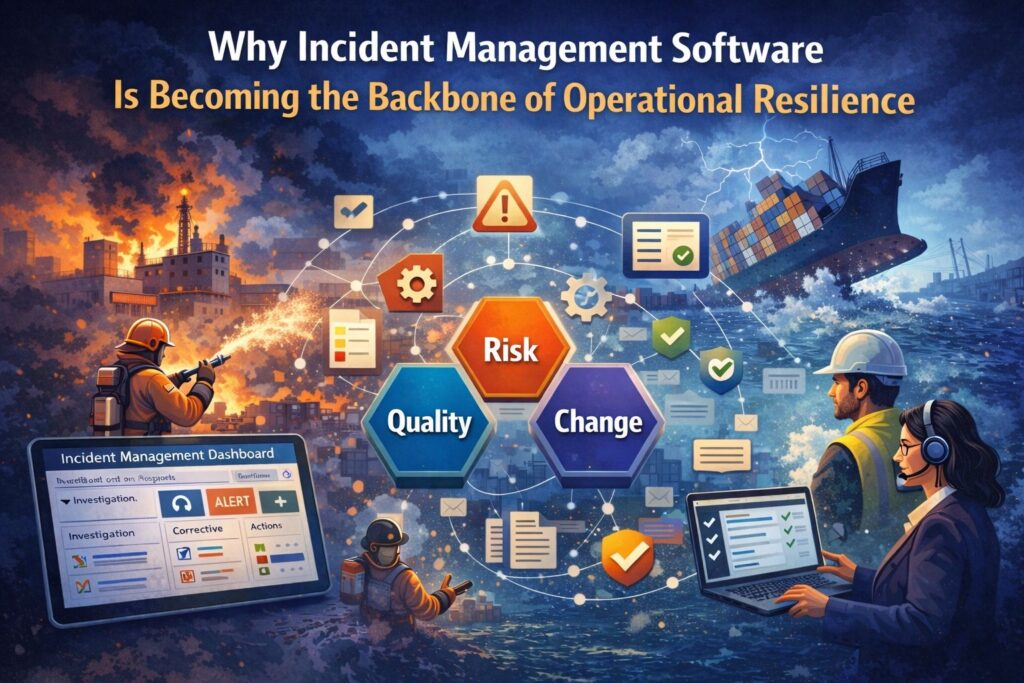

Operational resilience has moved from a theoretical concept to a board-level priority. In an environment defined by supply chain disruptions, evolving regulations, cyber threats, and increasing customer expectations, organizations can no longer afford to treat incidents as isolated events. Every disruption—whether it’s a production deviation, safety issue, system outage, or compliance failure—has the potential to cascade across operations.
As a result, Incident Management Software is emerging as a critical foundation for building resilient operations. When embedded within a broader Quality Management Software ecosystem, it enables organizations to detect issues early, respond effectively, and learn continuously—turning disruption into a source of strength rather than vulnerability.
The evolving definition of operational resilience
Operational resilience is not just about avoiding failures. It is about the ability to anticipate, respond to, recover from, and adapt to disruptive events while continuing to deliver critical products and services.
Modern resilience requires:
- Real-time visibility into operational risks
- Structured and repeatable response processes
- Cross-functional coordination during incidents
- Continuous improvement based on past disruptions
Organizations that rely on ad hoc processes or disconnected systems often struggle to meet these demands, especially as operations scale.
Why traditional incident handling falls short
In many organizations, incident management is still reactive. Issues are logged in spreadsheets, emails, or local systems, making it difficult to see patterns or enforce accountability. This fragmented approach creates blind spots that undermine resilience.
Common limitations of traditional incident handling include:
- Delayed identification of systemic issues
- Inconsistent investigation and root cause analysis
- Poor traceability between incidents and corrective actions
- Limited ability to demonstrate compliance during audits
Without a centralized approach, incidents are resolved in isolation, and the organization misses the opportunity to strengthen its overall operating model.
Incident management as a core resilience capability
Incident management is no longer just a quality or safety function—it is a strategic capability that supports business continuity and risk management. A robust incident management framework ensures that disruptions are handled consistently, transparently, and efficiently across the organization.
When supported by modern Incident Management Software, organizations can:
- Capture incidents in real time from any location or function
- Standardize investigation workflows and escalation paths
- Assign ownership and track resolution progress
- Link incidents to corrective and preventive actions
This structured approach reduces response time and minimizes the impact of disruptions.
Connecting incidents to enterprise quality systems
Incidents rarely exist in isolation. They are often symptoms of deeper process, supplier, or design issues. This is why incident management delivers the most value when integrated with enterprise Quality Management Software.
Integration enables organizations to:
- Analyze incident trends across products, sites, and regions
- Identify recurring failure modes and systemic risks
- Prioritize improvements based on risk and impact
- Align incident data with quality objectives and KPIs
By embedding incident management into the quality ecosystem, organizations shift from firefighting to proactive risk mitigation.
Strengthening audit readiness and compliance
Operational resilience is closely tied to regulatory and customer trust. Organizations must be able to demonstrate not only that incidents are managed, but that they are managed effectively and consistently.
When incident processes are aligned with Audit Software capabilities:
- Incident records, investigations, and actions are fully traceable
- Evidence is readily available for internal and external audits
- Audit findings can be linked directly to related incidents
- Organizations can show a closed-loop approach to compliance
This level of transparency strengthens regulatory confidence and reduces the risk of repeat findings.
Enabling effective change through incident insights
Many operational failures stem from poorly managed change. Process updates, equipment modifications, or supplier changes can introduce unintended risks if not properly controlled.
By connecting incident data with Change Management Software, organizations can:
- Identify changes that are driving incidents or near-misses
- Assess risk before implementing future changes
- Validate whether changes have effectively reduced incidents
- Create a feedback loop between operations and quality governance
This insight-driven approach ensures that change becomes a driver of resilience rather than a source of disruption.
Building a culture of accountability and learning
Technology alone does not create resilience—people and culture play a critical role. Incident management systems support cultural change by making expectations clear and outcomes visible.
A strong incident management framework encourages:
- Early reporting without fear of blame
- Clear accountability for investigation and resolution
- Cross-functional collaboration during response efforts
- Organizational learning from both incidents and near-misses
Over time, this culture reduces the likelihood of major disruptions and improves operational maturity.
Improving speed, consistency, and decision-making
In a crisis, speed and clarity matter. Incident Management Software provides a single source of truth during disruptions, enabling leaders to make informed decisions quickly.
Key benefits include:
- Faster incident detection and escalation
- Consistent response workflows across teams and sites
- Real-time dashboards showing incident status and impact
- Data-driven prioritization of corrective actions
This capability is especially critical for global organizations where coordination across time zones and functions is essential.
Resilience in an era of constant disruption
As disruptions become more frequent and complex, resilience can no longer be built through isolated controls. It requires connected systems that provide visibility, structure, and insight across the enterprise.
Incident management has become the backbone of operational resilience because it sits at the intersection of risk, quality, compliance, and continuous improvement. When supported by integrated quality, audit, and change processes, it enables organizations not just to survive disruption, but to emerge stronger from it.
Platforms like ComplianceQuest help organizations operationalize this approach by delivering incident management as part of a unified, cloud-based quality system—connecting incidents, audits, and changes into a resilient framework that supports sustained operational excellence.