
Key Takeaways
- You need digital marketing because customers search, compare, and choose online
If you are not visible on search and social, your competitors get the clicks and sales first. - Digital marketing grows business through a simple path
Help people discover you, trust you, take action, and return through follow-ups like email and retargeting. - Local visibility and reviews matter a lot for local businesses
Strong local SEO and good reviews help you show up on Maps and win nearby customers. - The best results come from tracking and improving
Use tools like Google Analytics and Search Console to measure leads and sales, then improve what works each month.
You need digital marketing because your customers are online, they research before they buy, and they compare options fast. Digital marketing helps your business get found (search and social), build trust (reviews and helpful content), drive action (calls, forms, checkout), and bring customers back (email and retargeting).
This matters even more in 2026 because people do not stick to one app. DataReportal reports that online adults use an average of 6.75 social platforms each month, and it also reports 5.66 billion active social media user identities worldwide (October 2025).
What Is Digital Marketing?
Digital marketing means promoting your business online using channels like:
- Search engines (Google)
- Social media (Instagram, TikTok, Facebook, YouTube, LinkedIn)
- Email marketing
- Content marketing (blog posts, guides, videos)
- Paid ads (Google Ads, paid social)
It works for online businesses and local businesses. A local plumber uses digital marketing to get more calls. An online store uses it to get more orders. The goal is the same: get more customers and more sales.
How Digital Marketing Helps a Business Grow (Simple Growth Path)
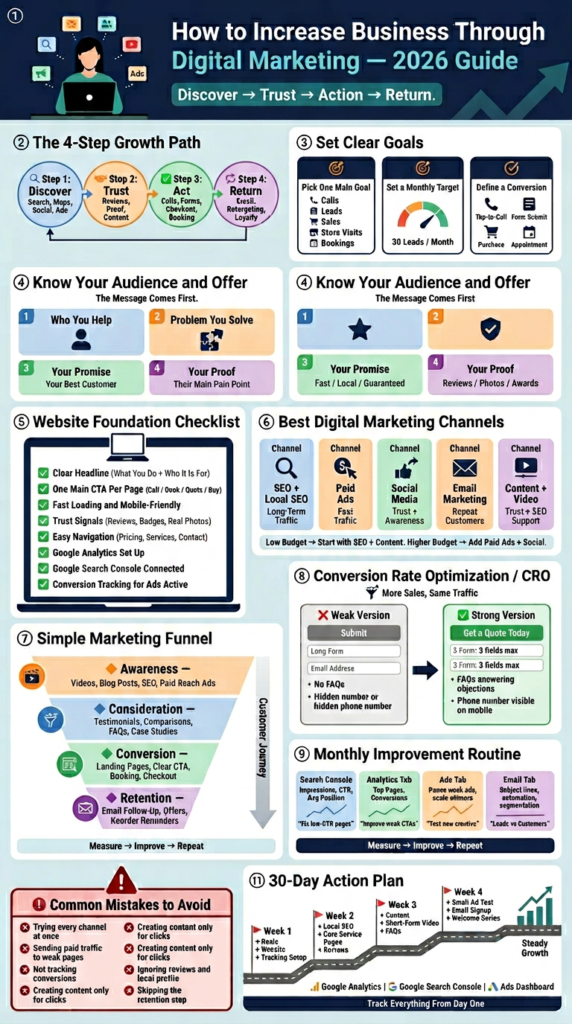
A simple way to explain why you need digital marketing for your business is to look at the customer journey. Most people move through four steps:
- Discover you
They find you on Google, Google Maps, social media, or an ad. - Trust you
They read reviews, view photos, watch a short video, or read a helpful page. - Act
They call you, fill out a form, book an appointment, or buy. - Return
They come back because of email follow-ups, reminders, retargeting ads, or a great experience.
Because people use many platforms each month, a customer might see you on Instagram first, then search your name on Google, then check reviews, then finally call. DataReportal’s 6.75 platforms per month number is a simple reminder that attention is spread out.
Top Reasons You Need Digital Marketing for Your Business
Your customers are already online
People spend time online every day. If your business is hard to find online, customers will not wait. They will click a competitor who shows up first.
People research before they buy
Even when someone plans to buy in a store, they often research first. Google’s consumer insights content says that over 40 percent of shoppers go to Google when researching a purchase they plan to make in-store or online.
That research usually includes:
- Checking prices
- Reading reviews
- Comparing options
- Looking at photos
- Searching best near me or top rated
If you are not present during research, you lose the sale before the customer even contacts you.
You can target the right people (not everyone)
Traditional marketing often targets everyone. Digital marketing lets you target the right people.
Examples of simple targeting:
- Location targeting
City, ZIP code, or a radius around your store - Interest targeting
Fitness, home improvement, travel, pet owners - Keyword targeting
What people type into Google, like emergency dentist near me or buy running shoes
This matters because targeting helps you spend less and get better leads.
It builds trust faster (proof beats promises)
People do not just want claims. They want proof.
Trust builders that work well:
- Customer reviews
- Before-and-after photos
- Case studies and results
- Testimonials
- Guarantees and clear policies
Digital marketing helps you show this proof where customers are already looking.
It is measurable (you can see what works)
One of the biggest reasons to use digital marketing is that you can measure results.
You can find out:
- Which channel brought the lead (Google, social, email, ads)
- Which page led to the call or form
- Which ad produced sales
- Which content topics bring the best customers
When you can measure, you can improve. When you can improve, you can grow.
It supports both quick wins and long-term growth
Digital marketing gives you options based on your timeline:
- Quick wins
Paid ads can bring leads quickly. - Long-term growth
SEO and helpful content can build steady traffic over time.
HubSpot’s 2026 marketing statistics say website, blog content, and SEO remain a top ROI channel, followed closely by paid social, and video formats lead content ROI.
It helps local businesses show up on Maps
If you are a local business, being visible on Google Maps can be a game changer.
Google says local results are mainly based on:
- Relevance
- Distance
- Popularity (prominence)
Google also says more reviews and positive ratings can help your local ranking, which is why local SEO is important for small businesses that depend on nearby customers.
It brings repeat customers (retention is cheaper than starting over)
Many businesses focus only on getting new customers. But repeat customers are often where real profit grows.
Digital retention tools include:
- Email newsletters
- Automated follow-ups (welcome series, reminders)
- Promotions and seasonal offers
- Retargeting ads (ads shown to people who already visited your site)
Litmus reports that email marketing drives an average 36 dollar return for every 1 dollar spent.
It helps you compete with bigger brands
You do not need the biggest budget to win online. Small businesses can compete by being:
- Clear (simple message)
- Helpful (useful content)
- Trusted (reviews and proof)
- Easy to contact (fast site, clear calls to action)
A strong local presence plus great reviews can make a small business look like the best option in town.
It improves customer service and reputation
Digital marketing also supports customer service.
Examples:
- Replying to reviews
- Answering FAQs on your website
- Posting updates on social media (hours, delays, new services)
- Sending what to expect emails after booking
When customers feel informed, they trust you more and complain less.
Which Digital Marketing Channels Matter Most (and Why)
You do not need every channel. You need the right mix for your goals.
SEO (Search Engine Optimization)
SEO helps you show up when people search for your service or product on Google.
A simple SEO focus looks like this:
- One strong page for each main service
- Helpful blog posts that answer customer questions
- Clear titles and headings
- Fast, mobile-friendly pages
Google recommends creating helpful, reliable, people-first content, not content created mainly to manipulate rankings.
Local SEO (Google Business Profile + local pages)
Local SEO helps you show up in Google Maps and local searches.
High-impact local actions:
- Complete your Google Business Profile (hours, services, photos)
- Keep your info correct (name, address, phone)
- Ask for reviews and respond to reviews
This is a major part of how digital marketing helps small business win local customers who are ready to buy.
Paid ads (Google Ads, paid social)
Paid ads are best for speed.
They work well when you have:
- A clear offer (free quote, discount, free trial)
- A focused landing page (one page, one goal)
- Good tracking (so you know what made money)
Social media marketing (organic + paid)
Social media helps people get familiar with your brand.
A simple social plan:
- Helpful posts (tips, how-to)
- Proof posts (reviews, results, before-and-after)
- Offer posts (packages, promos)
HubSpot’s 2026 marketing statistics also highlight that short-form video is a top ROI format for many marketers.
Email marketing
Email helps you bring people back and create repeat sales.
A simple email setup:
- Email signup (coupon, checklist, free guide)
- Welcome series (3 to 5 emails)
- Monthly email (tips plus offer)
Litmus reports the 36 dollar per 1 dollar ROI benchmark, which is why email is often a top retention channel.
Content and video marketing
Content answers questions and builds trust. Video helps people understand fast.
Simple content ideas:
- Pricing and cost pages
- Best option for pages
- FAQs and troubleshooting guides
- Short videos answering one question at a time
- Case studies and real results
Tools You Should Mention (to Make the Article Complete)
These tools make digital marketing clearer and easier:
- Google Search Console
Helps you see search clicks, impressions, CTR, and average position. - Google Analytics
Helps you see what visitors do on your site and which pages convert. - Keyword research tool
Options include Google Keyword Planner, Semrush, Ahrefs, or Ubersuggest.
What to Measure (So You Know It’s Working)
Keep measurement simple. Track what connects to money.
Core metrics:
- Leads
Calls, forms, bookings - Sales
Online purchases or signed deals - Cost per lead (if running ads)
How much you pay for each lead - Conversion rate
How many visitors become leads or customers
A practical rule: if traffic is rising but sales are not, the problem is usually your offer, your page clarity, your speed, or your trust signals (like reviews and proof).
Common Mistakes Businesses Make With Digital Marketing
Avoid these mistakes if you want steady growth:
- Doing every channel at once with no plan
- Sending paid traffic to a weak page
- Not tracking conversions
- Posting content only for rankings instead of helping people
- Ignoring reviews and local profile updates (local rankings and trust can suffer)
Conclusion (Simple Starter Plan)
If you want the simplest answer to why you need digital marketing for your business, it is this: customers are searching, comparing, and choosing online. Digital marketing helps you be the one they find and trust.
A simple starter plan:
- Fix your website basics
Clear headline, clear call to action, trust signals, mobile-friendly pages - Set up tracking
Google Search Console plus Google Analytics - Choose one channel for fast results
Paid ads or local SEO - Choose one channel for long-term growth
SEO plus helpful content - Add email to bring customers back
Welcome series, monthly tips, simple offers
Do these steps consistently, and digital marketing becomes a system that grows your business month after month.
FAQ
How does digital marketing help my business get more customers?
It helps new people find you on Google and social media, builds trust with reviews and helpful content, and makes it easy to contact you or buy from you.
Do I need digital marketing if I already get referrals?
Yes. Referrals are great, but many people still search your business name online before they call. Digital marketing helps you look trustworthy and helps you get extra leads when referrals slow down.
Which digital marketing channel should I start with first?
Start with one channel that matches your goal. For local businesses, local SEO and reviews are often the best first step. For faster leads, try a small paid ads test. For repeat customers, start email marketing.
How long does it take to see results from digital marketing?
Paid ads can work in days. Social media can take a few weeks. SEO and content marketing usually take 3 to 6 months for stronger results, but they can bring steady traffic over time.
What should I track to know if digital marketing is working?
Track real actions like calls, form submissions, bookings, and sales. Also track where leads came from so you know which channel is bringing the best customers.