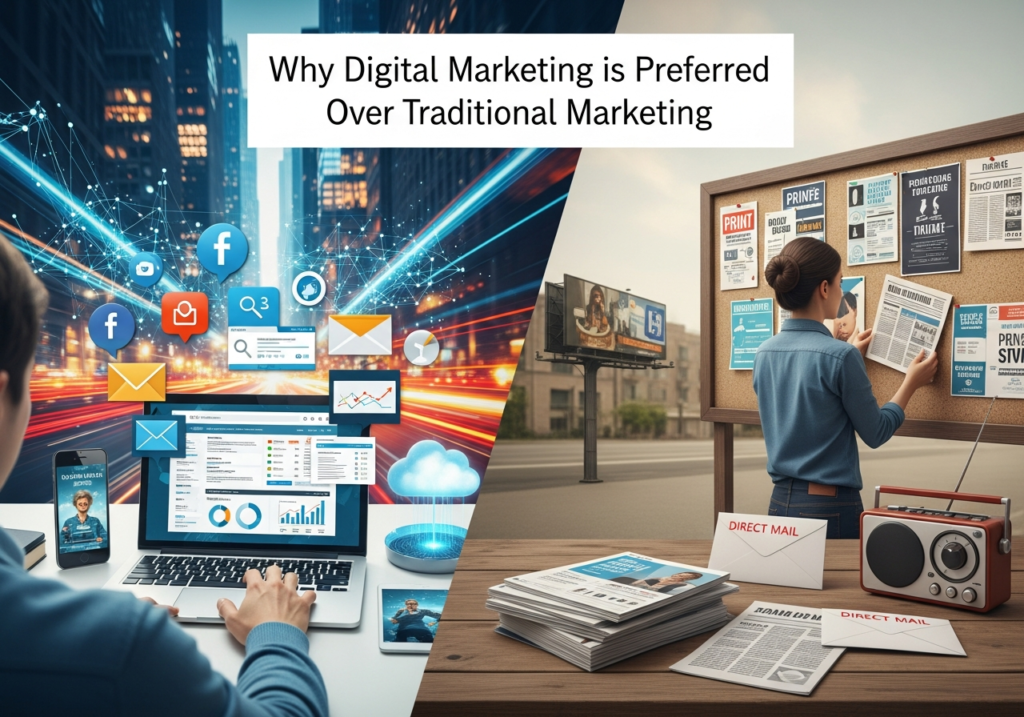

Why Digital Marketing Is Preferred Over Traditional Marketing
In today’s fast-paced digital era, the way businesses promote their products and services has changed dramatically. For decades, traditional marketing methods such as television advertisements, radio promotions, newspaper ads, billboards, and direct mail campaigns dominated the marketing landscape. These channels helped companies build brand awareness and reach mass audiences.
However, with the rise of the internet and digital technologies, marketing strategies have shifted significantly. Businesses are now increasingly focusing on digital marketing because it offers better targeting, measurable results, cost efficiency, and global reach. Compared to traditional marketing, digital marketing provides more flexibility and data-driven insights that help companies achieve stronger results.
The Evolution from Traditional to Digital Marketing
Traditional marketing was built around one primary objective: reaching as many people as possible. Companies invested heavily in TV commercials, magazine advertisements, and outdoor billboards to promote their products. These strategies were effective in building brand awareness, especially before the widespread use of the internet.
Despite its success, traditional marketing has several limitations. It is often expensive, difficult to measure accurately, and lacks the ability to target specific audiences. For example, a company placing a billboard on a busy highway cannot determine exactly how many people saw the advertisement or whether it influenced purchasing decisions.
The rise of the internet transformed marketing completely. Digital platforms such as search engines, social media networks, and websites allow businesses to communicate directly with their target audience. Instead of broadcasting messages to everyone, companies can now deliver personalized marketing campaigns to individuals who are most likely to be interested in their products or services.
Cost-Effectiveness and Higher ROI
One of the main reasons businesses prefer digital marketing is its affordability. Traditional advertising methods often require significant budgets. A television commercial or a full-page newspaper advertisement can cost thousands of dollars, making it difficult for small businesses or startups to compete.
Digital marketing, on the other hand, offers flexible and budget-friendly options. Businesses can run advertising campaigns on platforms like search engines and social media with relatively small budgets. Even a small investment can generate significant exposure and engagement if campaigns are properly optimized.
Another advantage is the potential for higher return on investment (ROI). Digital marketing strategies such as search engine optimization (SEO), pay-per-click (PPC) advertising, and social media marketing allow businesses to target specific audiences and optimize campaigns based on performance data. This ensures marketing budgets are used more efficiently and produce measurable results.
Precise Audience Targeting
Traditional marketing methods often rely on broad audience reach, which means advertisements are shown to many people who may not be interested in the product. This approach can result in wasted marketing resources.
Digital marketing provides advanced targeting capabilities that allow businesses to reach the right audience at the right time. Marketers can target potential customers based on demographics, location, interests, and online behavior.
For example, a fitness brand can target individuals who have shown interest in health, wellness, or exercise content online. Similarly, a local service provider can target customers within a specific geographic area. This level of precision ensures that marketing messages are delivered to people who are more likely to engage and convert.
Real-Time Performance Tracking
One of the biggest challenges with traditional marketing is measuring its effectiveness. Businesses often rely on indirect indicators such as sales increases or customer surveys to estimate the impact of a campaign.
Digital marketing eliminates this uncertainty by providing detailed analytics and performance tracking. Tools such as website analytics platforms and social media insights allow marketers to monitor campaign performance in real time. Metrics such as website traffic, click-through rates, conversion rates, and user engagement help businesses understand how their campaigns are performing.
With this data, companies can quickly adjust strategies, improve underperforming campaigns, and allocate budgets more effectively. This real-time optimization leads to better results and more efficient marketing strategies.
Global Reach and Scalability
Another major advantage of digital marketing is its global reach. Traditional marketing campaigns are usually limited to a specific geographic area. For example, a local newspaper advertisement will only reach readers in that region.
Digital marketing removes these geographic barriers. Businesses can promote their products and services to audiences around the world through websites, social media platforms, and online advertising. This is particularly beneficial for e-commerce businesses that want to expand into international markets.
In addition, digital campaigns are highly scalable. Businesses can easily increase or decrease their advertising budgets depending on their goals and performance results. This flexibility allows companies to adapt quickly to market changes and customer demands.
Enhanced Customer Engagement
Unlike traditional marketing, which typically involves one-way communication, digital marketing encourages interaction between businesses and customers. Social media platforms, email marketing campaigns, and website content allow brands to communicate directly with their audience.
Customers can comment on posts, send messages, participate in polls, or share content with others. This two-way communication builds stronger relationships and increases customer loyalty.
Digital marketing also enables personalization. Businesses can send tailored messages, product recommendations, or promotional offers based on customer preferences and previous interactions. Personalized marketing experiences help improve customer satisfaction and increase conversion rates.
The Long-Term Value of SEO
Search engine optimization (SEO) is one of the most valuable components of digital marketing. Unlike traditional advertisements that stop generating results once the campaign ends, SEO can drive organic traffic to a website for months or even years.
By optimizing website content with relevant keywords, high-quality information, and user-friendly design, businesses can improve their visibility in search engine results. When potential customers search for products or services online, companies that rank higher in search results are more likely to attract visitors and generate leads.
SEO also helps build trust and credibility. Websites that appear at the top of search results are often perceived as more reliable and authoritative by consumers.
Conclusion
Traditional marketing played an important role in shaping the advertising industry and continues to be useful for certain branding purposes. However, in the modern digital landscape, businesses require more precise, flexible, and measurable marketing strategies.
Digital marketing offers several advantages, including cost-effectiveness, targeted audience reach, real-time performance tracking, global exposure, and improved customer engagement. These benefits make it a powerful tool for businesses looking to grow and stay competitive.
As technology continues to evolve, digital marketing will become even more essential for organizations of all sizes. Businesses that embrace digital strategies today will be better positioned to connect with their audiences, drive conversions, and achieve long-term success.