
Cold chain management is one of the most critical parts of industries like pharmaceuticals, food and beverage, and healthcare. A single temperature deviation can spoil an entire batch of products, leading to financial losses and, in some cases, serious health risks. This is where data loggers come in. They are simple yet powerful tools that help businesses keep track of temperature and other environmental conditions throughout the supply chain.
In this article, we will walk you through everything you need to know about data loggers and why they matter for cold chain monitoring.
What Are Data Loggers?
A data logger is an electronic device that automatically records environmental data over time. In cold chain monitoring, data loggers are primarily used to track temperature and humidity. They work continuously in the background, capturing readings at set intervals and storing the data for review later.
Think of a data logger as a silent watchman. It stays with your shipment or storage unit and keeps a complete record of the conditions your products experienced from the point of origin to the point of delivery.
Data loggers are compact, battery-powered, and designed to work in challenging environments like refrigerated trucks, cold storage warehouses, and even during air freight. They are widely used in industries where product quality is directly tied to temperature control.
How Do Data Loggers Work?
Data loggers work through a simple and reliable process. Here is a step-by-step breakdown of how they function.
Step 1: Sensing A data logger uses built-in sensors to detect environmental conditions like temperature and humidity. These sensors are designed to measure with high accuracy, often within fractions of a degree.
Step 2: Recording The device records readings at regular intervals. This interval can be set by the user depending on the requirement. For example, a logger can be set to record temperature every 5 minutes, every 30 minutes, or every hour.
Step 3: Storage All recorded data is stored in the device’s internal memory. Depending on the model, a data logger can store thousands to millions of readings without losing any data.
Step 4: Data Retrieval Once the shipment reaches its destination or after a monitoring period, the stored data is retrieved. This can be done through USB connection, wireless download, or in real time through cloud integration.
Step 5: Analysis and Reporting The retrieved data is then viewed through software or a mobile application. Reports can be generated to check if the temperature stayed within the required range throughout the journey.
This straightforward process makes data loggers one of the most trusted tools in cold chain operations.
What Are the Types of Data Loggers in Cold Chain Monitoring?
There are several types of data loggers available for cold chain monitoring. Each type is suited to different operational needs. Here are the most commonly used ones.
1. Data Loggers with Cloud Integration
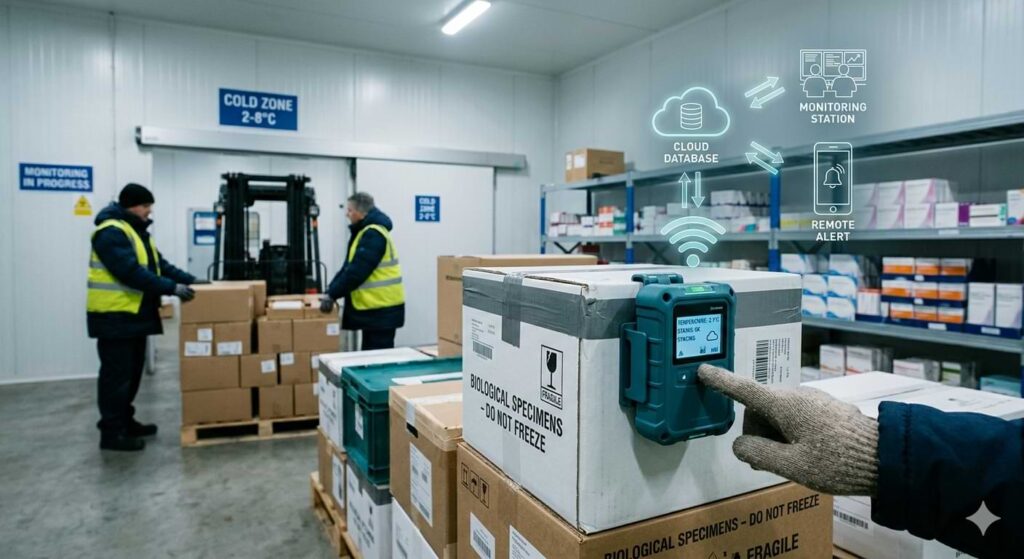
Cloud-connected data loggers are among the most advanced options available today. These devices send recorded data directly to a cloud platform in real time using cellular or Wi-Fi connectivity.
The biggest advantage of cloud-integrated data loggers is that you do not have to wait for a shipment to arrive before checking the data. You can monitor temperature conditions live from anywhere in the world using a web dashboard or mobile app. If a temperature excursion occurs, the system can send an instant alert to the concerned team so they can take corrective action immediately.
These loggers are ideal for businesses that handle large-scale operations, long-distance shipments, and high-value products like life-saving medicines and vaccines.
2. Data Loggers with USB Connectivity
USB data loggers are one of the most widely used options in the industry. They are simple, cost-effective, and easy to operate. These devices record temperature and humidity data throughout the monitoring period and store it internally.
When the monitoring period ends, you simply plug the device into a computer using a USB cable and download the recorded data. The accompanying software generates a detailed report with graphs and statistics.
USB data loggers are commonly used for shorter shipments, laboratory storage monitoring, and situations where real-time data is not a priority. They are disposable or reusable depending on the model, which makes them very flexible for different use cases.
3. Data Loggers with Display
Some data loggers come with a built-in screen that shows current readings directly on the device. This means that anyone handling the shipment or managing the storage area can see the current temperature or humidity without needing a phone or computer.
Display data loggers often include visual or audible alarms that alert the handler if conditions go out of the acceptable range. This is very useful in warehouses and distribution centers where staff need to monitor conditions at a glance.
These loggers are particularly popular in pharmacy retail, hospital storage, and food distribution because they give immediate on-site visibility without any additional tools.
How Do Data Loggers Help in Cold Chain Compliance?
Regulatory compliance is a major concern for businesses in pharmaceuticals, food safety, and healthcare. Regulatory bodies like the CDSCO in India, the FDA in the United States, and the WHO require detailed temperature records for certain products. Data loggers play a key role in meeting these requirements.
Here is how data loggers support cold chain compliance.
Complete and Accurate Records Data loggers provide a full history of temperature conditions from start to finish. This digital record can be presented during audits and inspections as proof that proper storage conditions were maintained.
Detection of Excursions If temperature goes above or below the required range at any point, data loggers capture this event with a timestamp. This helps businesses identify exactly when and where the excursion happened and take corrective action.
Traceability Each data logger is associated with a specific shipment or batch. This makes it easy to trace the temperature history of any product back to its source, which is critical during quality investigations or product recalls.
Reduction in Manual Errors Manual temperature logging by staff is prone to errors and inconsistencies. Data loggers eliminate this risk by automating the entire recording process.
Audit-Ready Reports Modern data loggers generate reports in formats that are accepted by regulatory bodies. These reports include statistical summaries, graphs, and alarm events, making compliance documentation straightforward.
How to Choose the Right Data Logger for Your Cold Chain Monitoring?
With so many options available in the market, choosing the right data logger can feel overwhelming. Here are some key factors to consider before making a decision.
Temperature Range Make sure the logger you choose can measure and record the temperature range your products require. For example, frozen products need a logger that works at minus 20 degrees Celsius or lower, while vaccines may need a range between 2 and 8 degrees Celsius.
Accuracy Look for a data logger with high accuracy, typically plus or minus 0.5 degrees Celsius. In pharmaceutical cold chains especially, even small deviations can matter.
Battery Life Consider how long your shipment or monitoring period lasts and choose a logger with adequate battery life. Some loggers can run for months or even years on a single battery.
Connectivity and Data Access Decide whether you need real-time monitoring or whether end-of-journey data retrieval is sufficient. If real-time visibility is important, go for a cloud-connected logger. If you just need a reliable record at the end, a USB logger may be enough.
Display Requirement If on-site visibility is important for your team, choose a logger with a built-in display and alarm system.
Regulatory Compliance Check whether the logger meets the standards required by your industry. Look for loggers that comply with WHO, FDA, or EU GDP guidelines depending on your market.
Ease of Use The device should be easy to configure, activate, and read. Complex devices can slow down operations and lead to errors in usage.
Cost Weigh the upfront cost against the long-term benefits. Reusable loggers may have a higher initial cost but offer savings over time. Disposable loggers are better for one-way shipments.
After-Sales Support Choose a supplier who provides good technical support, software updates, and calibration services. This ensures your loggers remain accurate and functional over time.
Which Are Some of the Good Data Logger Suppliers in India?
India has a growing number of reliable data logger suppliers catering to the pharmaceutical, food, and logistics sectors. Here are some well-known names in the Indian market.
Elitech India Elitech is a globally recognized brand with a strong presence in India. They offer a wide range of temperature and humidity data loggers including USB, Bluetooth, and cloud-connected models. Their products are commonly used in pharmaceutical cold chains and food storage.
Testo India Testo is a German brand with a well-established distribution network in India. They are known for precision instruments and offer high-quality data loggers with both standalone and cloud connectivity options. Testo is a popular choice among regulated industries.
Tempmate (distributed in India by local partners) Tempmate loggers are widely used for pharmaceutical shipment monitoring. They are known for their accuracy, long battery life, and compliance with international regulatory standards. Several authorized distributors operate across India.
Monnit India Monnit offers wireless sensor solutions including temperature data loggers with cloud monitoring capabilities. They are suitable for businesses looking for scalable monitoring across multiple locations.
Sensitech (available through partners in India) Sensitech is a global leader in cold chain monitoring and their products are available through partners in India. They are well-regarded in the pharmaceutical and food industries for their robust and reliable loggers.
Oceasoft (available in India) Oceasoft provides connected data loggers with cloud platforms. They serve healthcare and life sciences industries and are known for their compliance-ready solutions.
Lisaline Asia Lisaline Asia is a trusted name in cold chain monitoring solutions in India. They offer a range of data loggers designed for pharmaceutical, healthcare, and food storage applications. Their products support temperature and humidity monitoring with options for USB connectivity and cloud-based data access. Lisaline Asia is known for providing compliance-ready solutions that align with WHO and GDP guidelines, making them a reliable choice for regulated industries across India.
Local Indian Manufacturers There are also several Indian manufacturers producing cost-effective data loggers suitable for domestic cold chain applications. Companies like Rotronic India and local MSME manufacturers offer budget-friendly options with reasonable accuracy for food and general logistics use.
When choosing a supplier in India, it is advisable to check for ISO certification, calibration services, and after-sales support alongside the product specifications.
Final Thoughts
Data loggers are no longer optional in modern cold chain operations. They are a necessity. Whether you are shipping vaccines across states, storing frozen food in a warehouse, or transporting fresh produce to a retail store, data loggers give you the confidence that your products are being handled correctly.
They protect product quality, support regulatory compliance, reduce waste, and give businesses the data they need to continuously improve their operations. With a wide variety of options available, from simple USB loggers to sophisticated cloud-connected systems, there is a data logger suited to every need and budget.
Investing in the right data logger today means fewer surprises tomorrow.