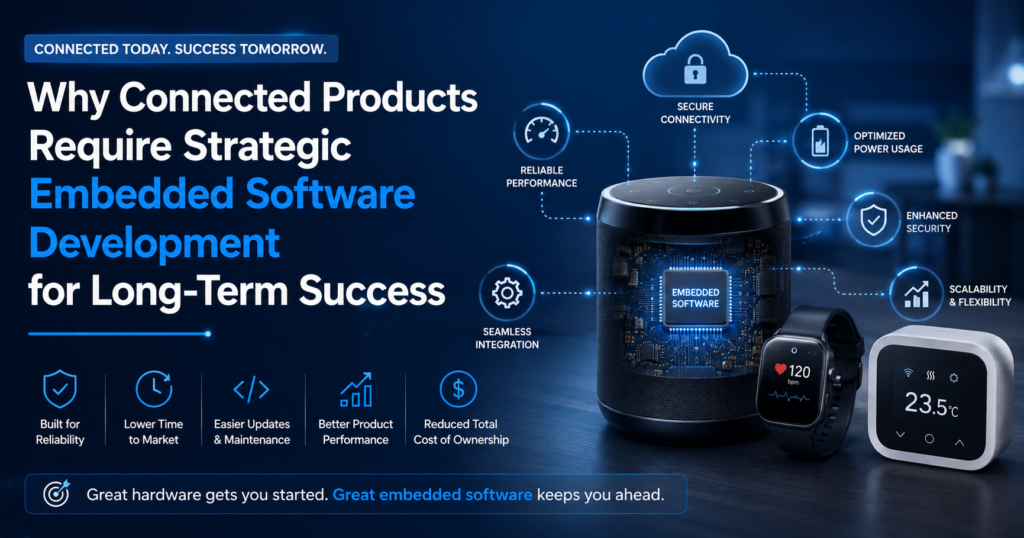

Connected products have become a core part of modern business operations. From industrial sensors and medical devices to smart appliances and connected vehicles, organizations increasingly depend on products that can collect, process, and exchange data in real time. However, the success of these products depends on more than hardware innovation. The software running inside the device often determines reliability, security, scalability, and long-term performance.
Industry forecasts highlight the growing importance of connected technologies. According to Statista, the number of Internet of Things (IoT) devices worldwide is expected to exceed 29 billion by 2030. IDC also reports continued growth in enterprise spending on IoT solutions as organizations seek greater operational visibility and automation. Meanwhile, research from McKinsey suggests that IoT-enabled systems could generate trillions of dollars in economic value annually across industries such as manufacturing, healthcare, logistics, and energy.
Despite these opportunities, many connected products struggle after deployment due to software limitations rather than hardware failures. This reality explains why businesses increasingly view Embedded Software Development as a strategic investment rather than a technical requirement.
Connected Products Face Challenges Beyond Initial Deployment
Many organizations focus heavily on product launch timelines. They prioritize hardware design, manufacturing readiness, and feature development while treating software as a secondary component.
This approach creates long-term risks.
A connected device does not operate in a static environment. Customer expectations evolve, security threats change, network infrastructures advance, and business requirements expand over time.
Products that lack a strategic software foundation often experience issues such as:
- Performance degradation
- Security vulnerabilities
- Firmware instability
- Integration challenges
- Limited scalability
- Expensive maintenance cycles
The true measure of success is not whether a product launches successfully. It is whether the product continues to deliver value years after deployment.
Why Embedded Software Is the Core of Connected Products
Hardware provides the physical foundation of a connected product, but software determines how the device behaves.
Embedded software manages critical functions including:
- Sensor communication
- Data processing
- Device control
- Connectivity management
- Security protocols
- Power optimization
- User interactions
Every action performed by a connected device depends on software logic.
For example, in a smart energy management system, embedded software continuously monitors consumption patterns, processes incoming sensor data, manages communication with cloud platforms, and executes automated responses based on predefined conditions.
Without robust software architecture, even advanced hardware can fail to meet operational requirements.
Scalability Begins at the Software Architecture Level
Many connected products perform well during pilot deployments. Problems often emerge when organizations attempt to scale.
A solution designed for hundreds of devices may encounter challenges when supporting tens of thousands of connected endpoints.
Scalability issues commonly appear in areas such as:
Device Communication
As device volumes increase, communication systems must handle larger data streams without introducing latency.
Firmware Management
Updating software across thousands of devices requires reliable over-the-air update mechanisms.
Resource Utilization
Memory, processing power, and storage constraints become more significant as functionality expands.
Cloud Integration
Backend systems must support increasing volumes of device-generated information.
Strategic Embedded Software Development accounts for future growth requirements from the beginning rather than treating scalability as an afterthought.
Security Cannot Be Added Later
Cybersecurity has become one of the most important considerations in connected product development.
Every connected device creates a potential entry point into broader digital ecosystems. Attackers increasingly target IoT devices because many organizations overlook embedded security during development.
Common risks include:
- Unauthorized device access
- Data interception
- Firmware manipulation
- Credential theft
- Network intrusion
Addressing these risks requires software-level protections such as secure boot mechanisms, encrypted communication protocols, device authentication, and firmware integrity verification.
Organizations that postpone security considerations often face higher remediation costs and greater operational risk later.
Strategic software planning helps ensure that security remains integrated throughout the product lifecycle.
Long-Term Product Success Depends on Maintainability
Connected products rarely remain unchanged after deployment.
Businesses regularly introduce new features, improve performance, address vulnerabilities, and adapt to changing customer expectations.
Maintainability therefore becomes a critical success factor.
Poorly structured software often creates development bottlenecks. Small modifications may require extensive code changes, increasing costs and slowing release cycles.
A structured Embedded Software Development Solution focuses on maintainability through:
- Modular architecture
- Reusable components
- Clear documentation
- Version control practices
- Automated testing frameworks
These practices reduce long-term complexity and support continuous product improvement.
Reliability Matters More Than Feature Quantity
Many connected products compete based on feature lists.
However, enterprise customers often prioritize reliability over feature count.
Industrial environments provide a strong example. Manufacturing facilities depend on connected devices for monitoring production equipment, managing inventory, and supporting predictive maintenance programs.
In these environments, system failures can disrupt operations and generate significant financial consequences.
Reliable software ensures:
- Consistent device operation
- Accurate sensor readings
- Stable network communication
- Predictable system behavior
Organizations that focus exclusively on adding features often introduce unnecessary complexity that affects reliability.
Strategic software development balances functionality with stability.
Enterprise Example: Tesla’s Over-the-Air Software Strategy
Tesla provides a compelling example of how embedded software contributes to long-term product success.
Unlike traditional automotive manufacturers that rely heavily on physical service interventions, Tesla designed its vehicles around software-centric architecture. The company regularly deploys over-the-air updates that improve performance, introduce new features, enhance safety systems, and address software issues.
This approach extends product value long after initial purchase.
Customers receive continuous improvements without requiring hardware replacements, while Tesla maintains greater control over product performance across its vehicle fleet.
The example demonstrates how strategic software architecture supports innovation, maintainability, and customer satisfaction throughout the product lifecycle.
Data Processing at the Edge Is Becoming More Important
Connected products increasingly operate in environments where real-time decision-making is essential.
Relying solely on cloud infrastructure can introduce delays that affect performance.
As a result, many organizations are shifting toward edge computing models.
Embedded software now handles tasks such as:
- Local data processing
- Event detection
- Anomaly identification
- Device-level automation
- Immediate response execution
By processing information closer to the source, devices can respond faster while reducing bandwidth requirements.
A well-designed Embedded Software Development Solution supports this transition by optimizing resource utilization and processing efficiency.
The Cost of Poor Embedded Software Decisions
Software design choices made during early development stages often affect products for years.
Poor decisions can result in:
- Higher Maintenance Costs: Frequent troubleshooting and patching consume engineering resources.
- Product Reliability Issues: Software instability can affect customer trust and brand reputation.
- Delayed Feature Releases: Complex architectures make future enhancements more difficult.
- Security Exposure: Weak software foundations increase vulnerability to cyber threats.
- Reduced Product Lifespan: Organizations may need to replace products sooner when software limitations prevent ongoing improvements.
These risks highlight why software strategy deserves the same attention as hardware engineering.
ROI and Business Impact
Businesses that invest in strategic embedded software practices often experience measurable benefits.
-
Reduced Operational Disruptions: Reliable software minimizes unexpected failures and downtime.
-
Lower Lifecycle Costs: Well-structured architectures reduce maintenance and upgrade expenses.
-
Faster Product Evolution: Modular software frameworks support continuous innovation.
-
Improved Security Posture: Integrated security controls help reduce cyber risks.
-
Stronger Customer Retention: Reliable products with ongoing improvements create better customer experiences.
While outcomes vary across industries, organizations consistently achieve stronger long-term results when software planning becomes a core part of product strategy.
Final Thoughts
Connected products operate in dynamic environments where performance expectations, security requirements, and business demands continuously evolve. Hardware innovation remains important, but software ultimately determines how effectively a product adapts to change over time.
Strategic Embedded Software Development provides the foundation needed to support scalability, security, maintainability, and reliability throughout the product lifecycle. Rather than focusing solely on initial deployment, organizations should view software architecture as a long-term business asset that influences product success for years after launch.
As connected ecosystems continue to expand, businesses that invest in a robust Embedded Software Development Solution will be better positioned to deliver reliable products, respond to evolving market requirements, and maintain competitive advantage in increasingly connected industries.