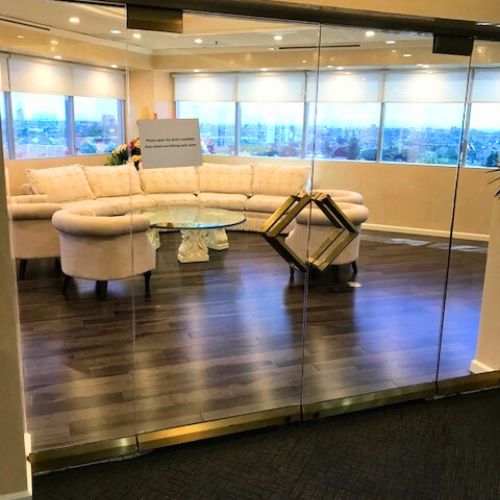

A glass table top transforms a piece of furniture. It protects a wood dining table from scratches and spills. It turns a wrought-iron patio base into a sophisticated outdoor dining surface. It gives a desk a sleek, modern look while providing a clean, easy-to-maintain work surface. But not all glass table tops are created equal — and the differences between a $200 panel and an $800 panel aren’t just about size. They’re about thickness, edge work, tempering, and the expertise of the glazier who fabricates the glass.
Here’s what to look for when ordering a custom glass table top — and what corners some suppliers cut that you should never accept.
Thickness: The Foundation of Everything
Glass table top thickness typically ranges from 1/4-inch (6mm) to 1/2-inch (12mm), with 3/8-inch (10mm) being the most common choice for residential dining tables and desks. The right thickness depends on the size of the glass, the type of support underneath, and how the table will be used.
A 1/4-inch glass top works for small end tables and nightstands with full perimeter support — meaning the glass rests on a frame or edge that supports it around all four sides. But for a dining table where the glass spans between pedestals or legs, 1/4-inch glass flexes visibly under weight, and that flexing creates stress concentrations that can lead to failure. DIN 52337, the European standard for glass in building, recommends that glass deflection under load should not exceed 1/200th of the span — a standard that many thin table tops fail to meet.
At LA Glass Company, we recommend 3/8-inch tempered glass for dining tables up to 48 inches in any dimension, and 1/2-inch for larger surfaces, tables with minimal support, or commercial applications like restaurant tabletops. Thicker glass costs more, but it resists flexing, feels substantial, and gives the table the weight and stability that thin glass can’t provide.
Tempering: Safety Is Not Optional
Tempered glass is heat-treated to increase its strength by a factor of four to five compared to annealed glass of the same thickness. More importantly, when tempered glass does break — and it takes significant force to break it — it shatters into small, relatively harmless pebble-like fragments rather than dangerous shards.
For table tops, tempering isn’t just a recommendation — it’s effectively a safety requirement. A dining table with an annealed glass top is a liability waiting to happen. Someone leans on an edge, a hot dish creates thermal stress, or an accidental impact occurs, and suddenly you’re dealing with broken glass and potential injury. Tempered glass reduces that risk dramatically.
One important note: tempered glass cannot be cut or modified after tempering. The fabrication — cutting to size, edge work, and any drilled holes for mounting hardware — must all be completed before the tempering process. That means your glass table top is custom-fabricated to your exact specifications, and measurements must be precise. At LA Glass Company, our third-generation glaziers verify every measurement because there’s no such thing as “close enough” when working with tempered glass.
Edge Work: The Detail That Defines Quality
The edge profile of a glass table top is the first thing you see and touch. It’s also where you can immediately tell the difference between quality fabrication and cut-corner work.
The most common edge profiles for table tops are:
- **Flat Polish Edge:** The edge is ground flat and polished to a glossy finish. This is the most popular choice for modern and contemporary furniture. A quality flat polish should be perfectly smooth, with no visible grinding marks, chips, or dull spots. The corners should be slightly eased — not sharp — for comfort and safety.
- **Pencil Edge:** The edge is ground to a rounded profile resembling a pencil tip. This is an elegant look for thicker glass (3/8-inch and above) and provides a softer, more forgiving edge that’s pleasant to touch and less prone to chipping.
- **Beveled Edge:** The glass edge is ground at an angle, creating a decorative prismatic effect that catches and refracts light. Bevels are typically specified in widths — 1/2-inch, 1-inch, or wider — and add a traditional, formal look to the glass.
- **Seamed Edge:** This is the minimum acceptable finish — the sharp edge is lightly ground to remove burrs and prevent cuts, but it’s not polished. Seamed edges are appropriate for glass that will be fully concealed within a frame but not for exposed table tops.
At LA Glass Company, every custom glass table top receives edge work that matches the intended use. Exposed edges are polished to a glossy, smooth finish. Corners are radiused to eliminate sharp points. The result is glass that’s beautiful to look at and safe to live with.
Glass Types: Clear, Low-Iron, and Tinted
Standard clear float glass has a slight green tint caused by iron oxide in the raw materials. For most applications, this tint is barely noticeable — especially on thinner glass. But on a 1/2-inch thick table top, the green edge becomes visible, particularly against a white or light-colored surface.
Low-iron glass — sometimes called “starphire” or “ultra-clear” — is manufactured with reduced iron content, eliminating the green tint and producing a crystal-clear edge. Low-iron glass costs more than standard clear glass, but for high-end furniture, designer dining tables, and applications where the glass edge is prominently visible, it delivers a noticeably superior aesthetic.
Tinted glass — bronze, gray, or custom colors — is less common for table tops but worth considering for outdoor applications where glare reduction is desired or where the glass needs to coordinate with specific design elements.
Support Systems and Hardware
A table top is only as stable as the support beneath it. Glass tops can be supported by perimeter frames, individual bumpers or pads placed on the base, or through drilled holes with standoff hardware. Each approach has its requirements.
Through-drilled holes must be positioned away from edges — typically no closer than the glass thickness plus 1/4-inch — to prevent stress fractures. The holes must be drilled before tempering. And the hardware must include rubber or silicone grommets that isolate the glass from metal contact. Metal-on-glass contact creates point stresses that will eventually crack the glass.
For tables that use adhesive-mounted pads or bumpers, the adhesive must be UV-stable and formulated for glass-to-metal or glass-to-wood bonding. Consumer-grade adhesives degrade under heat and sunlight, and a table top that comes loose from its base is a dangerous situation.
Why Custom Matters
Pre-made glass table tops sold online or at home-improvement stores come in standard sizes and limited thickness options. They’re mass-produced, the edge work is utilitarian, and the fit is whatever it is. A custom glass table top from LA Glass Company is fabricated to your exact specifications — precise dimensions, your choice of thickness, your selected edge profile, tempered for safety, and delivered to your home or business across Los Angeles, Orange County, and the San Fernando Valley.
Gus Ramos, a third-generation glazier and Air Force veteran who founded LA Glass Company in 2008, built this business on the principle that custom glass should be accessible, expertly fabricated, and installed with care. When you order a glass table top from us, you’re getting the same standard of craftsmanship that goes into our frameless shower doors, commercial storefronts, and custom mirror installations.
REQUEST QUOTE NOW! Call LA: 323-366-4202 | OC: 714-831-3190 | SFV: 747-285-7941.